

Explainer
Power Station vs Generator for Outages
Which Will Last?
Power station vs generator for outages: compare runtime, recharging and indoor use, then choose a battery size or recognise when stored energy falls short.
By thisWATT EditorialUpdated November 3, 20268 min read
On this page · Quick picks: battery examples, sized to the job
Choose a portable power station when its stored energy and realistic recharging cover your outage; consider fuel-powered generation when prolonged demand needs replenishable fuel and you have a safe outdoor operating site. For short outages, our starting point is the Anker SOLIX C1000 Gen 2, with 1,024Wh and 2,000W continuous output. If the energy budget fails, a portable battery alone will not meet the plan.
Quick picks: battery examples, sized to the job
- Anker SOLIX C1000 Gen 2: our short-outage starting point; 1,024Wh, with no battery expansion.
- EcoFlow RIVER 3 Plus: choose for a small electronics budget; 286Wh and 600W rated AC output.
- Anker SOLIX C2000 Gen 2: choose for more stored energy; 2,048Wh, expandable with BP2000 Gen 2.
These are battery class examples, not a fuel-generator shortlist. Start with your loads rather than choosing by the largest wattage on the box.
Choose by duration, load, recharging and location
A few hours of electronics and lights
- Recharging and location
- Start charged; indoor placement permitted by the manual
- What to choose
- A battery station sized to the energy budget
Overnight essentials, including refrigeration
- Recharging and location
- Check average consumption and compressor starting demand; identify the next refill
- What to choose
- More battery capacity if the smaller budget fails
Several days of continuous loads
- Recharging and location
- No dependable solar, vehicle charging or access to working mains
- What to choose
- A portable battery alone is insufficient if demand exceeds storage; investigate a professionally planned backup system
Several days with usable outdoor sunlight
- Recharging and location
- Harvest must cover consumption; storage must bridge dark periods
- What to choose
- A station-and-panel kit only if both tests pass
Apartment with no compliant outdoor generator site
- Recharging and location
- Indoor battery placement still needs to meet its manual
- What to choose
- A battery within its limits, plus an alternative place to stay if essential needs exceed them
Household circuits or equipment requiring 240V
- Recharging and location
- Installation and appliance compatibility need assessment
- What to choose
- Use the home battery backup guide and a licensed electrician, with permits where required
Full comparison table
Swipe to compare. Row labels stay visible.
| Your outage plan | Recharging and location | What to choose |
|---|---|---|
| A few hours of electronics and lights | Start charged; indoor placement permitted by the manual | A battery station sized to the energy budget |
| Overnight essentials, including refrigeration | Check average consumption and compressor starting demand; identify the next refill | More battery capacity if the smaller budget fails |
| Several days of continuous loads | No dependable solar, vehicle charging or access to working mains | A portable battery alone is insufficient if demand exceeds storage; investigate a professionally planned backup system |
| Several days with usable outdoor sunlight | Harvest must cover consumption; storage must bridge dark periods | A station-and-panel kit only if both tests pass |
| Apartment with no compliant outdoor generator site | Indoor battery placement still needs to meet its manual | A battery within its limits, plus an alternative place to stay if essential needs exceed them |
| Household circuits or equipment requiring 240V | Installation and appliance compatibility need assessment | Use the home battery backup guide and a licensed electrician, with permits where required |
Scroll horizontally to see every column
| Your outage plan | Recharging and location | What to choose |
|---|---|---|
| A few hours of electronics and lights | Start charged; indoor placement permitted by the manual | A battery station sized to the energy budget |
| Overnight essentials, including refrigeration | Check average consumption and compressor starting demand; identify the next refill | More battery capacity if the smaller budget fails |
| Several days of continuous loads | No dependable solar, vehicle charging or access to working mains | A portable battery alone is insufficient if demand exceeds storage; investigate a professionally planned backup system |
| Several days with usable outdoor sunlight | Harvest must cover consumption; storage must bridge dark periods | A station-and-panel kit only if both tests pass |
| Apartment with no compliant outdoor generator site | Indoor battery placement still needs to meet its manual | A battery within its limits, plus an alternative place to stay if essential needs exceed them |
| Household circuits or equipment requiring 240V | Installation and appliance compatibility need assessment | Use the home battery backup guide and a licensed electrician, with permits where required |
The distinction is stored energy versus a replenishable fuel supply. A station stores electricity; a fuel generator makes it by burning fuel. Refuelling can extend generator operation, but requires fuel access and shutdowns for safe refuelling, not uninterrupted or unlimited power. Anker explains the technologies; CPSC explains refuelling precautions.
Watts measure power; watt-hours measure energy. Check continuous output and motor-start demand separately: a bigger battery does not establish appliance compatibility. For refrigeration, use average energy consumption as well as startup demand; our refrigerator watts guide covers that job.
List essentials
Identify what must run together and what can wait.
Budget energy
Multiply average watts by hours; allow for losses, reserve and station consumption.
Find the next refill
Count only charging you can actually access during the outage.
Check the gaps
Storage must last until that refill, including overnight.
Worked example: a short outage and a multi-day shortfall
Energy demand is watts × hours, as in DOE's load-planning worksheet. For these examples, assume a steady 100W total load, initially full batteries, and illustrative usable budgets of 800Wh from the C1000 Gen 2's 1,024Wh or 1,600Wh from the C2000 Gen 2's 2,048Wh. We chose these rounded budgets, roughly 80% of nominal capacity, to allow for losses and reserve; they are not measured capacities or manufacturer efficiency claims.
Estimated runtime = assumed usable Wh ÷ average load W. Real inverter losses, station consumption and reserve settings change it; use our watt-hour and runtime calculator for your own assumptions.
Short outage, no refill
- Energy arithmetic
- 100W × 4 hours = 400Wh
- Decision
- Fits the assumed 800Wh budget; the C1000 class is plausible
Longer outage, no refill
- Energy arithmetic
- Estimated runtime (hours): 1,600Wh ÷ 100W = 16
- Decision
- The C2000 class still does not cover multiple days
Two-day outage (48-hour total)
- Energy arithmetic
- Demand (Wh): 100 × 48 = 4,800
- Decision
- Exceeds both assumed battery budgets
Two-day outage with limited solar
- Energy arithmetic
- 200W actual input × 4 hours daily = 800Wh daily; available energy (Wh): 1,600 + 800 + 800 = 3,200
- Decision
- Still short by 1,600Wh against the two-day demand, even ignoring charging losses
Full comparison table
Swipe to compare. Row labels stay visible.
| Example using those assumptions | Energy arithmetic | Decision |
|---|---|---|
| Short outage, no refill | 100W × 4 hours = 400Wh | Fits the assumed 800Wh budget; the C1000 class is plausible |
| Longer outage, no refill | Estimated runtime (hours): 1,600Wh ÷ 100W = 16 | The C2000 class still does not cover multiple days |
| Two-day outage (48-hour total) | Demand (Wh): 100 × 48 = 4,800 | Exceeds both assumed battery budgets |
| Two-day outage with limited solar | 200W actual input × 4 hours daily = 800Wh daily; available energy (Wh): 1,600 + 800 + 800 = 3,200 | Still short by 1,600Wh against the two-day demand, even ignoring charging losses |
Scroll horizontally to see every column
| Example using those assumptions | Energy arithmetic | Decision |
|---|---|---|
| Short outage, no refill | 100W × 4 hours = 400Wh | Fits the assumed 800Wh budget; the C1000 class is plausible |
| Longer outage, no refill | Estimated runtime (hours): 1,600Wh ÷ 100W = 16 | The C2000 class still does not cover multiple days |
| Two-day outage (48-hour total) | Demand (Wh): 100 × 48 = 4,800 | Exceeds both assumed battery budgets |
| Two-day outage with limited solar | 200W actual input × 4 hours daily = 800Wh daily; available energy (Wh): 1,600 + 800 + 800 = 3,200 | Still short by 1,600Wh against the two-day demand, even ignoring charging losses |
The solar row assumes that input is sustained for the stated hours; it is not a forecast from a panel's label. It also assumes charging is available before the battery empties. A sunny afternoon cannot rescue equipment that lost power overnight. Cut demand, secure more dependable recharging, increase storage, or change the backup plan.
At a hypothetical 1,000W steady load, that same 1,600Wh budget lasts under two hours. Do not turn a high inverter rating into a winter heating plan.
What a solar-generator bundle can replenish
A solar-generator kit pairs a station with panels; it does not turn the battery into an unlimited energy source. Anker's selectors distinguish a standalone C1000 Gen 2 from panel bundles. An expansion battery adds storage; a panel adds a way to recharge.
Match the panel's voltage, current and connector to the exact station's input requirements. The solar ceilings below are input limits, not forecasts of daily production. Goal Zero's official user guide explains that weather, temperature and cable length affect panel output. Budget winter production at your actual site and make a plan for poor-sun days.
Vehicle charging is another conditional refill, not free extra capacity. Anker lists the C2000 Gen 2's car input separately from its much faster optional alternator charger. Confirm which charging equipment your package includes before counting it.
Indoor and outdoor use: location can decide the answer
Battery stations produce no combustion exhaust during normal operation, but follow the manual. For the RIVER 3 Plus, EcoFlow requires stable placement and unobstructed heat dissipation; keep it dry and away from heat and water. Its product page's IP54 claim covers the battery pack, not the entire station.
Follow the generator maker's wet-weather instructions; a garage is not a weather shelter for a running generator. Never feed home wiring through a wall outlet. Home backup connections require a licensed electrician and permits where required; this guide covers the buying decision, not installation.
Short-outage starting point: Anker SOLIX C1000 Gen 2
Anker specifies 1,024Wh, 2,000W continuous output, 3,000W peak and up to 600W solar input. Choose it when the short-outage budget fits and you value a quick refill: Anker claims a full charge in 49 minutes with app-enabled UltraFast Charging at 1,600W. That speed needs a working AC supply and suitable battery temperature.
Variant trap: the original C1000 supports expansion; C1000 Gen 2 does not. Anker's embedded feature data also labels the Gen 2 sockets “NEMA 6-20”, while its electrical table specifies 120V output. Confirm the actual US socket and manual rather than inferring 240V capability from that inconsistent label.
Small electronics backup: EcoFlow RIVER 3 Plus
EcoFlow lists 286Wh, 600W rated AC output, 220W solar input and 10.4 lb. Choose it for a small energy budget; the 600W output rating does not make 286Wh sufficient for a long appliance outage. EcoFlow claims a full wall recharge in 60 minutes.
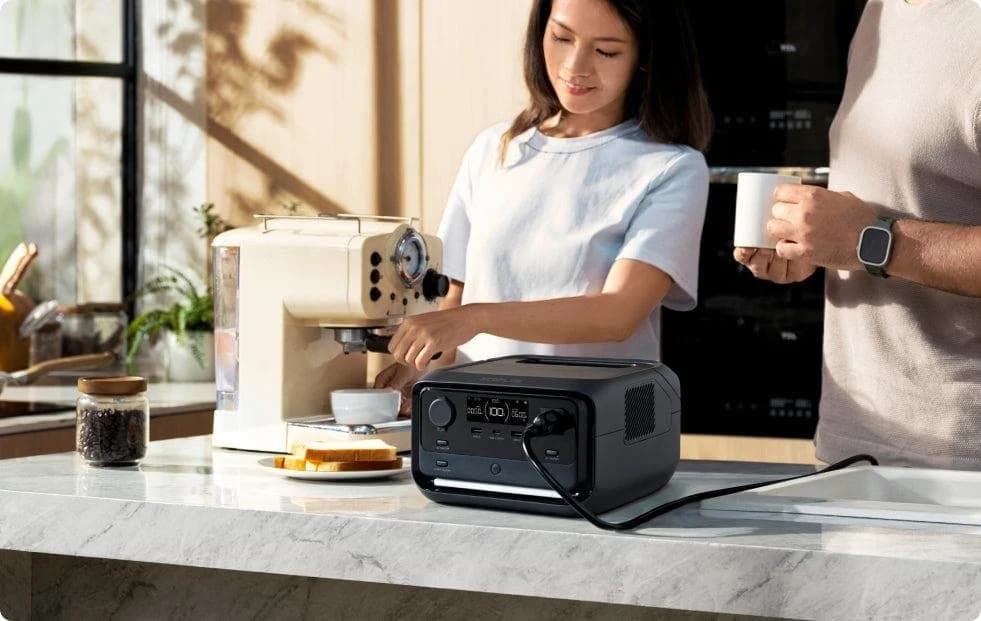
EcoFlow
A 10.4 lb, 286Wh LiFePO4 power station with 600W of AC output, a sub-10 ms UPS switchover, one-hour wall charging and expansion to 858Wh with a stackable extra battery.
Check package and model options
- 286 Wh capacity
- 600 W AC out
- LiFePO4
Variant trap: RIVER 3 Plus is the base station; adding EB300 or EB600 changes stored energy, up to 858Wh with EB600. A solar-panel bundle adds charging equipment instead. Match the selected contents and regional outlets, not just the family name.
More stored energy: Anker SOLIX C2000 Gen 2
Anker specifies 2,048Wh, 2,400W continuous output, 4,000W peak and 800W solar input. Choose it when the smaller energy budget fails. Its AC outlets are specified at 120V; this is not a 240V solution.
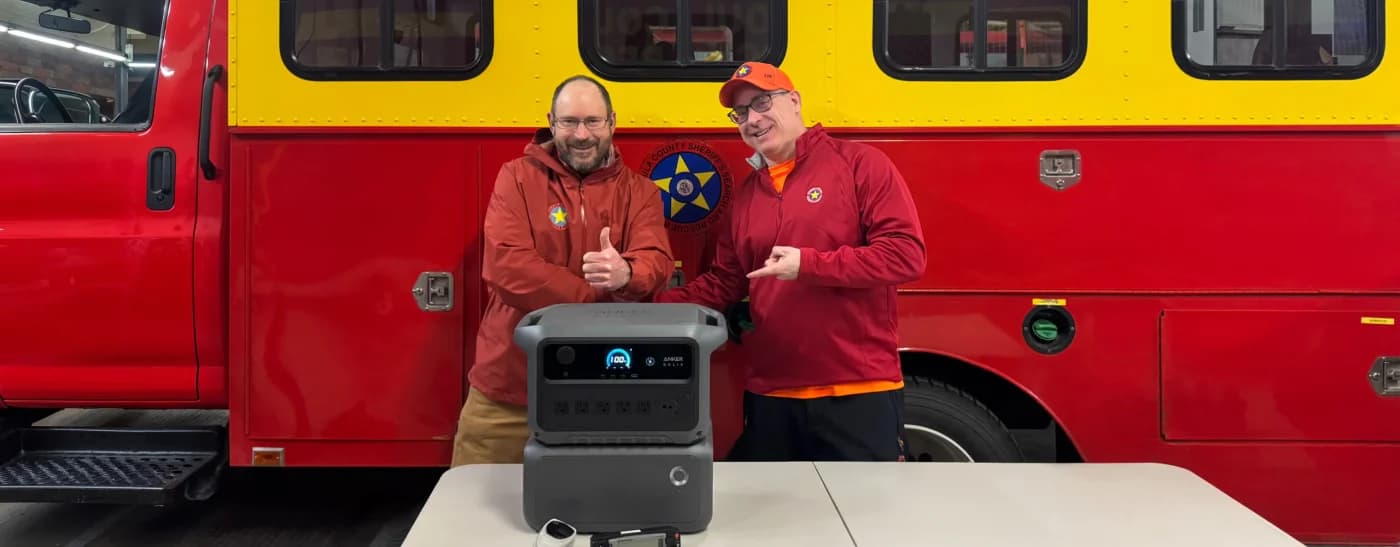
Anker SOLIX
A 2,048Wh LiFePO4 power station with 2,400W of AC output (4,000W peak), a TT-30R RV outlet, 1,800W wall charging, 800W of solar input and expansion to 4kWh with one BP2000 (Gen 2) battery.
Check package and model options
- 2,048 Wh capacity
- 2,400 W AC out
- LiFePO4
Variant trap: the BP2000 Gen 2 battery adds 2,048Wh, giving 4,096Wh total; a panel bundle adds recharging equipment. Anker's 58-minute full-recharge claim uses AC plus solar; its wall-only claim is 88 minutes. Do not plan a grid-outage refill around the combined-input headline.
Anker's cycle-life information conflicts: the visible comparison says 4,000 cycles to 80% capacity, while embedded feature data says 3,000+ cycles. Confirm that discrepancy before using longevity to choose it.
Compare the battery classes
EcoFlow RIVER 3 Plus
- Nominal storage
- 286Wh
- Continuous AC / peak
- 600W / 1,200W
- Maximum solar input
- 220W
Anker SOLIX C1000 Gen 2
- Nominal storage
- 1,024Wh
- Continuous AC / peak
- 2,000W / 3,000W
- Maximum solar input
- 600W
Anker SOLIX C2000 Gen 2
- Nominal storage
- 2,048Wh
- Continuous AC / peak
- 2,400W / 4,000W
- Maximum solar input
- 800W
Full comparison table
Swipe to compare. Row labels stay visible.
| Standalone US station | Nominal storage | Continuous AC / peak | Maximum solar input |
|---|---|---|---|
| EcoFlow RIVER 3 Plus | 286Wh | 600W / 1,200W | 220W |
| Anker SOLIX C1000 Gen 2 | 1,024Wh | 2,000W / 3,000W | 600W |
| Anker SOLIX C2000 Gen 2 | 2,048Wh | 2,400W / 4,000W | 800W |
Scroll horizontally to see every column
| Standalone US station | Nominal storage | Continuous AC / peak | Maximum solar input |
|---|---|---|---|
| EcoFlow RIVER 3 Plus | 286Wh | 600W / 1,200W | 220W |
| Anker SOLIX C1000 Gen 2 | 1,024Wh | 2,000W / 3,000W | 600W |
| Anker SOLIX C2000 Gen 2 | 2,048Wh | 2,400W / 4,000W | 800W |
Figures are the manufacturers' ratings above, not measured usable output.
Source: Official EcoFlow and Anker specifications linked above
Before buying for winter outages
All three models' specification tables start charging at 32°F. Anker says C1000 Gen 2 UltraFast Charging activates only above a battery temperature of 68°F, with significantly slower charging below that. A discharge-temperature rating does not establish that the battery can recharge in freezing conditions.
Check the exact generation, US outlets, included panels and charging cables, expansion-battery compatibility, and warranty coverage for your seller and region. Read the manual's output timeout settings before relying on intermittent loads: EcoFlow warns that AC timeout can switch off a refrigerator between cycles. Check current CPSC recalls by exact model before use.
How we choose
We compare official US product specifications, manuals and CPSC safety guidance. These picks illustrate different storage budgets; fuel-generator products and affiliate links remain outside the shortlist. Runtime examples use explicit assumptions and arithmetic, with output and startup checks kept separate. For broader shopping, see best portable power stations.
Verdict
Choose the C1000 Gen 2 for a short outage that fits its energy budget, RIVER 3 Plus for smaller essentials, or C2000 Gen 2 when more storage closes the gap. If daily consumption exceeds realistic replenishment, even a solar bundle eventually empties. If your plan requires household circuits, 240V or energy beyond portable storage, move to professionally planned backup rather than buying a battery that cannot finish the job.
Frequently asked questions
Can a power station replace a gas generator during an outage?
Yes, when its usable stored energy and realistic recharging cover your essential loads until power returns. A high output rating alone cannot establish that. Our short-outage starting point is the Anker SOLIX C1000 Gen 2, with 1,024Wh and 2,000W continuous output. For multi-day demand without dependable recharging, a portable battery alone may fall short; consider a professionally planned backup system.
Can you use a portable power station indoors?
Battery stations produce no combustion exhaust during normal use and can power devices indoors when used according to their instructions. Keep cooling paths clear and follow the model's placement and temperature limits. A fuel generator must stay outdoors: CPSC specifies at least 20 feet from the house, with exhaust directed away from buildings. An open garage door does not make indoor generator use safe.
Does a solar generator keep running indefinitely?
A solar-generator bundle adds panels to a battery station. It can extend backup only when harvested energy covers consumption and storage bridges periods without sufficient sunlight. Panel nameplate watts are not continuous charging power. In our hypothetical example, 200W collected for four hours supplies 800Wh, while a steady 100W load consumes 2,400Wh over a day. That plan still depletes the battery.
Can a fuel generator recharge a portable power station?
Some stations support this: EcoFlow explicitly lists generator charging for the RIVER 3 Plus. Confirm the station's AC input requirements against the generator's specified output and follow both manuals. Keep the fuel generator outdoors under CPSC's siting rules while charging. Never feed home wiring through a wall outlet; connections to household circuits require professional planning.
Related guides
Best picks · Portable Power Stations
Best Battery Backup for Refrigerators: Picks by Outage Length
Choose a battery backup for your refrigerator by daily energy use, compressor starts and outage length, with clear picks, runtime estimates and kit checks.
Comparison · Portable Power Stations
AFERIY P280 vs Anker SOLIX C2000 Gen 2: Which Backup Kit Fits?
Compare the US AFERIY P280 and Anker C2000 Gen 2 for fridge backup: matching battery kits, runtime estimates, outlet limits, recharge needs and warranty gaps.
Comparison · Portable Power Stations
Anker SOLIX C2000 Gen 2 vs Jackery Explorer 2000 v2: Which to Buy?
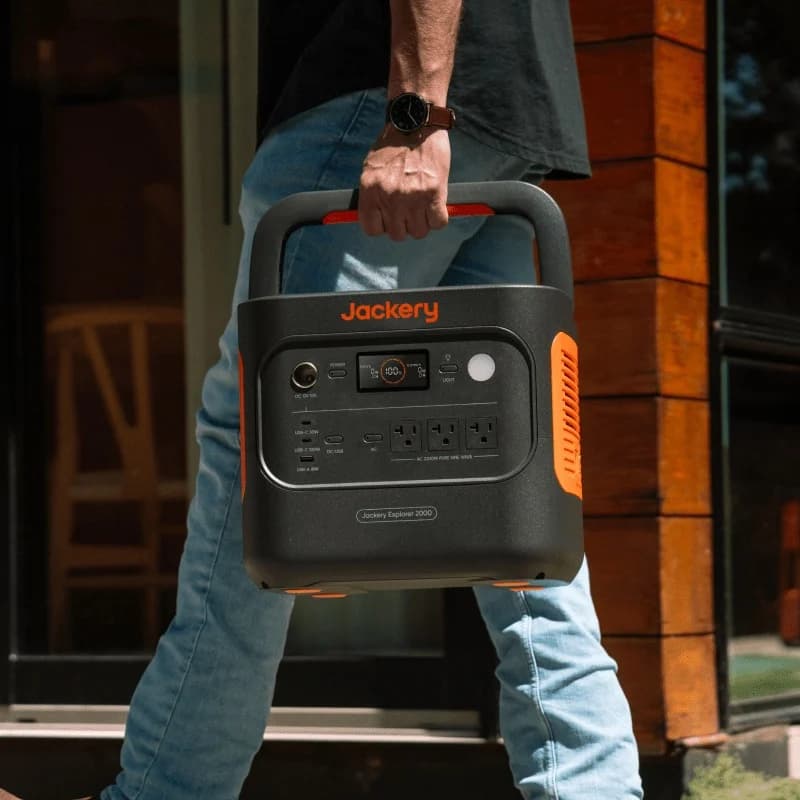
Compare Anker C2000 Gen 2 and Jackery 2000 v2 for fridge backup, carrying, expansion and solar. Get runtime estimates, complete kit checks and buying picks.