

Explainer
How Many Watts Does a Refrigerator Use? (And What Can Run It in an Outage)
A typical ENERGY STAR fridge averages about 30-75 watts over a day but surges at start-up. The math from official data, and the power stations that can run one.
By thisWATT EditorialUpdated November 2, 202612 min read3 picks

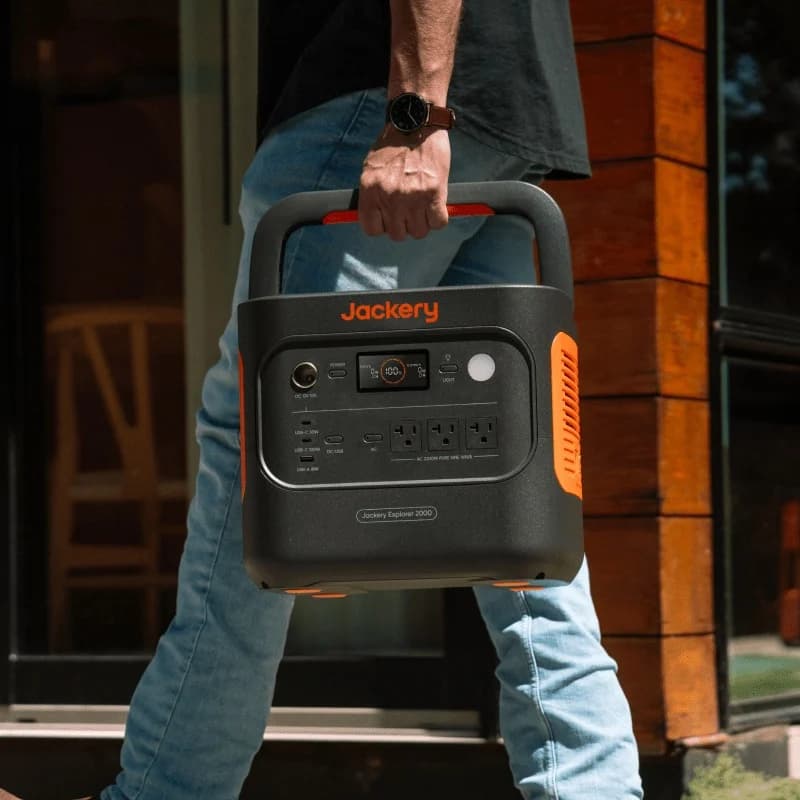

Our picks at a glance
- See on Amazon1
Best 1 kWh station for a fridge
EcoFlow DELTA 3 Plus Portable Power Station (1,024Wh)1024 Wh capacity · 1800W AC out · LiFePO4
- See on Amazon2
About a day for most fridges
Jackery Explorer 2000 v2 Portable Power Station2042 Wh capacity · 2200W AC out · LiFePO4
- See on Amazon3
Best for longer outages
Anker SOLIX C2000 Gen 2 Portable Power Station (2,048Wh)2048 Wh capacity · 2400W AC out · LiFePO4
A typical ENERGY STAR refrigerator averages about 30 to 75 watts over a day, roughly 0.7 to 1.8 kWh depending on its type and size, and that average is what decides how long a battery lasts. The compressor draws more while it runs and, for a moment at start-up, much more: that spike is what a power station's surge rating has to cover. In an outage, a 1 kWh station like the EcoFlow DELTA 3 Plus runs a typical full-size fridge for roughly 10 to 16 hours by our estimate, depending on the fridge, and a 2 kWh station roughly doubles that.
The figures below come from the ENERGY STAR certified-product lists (downloaded November 1, 2026) and the power station makers' own spec sheets and manuals. Runtimes are our arithmetic, labelled as estimates. We haven't lab-tested any fridge or station.
- 41WAverage draw of the median ENERGY STAR top-freezer fridge (363 kWh a year × 1,000 ÷ 8,760 hours)
- 2-4xHow much more power a motor or compressor may need to start, per BLUETTI's manual
- 4 hoursAbout how long a closed fridge keeps food cold without power, per Ready.gov
The three numbers that matter
1. Average watts decide the runtime. A fridge's compressor cycles on and off, so the useful number for a battery is its energy per day. The ENERGY STAR list gives each certified model's rated annual energy use; multiply it by 1,000, then divide by 8,760 (the hours in a year) to get the average watts.
2. Running watts decide the continuous output you need. When the compressor is on, the fridge draws more than its average. The station's continuous rating has to stay above that, plus anything else plugged in. A plug-in watt meter shows it directly: watch the reading while the compressor runs, and let it total the kWh over a day or two for your real average.
3. Start-up surge decides the surge rating you need. Motors take a burst of power to start. BLUETTI's Elite 100 V2 manual warns that "devices with motors or compressors may start at 2-4 times their rated power." Every station picked here lists a surge or peak rating of 3,600W or more.
Tap a label to explore. You can also hover or use your keyboard.
Energy over timeAverage cycling W → capacity in Wh
Use the compressor’s on and off periods to estimate average load, then estimate whether the stored energy covers the time you need. Do not substitute this average for the running or starting power checks.
Sources: 1: A refrigerator compressor cycles on and off; the diagram’s use of average cycling load for runtime is an inference from this behavior combined with the quoted runtime formula., 3: BLUETTI’s estimated-runtime formula includes depth of discharge, inverter efficiency and station self-consumption, not only battery capacity and load., 4: The formula’s assumptions are specific to Elite 100 V2: 90% depth of discharge, inverter efficiency over 90%, and about 10 W self-consumption; other stations need their own figures.Running powerRunning W → continuous output W
Keep the fridge’s running load plus other simultaneous loads below the station’s continuous output limit.
Sources: 2: BLUETTI instructs users to keep the total AC load within the station’s output limit, and separately warns about starting loads; the diagram applies those separate checks to the fridge and other connected devices.Starting burstActual compressor demand → surge capability
Check the actual appliance’s starting requirement separately. BLUETTI warns that some motors or compressors may start at 2-4 times their power; that is not a fixed multiplier for every fridge.
Sources: 2: BLUETTI instructs users to keep the total AC load within the station’s output limit, and separately warns about starting loads; the diagram applies those separate checks to the fridge and other connected devices.All checks fitDuration, running output and starting ability
All requirements must fit; estimated duration remains an estimate. For an Elite 100 V2 powering a fridge, disable ECO mode because low or no load can otherwise turn its output off.
Outcome
Sources: 1: A refrigerator compressor cycles on and off; the diagram’s use of average cycling load for runtime is an inference from this behavior combined with the quoted runtime formula., 2: BLUETTI instructs users to keep the total AC load within the station’s output limit, and separately warns about starting loads; the diagram applies those separate checks to the fridge and other connected devices., 3: BLUETTI’s estimated-runtime formula includes depth of discharge, inverter efficiency and station self-consumption, not only battery capacity and load., 5: Elite 100 V2 ECO mode may shut off AC or DC output after low or no load., 6: BLUETTI specifically tells owners to disable ECO mode for critical appliances including refrigerators.Recheck station choiceResolve the failed or unknown requirement
Adjust the planned load or station choice, and confirm missing appliance specifications before relying on the backup.
Outcome
Sources: 1: A refrigerator compressor cycles on and off; the diagram’s use of average cycling load for runtime is an inference from this behavior combined with the quoted runtime formula., 2: BLUETTI instructs users to keep the total AC load within the station’s output limit, and separately warns about starting loads; the diagram applies those separate checks to the fridge and other connected devices., 3: BLUETTI’s estimated-runtime formula includes depth of discharge, inverter efficiency and station self-consumption, not only battery capacity and load.Estimate hours = capacity (Wh) × depth of discharge × inverter efficiency ÷ (average cycling load (W) + station draw (W)). Applying the cited formula to an average cycling load is an estimate; use the relevant station’s loss and self-consumption figures.
Source notes6 references
A refrigerator compressor cycles on and off; the diagram’s use of average cycling load for runtime is an inference from this behavior combined with the quoted runtime formula.
www.bluettipower.com — source for A refrigerator compressor cycles on and off; the diagram’s use of average cycling load for runtime is an inference from this behavior combined with the quoted runtime formula.Refrigerators are not constant-load appliances. The compressor cycles on and off to maintain the thermostat’s set point.
BLUETTI instructs users to keep the total AC load within the station’s output limit, and separately warns about starting loads; the diagram applies those separate checks to the fridge and other connected devices.
s4.bluettipower.com — source for BLUETTI instructs users to keep the total AC load within the station’s output limit, and separately warns about starting loads; the diagram applies those separate checks to the fridge and other connected devices.Keep the total AC power below 1,800W. Some devices with motors or compressors may start at 2-4 times their rated power, which could easily overload the Elite 100 V2.
BLUETTI’s estimated-runtime formula includes depth of discharge, inverter efficiency and station self-consumption, not only battery capacity and load.
s4.bluettipower.com — source for BLUETTI’s estimated-runtime formula includes depth of discharge, inverter efficiency and station self-consumption, not only battery capacity and load.Operation time = Battery Capacity × DoD × η ÷ (Load + Elite 100 V2's Self-consumption)
The formula’s assumptions are specific to Elite 100 V2: 90% depth of discharge, inverter efficiency over 90%, and about 10 W self-consumption; other stations need their own figures.
s4.bluettipower.com — source for The formula’s assumptions are specific to Elite 100 V2: 90% depth of discharge, inverter efficiency over 90%, and about 10 W self-consumption; other stations need their own figures.Note: DoD (Depth of Discharge) is 90%. η (inverter efficiency) is over 90%. The Elite 100 V2 self-consumption is about 10W.
Elite 100 V2 ECO mode may shut off AC or DC output after low or no load.
s4.bluettipower.com — source for Elite 100 V2 ECO mode may shut off AC or DC output after low or no load.When ECO modes are turned on, please be cautious that the Elite 100 V2 will shut off the AC or DC output after a period of low or no load.
BLUETTI specifically tells owners to disable ECO mode for critical appliances including refrigerators.
s4.bluettipower.com — source for BLUETTI specifically tells owners to disable ECO mode for critical appliances including refrigerators.Disable the ECO mode when connecting small devices or critical appliances such as lights and refrigerators.
How many watts does a fridge use? ENERGY STAR's numbers
We took the median of each type in the ENERGY STAR certified refrigerators and certified freezers data. The averages are arithmetic from the rated annual kWh.
| Type (median size) | Rated energy use (median) | Average draw | Per day |
|---|---|---|---|
| Compact refrigerator (3.3 cu ft) | 246 kWh/yr | About 28W | 0.67 kWh |
| Top-freezer (18.0 cu ft) | 363 kWh/yr | About 41W | 0.99 kWh |
| Bottom-freezer (19.6 cu ft) | 560 kWh/yr | About 64W | 1.53 kWh |
| Side-by-side (24.8 cu ft) | 640 kWh/yr | About 73W | 1.75 kWh |
| Upright freezer (15.5 cu ft) | 438 kWh/yr | About 50W | 1.20 kWh |
| Chest freezer (10.6 cu ft) | 218 kWh/yr | About 25W | 0.60 kWh |
These are certified models rated on a standard test, and your own fridge can use more: ENERGY STAR says an old refrigerator uses about 20% more energy, on average, than a certified one, and settings, room temperature and door opening all change real use. The chest-freezer row rests on only nine full-size certified models, so treat it as a rough guide.
How long can a power station run a fridge?
These are estimates, not promises. We assume 81% of a station's rated watt-hours reach the fridge, which is BLUETTI's published formula (90% depth of discharge × 90% inverter efficiency), plus the station's own draw: about 10W for 1 and 2 kWh stations (BLUETTI's Elite 100 V2 figure) and about 20W for the 4 kWh column (BLUETTI's figure for its larger Apex 300).
| Fridge (median ENERGY STAR model) | 1,024Wh station | 2,048Wh station | 4,096Wh station |
|---|---|---|---|
| Compact refrigerator | About 22 h | About 44 h | About 69 h |
| Top-freezer | About 16 h | About 32 h | About 54 h |
| Bottom-freezer | About 11 h | About 22 h | About 40 h |
| Side-by-side | About 10 h | About 20 h | About 36 h |
| Upright freezer | About 14 h | About 28 h | About 47 h |
| Chest freezer | About 24 h | About 48 h | About 74 h |
If your outage plan is longer than that, you need recharging (solar or a car charger) or a bigger system: our home battery backup guide covers stations that expand past 10kWh.
Find the rated kWh per year
Look up your model on the ENERGY STAR list, or measure a day or two with a plug-in watt meter.
Turn it into average watts
Multiply the yearly kWh by 1,000, then divide by 8,760. A 363 kWh/yr fridge averages about 41W.
Add the station's own draw
About 10W for a 1kWh station, per BLUETTI; Anker lists 9W of idle draw for its 2kWh C2000 Gen 2.
Divide the usable watt-hours
Multiply the station's rated Wh by 0.81, then divide by the total watts to get hours (an estimate).
Check output and surge
Continuous watts above the fridge's running watts; surge above its start-up spike.
Best 1 kWh station for a fridge: EcoFlow DELTA 3 Plus
The DELTA 3 Plus has what a fridge needs at 1kWh: 1,800W continuous with a 3,600W surge, and an under-10 ms UPS switchover, so a fridge plugged through it stays on when the grid drops. At 1,024Wh it covers a median ENERGY STAR full-size fridge for roughly 10 to 16 hours by our estimate. It refills at 1,500W from the wall (0 to 100% in 56 minutes, per EcoFlow), takes up to 1,000W of solar across two inputs, and charges at 800W from EcoFlow's Alternator Charger (sold separately) if you can run a car.
EcoFlow
EcoFlow DELTA 3 Plus Portable Power Station (1,024Wh)
A 1,024Wh LiFePO4 portable power station with 1,800W of AC output, 1,500W wall charging, two 500W solar inputs and expansion to about 5kWh with EcoFlow extra batteries.
Comes in 5 versions: see which to buy
- 1024 Wh capacity
- 1800W AC out
- LiFePO4
For longer outages, EcoFlow's extra batteries take it to about 5kWh, roughly five times these runtimes. The cells are LFP, rated for 4,000 cycles to 80%, with a 5-year warranty.
Most start-up headroom at 1 kWh: DJI Power 1000
DJI rates the Power 1000 at 2,200W continuous, 2,600W for about 30 seconds and 4,400W peak, the most surge headroom in the 1kWh class, per its specs page. That headroom helps when the compressor kicks in while something else is already running. It switches to battery within 20 ms and lists noise as low as 23 dB while recharging in Standard mode, which matters for a unit in the kitchen.
It can grow, too: DJI says up to five of its 2,048Wh Power Expansion Battery 2000 units (sold separately) connect to it, for up to 11,264Wh, 11 times its own capacity. Two limits for outage duty: it has only two AC outlets, and solar charging runs through DJI's adapter modules (sold separately), each taking up to 400W from panels under 30V open-circuit. The cells are LFP, rated for over 70% capacity after 4,000 cycles. Buy the original Power 1000 in its US version, DYM1000L (not the Power 1000 V2, which DJI rates differently).
About a day for most fridges: Jackery Explorer 2000 v2
At 2,042Wh of LiFePO4, Jackery's Explorer 2000 v2 covers a median ENERGY STAR full-size fridge for roughly 20 to 32 hours by our estimate, at about 39.5 lb. It's rated 2,200W continuous with a 4,400W surge peak, and Emergency Super Charge (an app setting) refills it in about 1.7 hours when power comes back, per Jackery.
Jackery
Jackery Explorer 2000 v2 Portable Power Station
A 2,042Wh LiFePO4 portable power station with 2,200W of AC output (4,400W surge peak), app-enabled 1.7-hour emergency charging and up to 400W of solar input.
Comes in 4 versions: see which to buy
- 2042 Wh capacity
- 2200W AC out
- LiFePO4
Jackery's manual says it switches to battery within 20 ms in UPS mode, with a catch for a busy kitchen: while the grid is up, its output in UPS mode peaks at 1,500W, below its 2,200W rating, and returns to 2,200W during an outage. Solar input is 400W, which is slow for a 2kWh battery, and it doesn't expand.
Best for longer outages: Anker SOLIX C2000 Gen 2
The C2000 Gen 2 starts at 2,048Wh and doubles to 4,096Wh with one BP2000 (Gen 2) battery, so it can grow from about a day of fridge power to about two. Anker lists a 10 ms UPS switchover, 2,400W continuous with a 4,000W peak, and an idle draw of 9W, the figure that quietly eats runtime on a small load like a fridge. Solar input is 800W (11-60V), and Anker's 800W alternator charger refills it from a running car (100% in 3 hours, per Anker). The warranty is 5 years.
Anker SOLIX
Anker SOLIX C2000 Gen 2 Portable Power Station (2,048Wh)
A 2,048Wh LiFePO4 power station with 2,400W of AC output (4,000W peak), a TT-30R RV outlet, 1,800W wall charging, 800W of solar input and expansion to 4kWh with one BP2000 (Gen 2) battery.
Comes in 5 versions: see which to buy
- 2048 Wh capacity
- 2400W AC out
- LiFePO4
In an outage: the traps
Use the UPS or pass-through mode if you have one. Plug the fridge into the station and the station into the wall, and it switches over on its own when the grid drops. BLUETTI's Apex 300 manual even describes the fridge case: in UPS mode the unit backs up the fridge the moment grid power goes out, and if the battery runs flat it turns the AC output back on by itself once grid power returns. Each maker's switchover time is its own figure.
Keep the doors shut. Ready.gov says a closed refrigerator keeps food cold for about four hours and a full freezer holds its temperature for about 48 hours. Monitor temperatures with a thermometer, and throw away any food that has been at 40°F or higher for two hours or more.
Plan the recharge. A station's runtime is a fixed tank. For a multi-day outage, line up solar panels whose voltage fits the station's input, or a car charger, or choose a station that expands. Our best portable power stations guide lists each station's solar window, and our 1 kWh comparison lines up recharge times.
Don't run a gas generator indoors. If you use one alongside a station, Ready.gov says generators and fuel must always be used outdoors, at least 20 feet from windows, doors and attached garages.
How we choose
The fridge figures are medians we calculated from the ENERGY STAR certified refrigerator and freezer data on November 1, 2026. The station figures come from each maker's spec page and manual, and the runtime assumptions are BLUETTI's published formula, stated each time we use them. The picks pair enough surge headroom for a compressor with enough capacity for a meaningful outage, and we favoured stations with a stated switchover time. We checked each pick against the US Consumer Product Safety Commission's recall database on November 1, 2026 and found no recall. We haven't lab-tested these stations. We earn a commission on qualifying purchases through our links; it never decides a pick (disclosure).
Verdict
A typical ENERGY STAR fridge averages about 30 to 75 watts, so capacity, not output, is what limits you in an outage. The EcoFlow DELTA 3 Plus is the 1kWh station to buy for it, with a UPS switchover and room to expand, and the DJI Power 1000 has the most start-up headroom at that size. For about a day of fridge power, get the Jackery Explorer 2000 v2, or the Anker SOLIX C2000 Gen 2 if you want to double it later. For the whole kitchen, see our home battery backup guide.
Frequently asked questions
How many watts does a refrigerator use per day?
Per day, think in kilowatt-hours. Among ENERGY STAR certified models, the median top-freezer fridge is rated 363 kWh a year, about 1 kWh a day; the median bottom-freezer model 560 kWh (about 1.5 kWh a day); and the median side-by-side 640 kWh (about 1.75 kWh a day). Spread over 24 hours, that's an average of roughly 41W, 64W and 73W. ENERGY STAR says an old refrigerator uses about 20% more energy, on average, than a certified model.
Can a 1,000W power station run a refrigerator?
Usually, but check two numbers. The station's continuous watts must exceed the fridge's running watts, and its surge rating must cover the start-up spike: BLUETTI's manual warns that compressors may start at 2 to 4 times their rated power. Then capacity, in watt-hours, decides how long it runs. Don't confuse 1,000W of output with 1,000Wh of storage.
How long will a fridge run on a 2,000Wh power station?
Roughly 20 to 32 hours for a typical ENERGY STAR full-size fridge, by our estimate. We assume 81% of the rated capacity reaches the fridge (BLUETTI's published formula) and about 10W for the station itself. A median top-freezer model averages about 41W, so 2,048Wh lasts about 32 hours; a median side-by-side averages about 73W, so about 20 hours.
How long does food stay safe in a fridge without power?
Ready.gov says a closed refrigerator keeps food cold for about four hours and a full freezer holds its temperature for about 48 hours. Keep the doors shut, check temperatures with a thermometer, and throw away food that has been at 40°F or higher for two hours or more. A power station buys you time beyond that, which is why the runtime math matters.
Will my fridge stay on in an outage if it's plugged into a power station?
It can, if the station has a UPS or pass-through mode: you plug the fridge into the station and the station into the wall, and it switches to battery when the grid drops. Makers state the switchover time (under 10 ms for the EcoFlow DELTA 3 Plus, 10 ms for the Anker SOLIX C2000 Gen 2). Turn off any eco or auto-off setting for the AC outlets, or the station may cut power when the compressor rests.
Related guides
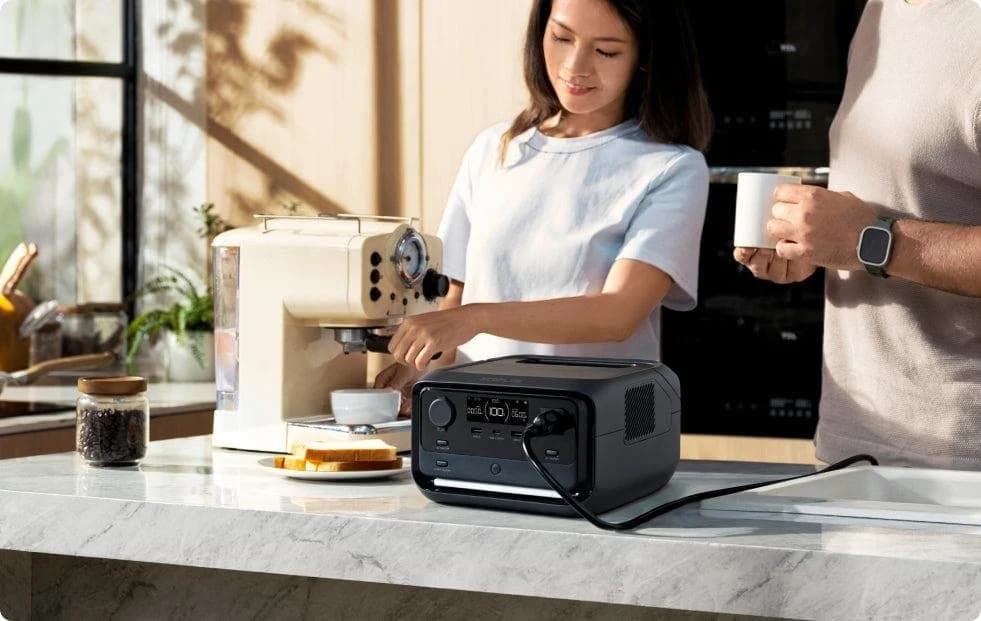
Appliance Wattage Chart: TVs, Microwaves and Backup Power
Find appliance running and starting watts, understand TV and microwave power labels, and choose a battery with enough output and energy for your outage plan.
Updated November 2, 2026Read
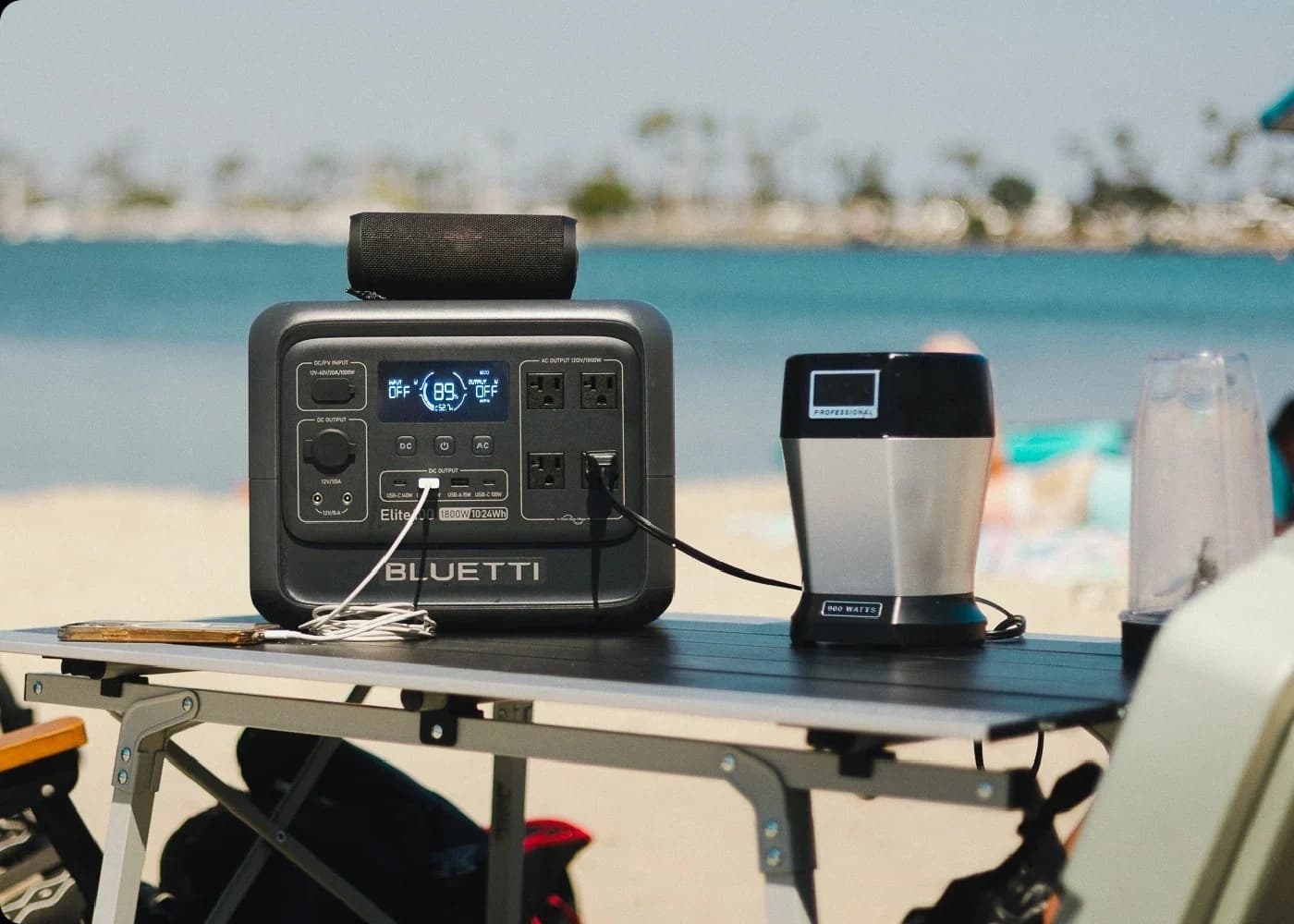
Best Portable Power Stations and Solar Generators in 2026
Portable power stations sized by what you need to run, from a 286Wh gift to 4kWh home backup, with output, solar input and UPS figures from makers' specs.
Updated November 2, 2026Read
EcoFlow vs Jackery vs Anker SOLIX vs BLUETTI: 1 kWh Power Stations Compared
Six 1 kWh power stations compared on output, recharge time, solar input, expansion and UPS switchover: EcoFlow, Jackery, Anker SOLIX, BLUETTI, Goal Zero and DJI.
Updated November 2, 2026Read