

Comparison
EcoFlow vs Jackery vs Anker SOLIX vs BLUETTI: 1 kWh Power Stations Compared
Six 1 kWh power stations compared on output, recharge time, solar input, expansion and UPS switchover: EcoFlow, Jackery, Anker SOLIX, BLUETTI, Goal Zero and DJI.
By thisWATT EditorialUpdated November 2, 202611 min read2 picks

Our picks at a glance
- See on Amazon1
Best overall
EcoFlow DELTA 3 Plus Portable Power Station (1,024Wh)1024 Wh capacity · 1800W AC out · LiFePO4
- See on Amazon2
Best for solar charging
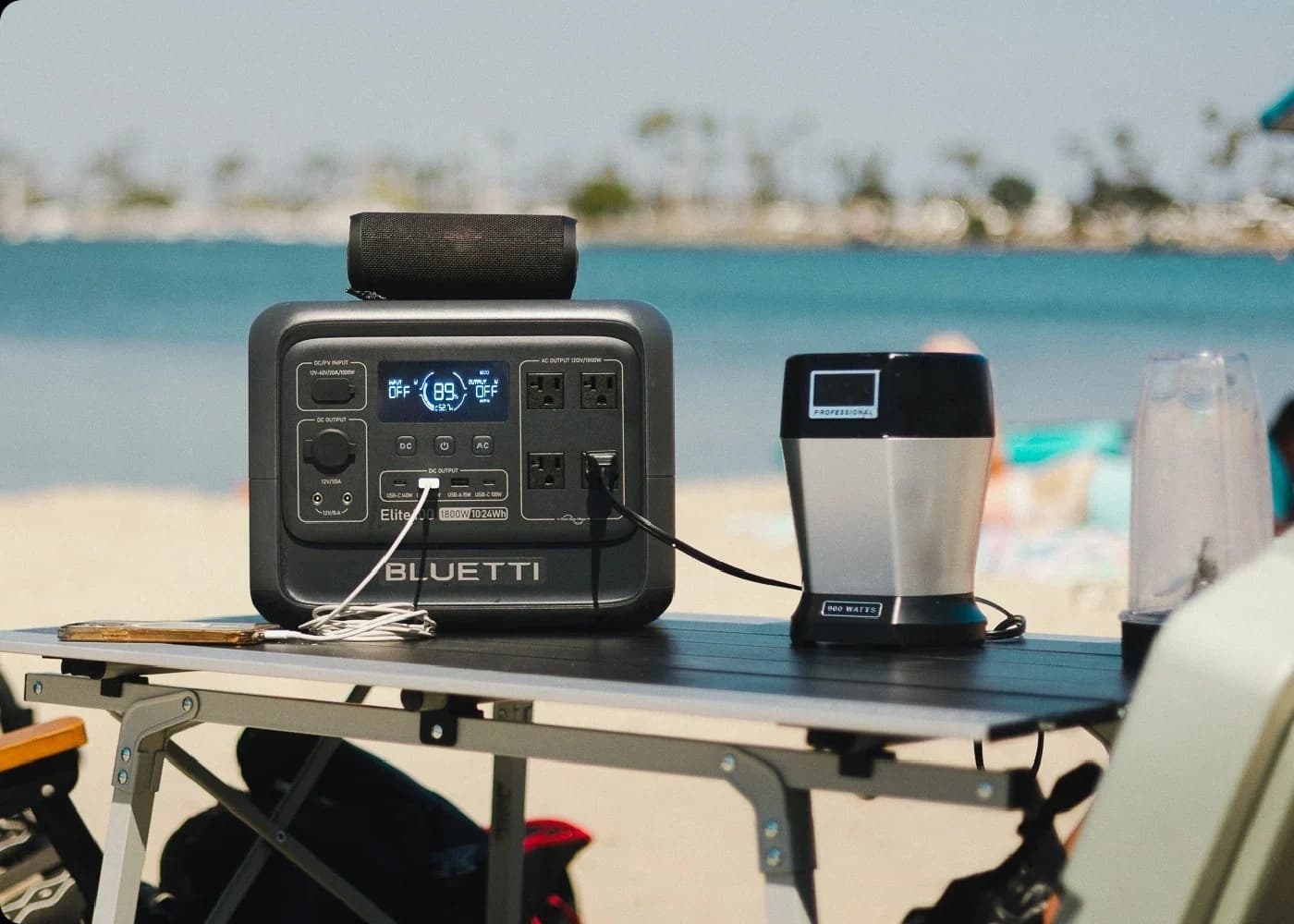
BLUETTI Elite 100 V2 Portable Power Station (1,024Wh)1024 Wh capacity · 1800W AC out · LiFePO4
If you want one 1 kWh power station that covers the most jobs, get the EcoFlow DELTA 3 Plus: six AC outlets sharing 1,800W, a wall recharge EcoFlow puts at 56 minutes, 1,000W of solar input across two ports, a switch to battery in under 10 ms when the grid drops (UPS mode), and extra batteries that take it to about 5kWh. Pick the DJI Power 1000 for the most output and the biggest expansion path, the Anker SOLIX C1000 Gen 2 for the fastest recharge, the BLUETTI Elite 100 V2 if you'll charge mostly from solar, or the Jackery Explorer 1000 v2 if weight matters most.
All six hold about 1kWh, enough for roughly 10 to 16 hours of a typical ENERGY STAR fridge by our estimate, and all six use LiFePO4 cells by their makers' own statements. The real differences are output, recharge speed, solar input and expansion, and they're bigger than the brand names suggest. Every figure below comes from the makers' own spec pages and manuals, checked on November 1, 2026. We haven't lab-tested these stations.
- 1,024WhRated capacity of four of the six (Goal Zero: 998Wh; Jackery: 1,070Wh in its spec table)
- 2,200WHighest continuous AC output here (DJI Power 1000)
- 11,264WhLargest expansion here: the DJI Power 1000 with five 2,048Wh expansion batteries
The six at a glance
Power and protection
| Station | Capacity | AC continuous / surge | AC outlets | UPS switchover |
|---|---|---|---|---|
| EcoFlow DELTA 3 Plus | 1,024Wh | 1,800W / 3,600W | 6 | Under 10 ms |
| Jackery Explorer 1000 v2 | 1,070Wh (spec table) | 1,500W / 3,000W | 3 | Within 20 ms |
| Anker SOLIX C1000 Gen 2 | 1,024Wh | 2,000W / 3,000W | 5 | 10 ms |
| BLUETTI Elite 100 V2 | 1,024Wh | 1,800W / 3,600W | Not listed | 10 ms or less |
| Goal Zero Yeti 1000 | 998Wh | 2,000W / 3,600W | 4 | Under 15 ms |
| DJI Power 1000 | 1,024Wh | 2,200W / 4,400W peak | 2 | 20 ms |
Charging and expansion
| Station | Wall charging | Max solar input | Expandable |
|---|---|---|---|
| EcoFlow DELTA 3 Plus | 1,500W: 0-100% in 56 min | 1,000W (2 x 500W, 11-60V) | Yes, to about 5kWh |
| Jackery Explorer 1000 v2 | About 1.58 h; 50 min with Emergency Super Charge (app) | 400W (12-60V) | No |
| Anker SOLIX C1000 Gen 2 | 1,600W UltraFast (app): 100% in 49 min | 600W (11-60V) | No |
| BLUETTI Elite 100 V2 | 1,200W in Turbo mode: 100% in 70 min (600W by default) | 1,000W in Turbo mode (12-60V, 20A; 600W by default) | No expansion port listed |
| Goal Zero Yeti 1000 | 1,000W: about 1.1-1.2 h | 900W (600W + 300W inputs) | Not with older Yeti Tanks |
| DJI Power 1000 | Up to 1,200W: full in 70 min | 800W (two adapter modules, sold separately) | Yes, to 11,264Wh |
Battery life, weight and warranty
| Station | Rated cycles | Weight | Warranty |
|---|---|---|---|
| EcoFlow DELTA 3 Plus | 4,000 to 80% | 27.6 lb | 5 years |
| Jackery Explorer 1000 v2 | 4,000 to 70% | 23.8 lb | 3 years (+2 if bought from jackery.com) |
| Anker SOLIX C1000 Gen 2 | 4,000 to 80% | 24.9 lb | 5 years |
| BLUETTI Elite 100 V2 | 4,000+ to 80% | 25 lb | 5 years |
| Goal Zero Yeti 1000 | 4,000 to 80% (at 25°C) | 35.3 lb | 5 years |
| DJI Power 1000 | 4,000 to 70% | About 28.7 lb (13 kg) | 5 years (DJI's default) |
"Not listed" means the maker's spec page doesn't state it, so we don't guess.
Best overall: EcoFlow DELTA 3 Plus
The DELTA 3 Plus gets the most right at once. EcoFlow rates it at 1,800W continuous with a 3,600W surge from six AC outlets, and its X-Boost mode runs devices rated up to 2,200W, per the spec table. It refills from the wall at 1,500W, which EcoFlow says takes it from 0 to 100% in 56 minutes, and takes solar on two inputs of up to 500W each (11-60V). UPS switchover is under 10 ms, and the cells are LFP, rated for 4,000 cycles to 80%, with a 5-year warranty.
EcoFlow
EcoFlow DELTA 3 Plus Portable Power Station (1,024Wh)
A 1,024Wh LiFePO4 portable power station with 1,800W of AC output, 1,500W wall charging, two 500W solar inputs and expansion to about 5kWh with EcoFlow extra batteries.
Comes in 5 versions: see which to buy
- 1024 Wh capacity
- 1800W AC out
- LiFePO4
It can also grow. EcoFlow lists four extra batteries that connect to it through its XT150 cable (the DELTA 3, DELTA 2, DELTA 2 Max and DELTA Pro 3 Extra Battery) and puts the ceiling at about 5kWh. DJI is the only other maker here that lists extra batteries that connect to its station, which matters if a 1kWh station is your first step toward outage backup. Two caveats: the IP65 rating covers the battery pack only, not the whole unit, and output above 1,800W relies on X-Boost, which EcoFlow's own marketing quotes at three different figures (we use the spec table's 2,200W).
Fastest recharge: Anker SOLIX C1000 Gen 2
Anker's C1000 Gen 2 refills fastest on paper: 1,600W with UltraFast Charging switched on in the Anker app, which Anker says reaches 100% in 49 minutes. Normal AC charging is 1,200W, and Anker notes charging slows when the cells are below 68°F. It also has the most output after DJI's: five AC outlets sharing 2,000W continuous (3,000W surge), plus two USB-C ports at up to 140W each. Switchover is 10 ms per Anker's spec table, solar input is up to 600W through an XT60i port (11-60V), and the warranty is 5 years.
The trade-off is expansion: it has no extra-battery port, and Anker points buyers who need one to the original C1000. Anker's spec table also leaves the battery chemistry blank, though an Anker SOLIX blog article says the C1000 Gen 2 uses LFP cells rated for 4,000 cycles to 80% capacity.
Best for solar charging: BLUETTI Elite 100 V2
BLUETTI's Elite 100 V2 takes up to 1,000W of solar on one input in Turbo mode (12-60V, 20A maximum, built-in MPPT; 600W in the default Standard mode), and BLUETTI states a full solar charge in 70 minutes. Read the current limit too: 1,000W at 20A means the panels have to deliver at least 50V while working (1,000 ÷ 20 = 50) while their open-circuit voltage stays at or under 60V, so panel choice decides whether you ever see the full 1,000W. BLUETTI's user manual says you can use third-party panels with an open-circuit voltage of 12-60V and MC4 connectors.
BLUETTI
BLUETTI Elite 100 V2 Portable Power Station (1,024Wh)
A 25 lb, 1,024Wh LiFePO4 portable power station with 1,800W of AC output, up to 1,000W of solar input in Turbo mode and a 10 ms UPS switchover.
Comes in 7 versions: see which to buy
- 1024 Wh capacity
- 1800W AC out
- LiFePO4
Elsewhere it's a light, solid all-rounder: 25 lb, 1,800W continuous with a 3,600W surge, a switchover of 10 ms or less, and LiFePO4 cells rated for 4,000+ cycles to 80%, with a 5-year warranty. Wall charging tops out at 1,200W in Turbo mode: 80% in 45 minutes and 100% in 70 minutes, per BLUETTI (600W in the default Standard mode). Its spec table lists no expansion port. BLUETTI does sell it in a kit with a B300K battery, its Charger 2 and a DC Hub, which BLUETTI's Charger 2 guide describes as an auxiliary battery for up to 600W of DC output, such as a 12V fridge, rather than more AC capacity.
Most output and expansion: DJI Power 1000
DJI's Power 1000 has the most headroom in the class: 2,200W continuous, 2,600W for about 30 seconds and a 4,400W peak, per DJI's specs page. It also has the biggest growth path: DJI says up to five of its 2,048Wh Power Expansion Battery 2000 units (sold separately) connect to it, for up to 11,264Wh, and that continuous output rises to 2,400W with the expansion battery connected (its figure at 25°C), per DJI. DJI lists it as quiet (as low as 23 dB while recharging in Standard mode), and it fast-charges DJI drone batteries from its SDC port. Two USB-C ports give up to 140W each.
The catches are in the details. It has only two AC outlets. Solar charging runs through DJI accessories sold separately: its Solar Panel Adapter Module takes up to 400W from panels with an open-circuit voltage under 30V, so the 800W maximum takes two modules. The full 1,200W wall recharge needs the battery at 60% or more and a room between 68 and 95°F, by DJI's footnote, and the cycle rating is to 70%, not 80%. Buy the original Power 1000 in its US version, DYM1000L (100-120V); the DYM1000H is the 220-240V version, and the Power 1000 V2 is a different model with different ratings.
Lightest: Jackery Explorer 1000 v2
At about 23.8 lb, Jackery's Explorer 1000 v2 is the lightest of the six. Jackery's product page says it goes from 0 to 100% in 50 minutes with Emergency Super Charge, which you turn on in the Jackery app (about 1.58 hours otherwise). It's rated 1,500W continuous with a 3,000W surge peak, and its US manual says it switches to battery within 20 ms. Jackery's spec table lists 1,070Wh (30.4Ah at 35.2V), while the headline on the same page says 1,024Wh.
It gives up the most elsewhere: three AC outlets, 400W of solar across two 8mm ports (12-60V), no expansion, and a rating of 4,000 cycles to 70%. The standard warranty is 3 years, and the 2 extra years apply only to units bought from jackery.com.
See the Jackery Explorer 1000 v2 at Jackery
Best for vans and cabins: Goal Zero Yeti 1000
Goal Zero's sixth-generation Yeti 1000 (SKU 37200) is built for a van or cabin. Its 12V High Power Port is rated 405W (30A continuous), and it takes solar on two inputs: up to 600W on the HPP input (12.3-60V) plus 300W on the 8mm input (13.2-30V). It's rated 2,000W continuous (3,600W surge) from four AC outlets, IPX4 water resistant, and Goal Zero says it's tested to meet UL 2743, the safety standard for portable power packs. The LiFePO4 cells are rated for 4,000 cycles to 80% at 25°C, with a 5-year warranty.
It's the heaviest here at 35.3 lb, holds 998Wh, and wall-charges at 1,000W (about 1.1-1.2 hours to full, per Goal Zero). Its user guide says the 6th-generation units don't work with the Tank expansion batteries from earlier Yetis.
See the Goal Zero Yeti 1000 at Goal Zero
Black Friday: check the exact model name
Deals on this class often lead with an older or regional model whose name is close to the current one. Match the listing to the model in this guide before you buy, and check the price on Amazon at checkout rather than trusting a headline.
| If the listing says... | It isn't the model here | Why it matters |
|---|---|---|
| Anker SOLIX C1000 (no "Gen 2") | SOLIX C1000 Gen 2 | Anker points buyers who need expansion to the original C1000, so the two differ in more than age |
| BLUETTI AC180 | Elite 100 V2 | BLUETTI's own comparison lists the AC180 at 1,800W with a 2,700W surge, against the Elite 100 V2's 3,600W |
| Goal Zero Yeti 1000X, Yeti 1000 Core or Yeti 1000 Lithium | 6th-gen Yeti 1000 (SKU 37200) | Different models; Goal Zero calls the 998Wh 6th-gen Yeti 1000 its newest |
| DJI Power 1000 DYM1000H | DYM1000L | The H version is the 220-240V model; US homes need the 100-120V L version |
| DJI Power 1000 V2 | DJI Power 1000 (DYM1000L) | DJI rates the V2 at 2,600W continuous on its own; this guide covers the original 2,200W Power 1000 |
| Jackery Explorer 1000 (no "v2") | Explorer 1000 v2 | A different model; look for "v2" and 120V on the listing |
| EcoFlow DELTA 3 Plus solar bundle | The base DELTA 3 Plus | Fine if the panel suits you; check its voltage fits the 11-60V input |
What actually separates them
Continuous vs surge. Continuous watts decide what you can run; surge decides what you can start. A fridge or a pump needs a moment of extra power when its motor starts: BLUETTI's manual warns that devices with motors or compressors may start at 2 to 4 times their rated power. All six list a surge or peak figure of 3,000W or more, but the continuous rating is what has to cover everything running at once.
Recharge speed. All six can refill from the wall in roughly 50 to 72 minutes on their fastest setting: 49 minutes for Anker, 50 for Jackery and 56 for EcoFlow, 70 for BLUETTI and DJI, and about 1.1-1.2 hours for Goal Zero. Fast modes often come with conditions: Anker's and Jackery's are app settings, BLUETTI needs Turbo mode, and DJI's needs the battery at 60% or more.
Solar input. The maximum watts only arrive if your panels' voltage and current fit the input. The open-circuit voltage of panels wired in series adds up and must stay inside the station's window (11-60V on the EcoFlow and Anker, 12-60V on the Jackery and BLUETTI, 12.3-60V on the Goal Zero's main input, and under 30V per panel on DJI's adapter module), and the current limit sets how much of that window you can use. Our power station guide covers matching panels.
Expansion. Only two of the six list extra batteries that connect to the station itself: EcoFlow for the DELTA 3 Plus (about 5kWh in total) and DJI for the Power 1000 (up to 11,264Wh). BLUETTI's B300K kit adds a separate DC battery instead. If a 1kWh station is your first step toward outage backup, expansion is the dividing line.
Switchover time. All six list one, from under 10 ms to 20 ms. It matters for a computer, router or anything that reboots when power blips, but it's the maker's figure. Whether a device rides through also depends on its own power supply.
Cycle ratings. "4,000 cycles to 80%" means the battery should still hold 80% of its capacity after 4,000 full cycles; "to 70%" is a lower bar at the same count.
For sizing a fridge in an outage, see how many watts a refrigerator uses. If you're thinking beyond 1kWh, our home battery backup guide compares 120/240V systems that can feed a house.
How we choose
We compared the current 1 kWh model from each of six major brands using only the makers' own spec pages, manuals and product pages. Where a page contradicts itself, we use its spec table and say so: Jackery's headline says 1,024Wh but its spec table says 1,070Wh, and EcoFlow quotes three different X-Boost figures. Where a fact appears only outside the spec table, such as Anker's battery chemistry or DJI's expansion battery, we say where it comes from. We checked each model against the US Consumer Product Safety Commission's recall database on November 1, 2026 and found no recall for any of them. We haven't lab-tested these stations, and runtimes on this page are arithmetic labelled as estimates. We earn a commission on qualifying purchases through our links; it never decides a pick (disclosure).
Verdict
Get the EcoFlow DELTA 3 Plus if you want the most capable 1kWh station and a path to about 5kWh later. Choose the DJI Power 1000 for the most output and the largest expansion path, if two AC outlets are enough. The Anker SOLIX C1000 Gen 2 recharges fastest, and the BLUETTI Elite 100 V2 is the one for solar. The Jackery Explorer 1000 v2 is the one to carry, and the Goal Zero Yeti 1000 is the one to wire into a van.
Frequently asked questions
Is EcoFlow or Jackery better?
In the 1 kWh class it depends on what you value. EcoFlow's DELTA 3 Plus has more output (1,800W vs 1,500W), takes 1,000W of solar to the Jackery's 400W and can expand to about 5kWh, which the Explorer 1000 v2 can't. The Jackery is lighter (about 23.8 lb vs 27.6 lb). EcoFlow rates its cells for 4,000 cycles to 80% capacity; Jackery rates its own for 4,000 cycles to 70%.
Do all 1 kWh power stations use LiFePO4 batteries?
All six here do, by their makers' own statements. EcoFlow, Jackery, BLUETTI, Goal Zero and DJI list LiFePO4 (LFP) cells in their specs, and Anker says so in a SOLIX blog article rather than in the C1000 Gen 2's spec table. The cycle rating tells you more than the label: 4,000 cycles to 80% of original capacity (EcoFlow, Anker, BLUETTI, Goal Zero) is a stronger claim than 4,000 cycles to 70% (Jackery, DJI).
Which 1 kWh power stations can you add batteries to?
Two of these six take extra batteries that connect to the station itself. EcoFlow lists four for the DELTA 3 Plus, up to about 5kWh in total, and DJI says up to five of its 2,048Wh Power Expansion Battery 2000 units connect to the Power 1000, for up to 11,264Wh. BLUETTI sells the Elite 100 V2 in a kit with a B300K auxiliary battery that powers DC loads, and Goal Zero's 6th-gen Yeti doesn't work with older Yeti Tanks.
Which 1 kWh power station charges fastest?
On paper, the Anker SOLIX C1000 Gen 2: 1,600W with UltraFast Charging switched on in the Anker app, which Anker says reaches 100% in 49 minutes, more slowly when the cells are below 68°F. Jackery quotes 50 minutes for the Explorer 1000 v2 with Emergency Super Charge, also an app setting. EcoFlow says the DELTA 3 Plus goes from 0 to 100% in 56 minutes at 1,500W.
Can I use a 1 kWh power station as a UPS for my computer?
All six list a switchover time: under 10 ms for the EcoFlow, 10 ms for the Anker, 10 ms or less for the BLUETTI, under 15 ms for the Goal Zero, and within 20 ms for the Jackery and the DJI. Whether a desktop PC rides through also depends on its own power supply, so treat these as the makers' figures, not a guarantee, and keep the load below the station's continuous rating.
How long will a 1,000Wh power station run a fridge?
Roughly 10 to 16 hours for a typical ENERGY STAR full-size fridge, by our estimate. A median ENERGY STAR top-freezer model is rated 363 kWh a year, about 41W on average. Using BLUETTI's published runtime formula, a 1,024Wh station delivers roughly 830Wh after losses, and the station itself uses about 10W. That's arithmetic, not a promise: your fridge, your kitchen and how often the door opens all change it.
Related guides

Appliance Wattage Chart: TVs, Microwaves and Backup Power
Find appliance running and starting watts, understand TV and microwave power labels, and choose a battery with enough output and energy for your outage plan.
Updated November 2, 2026Read
How Many Watts Does a Refrigerator Use? (And What Can Run It in an Outage)
A typical ENERGY STAR fridge averages about 30-75 watts over a day but surges at start-up. The math from official data, and the power stations that can run one.
Updated November 2, 2026Read
Best Portable Power Stations and Solar Generators in 2026
Portable power stations sized by what you need to run, from a 286Wh gift to 4kWh home backup, with output, solar input and UPS figures from makers' specs.
Updated November 2, 2026Read