

Comparison
Anker SOLIX C2000 Gen 2 vs Jackery Explorer 2000 v2
Which to Buy?
Compare Anker C2000 Gen 2 and Jackery 2000 v2 for fridge backup, carrying, expansion and solar. Get runtime estimates, complete kit checks and buying picks.
By thisWATT EditorialUpdated November 3, 20269 min read2 picks
Our recommendation: Jackery Explorer 2000 v2
2,042 Wh and 2,200 W continuous output at about 39.5 lb.
Limit: Not expandable; solar input tops out at 400 W and there are three AC outlets.
On this page · Our picks at a glance
Our picks at a glance
- 1
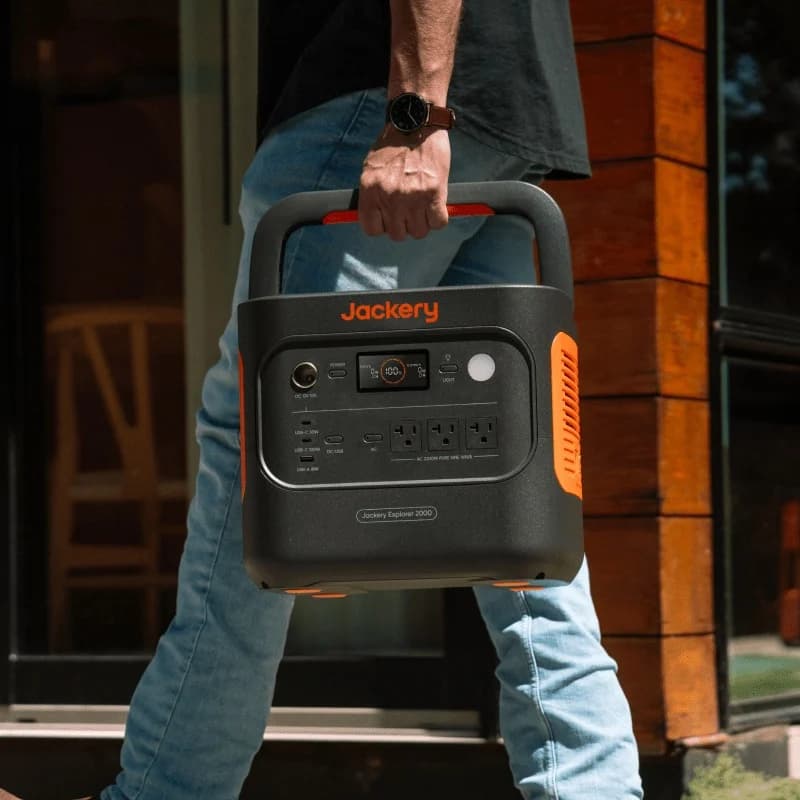
Choose for: 2,042 Wh and 2,200 W continuous output at about 39.5 lb.
Limit: Not expandable; solar input tops out at 400 W and there are three AC outlets.
- 2

Choose for: More stored energy with an option to add a battery.
Limit: Expansion stops at one extra battery, for 4,096 Wh total.
Choose the Anker SOLIX C2000 Gen 2 for backup that may grow: it supports an expansion battery, higher continuous output and more solar input. Choose the Jackery Explorer 2000 v2 for carrying one fixed-capacity station; its storage is practically identical, with a modest weight advantage. For most buyers prioritizing outages over carrying, Anker is our starting pick.
Quick picks
- Longer backup later: Anker plus the exact BP2000 Gen 2 battery.
- Frequent lifting, no expansion planned: Jackery, provided its fixed storage covers your load.
- Power in separate rooms: consider two independent stations; an expansion battery serves its host.
Availability checked November 2, 2026: Jackery's page marks the standalone option sold out. Anker SOLIX says orders from November 2 begin shipping November 21, while Anker.com shows in stock. Confirm the selected package's delivery date before buying for an imminent outage. Sources: Jackery, Anker SOLIX, Anker.com.
The exact US stations compared
These are the US 120V models. Figures below come from the C2000 Gen 2 specifications and Explorer 2000 v2 specifications. Output is shared across AC outlets.
Nominal storage
- Anker C2000 Gen 2
- 2,048Wh
- Jackery Explorer 2000 v2
- 2,042Wh
Battery chemistry
- Anker C2000 Gen 2
- LFP / LiFePO4
- Jackery Explorer 2000 v2
- LiFePO4
Continuous AC output
- Anker C2000 Gen 2
- 2,400W
- Jackery Explorer 2000 v2
- 2,200W
Published peak
- Anker C2000 Gen 2
- 4,000W
- Jackery Explorer 2000 v2
- 4,400W in technical table; other copy says 4,000W
Expansion
- Anker C2000 Gen 2
- One BP2000 Gen 2; 4,096Wh total
- Jackery Explorer 2000 v2
- Not supported
Station weight
- Anker C2000 Gen 2
- 41.7 lb / 18.9kg
- Jackery Explorer 2000 v2
- About 39.5 lb / 17.9kg
AC connectors
- Anker C2000 Gen 2
- NEMA 5-20R and TT-30R
- Jackery Explorer 2000 v2
- Three AC outlets
High-power USB-C
- Anker C2000 Gen 2
- Two ports, 140W each
- Jackery Explorer 2000 v2
- One 100W port; one 30W port
Solar input ceiling
- Anker C2000 Gen 2
- 800W; XT60i, 11–60V, 17A maximum
- Jackery Explorer 2000 v2
- 400W combined; two DC 8mm ports; see input limits below
Full wall recharge, maker claim
- Anker C2000 Gen 2
- 88 minutes
- Jackery Explorer 2000 v2
- Conflicting claims: 1.3 hours / about 1.7 hours emergency; 1.75 hours in AC table
Automatic transfer, maker claim
- Anker C2000 Gen 2
- 10 ms
- Jackery Explorer 2000 v2
- Under 20 ms
Published cycle rating
- Anker C2000 Gen 2
- 4,000 to 80%; conflicting embedded table noted below
- Jackery Explorer 2000 v2
- 4,000 to 70%+ capacity
Full comparison table
Swipe to compare. Row labels stay visible.
| Purchase-changing spec | Anker C2000 Gen 2 | Jackery Explorer 2000 v2 |
|---|---|---|
| Nominal storage | 2,048Wh | 2,042Wh |
| Battery chemistry | LFP / LiFePO4 | LiFePO4 |
| Continuous AC output | 2,400W | 2,200W |
| Published peak | 4,000W | 4,400W in technical table; other copy says 4,000W |
| Expansion | One BP2000 Gen 2; 4,096Wh total | Not supported |
| Station weight | 41.7 lb / 18.9kg | About 39.5 lb / 17.9kg |
| AC connectors | NEMA 5-20R and TT-30R | Three AC outlets |
| High-power USB-C | Two ports, 140W each | One 100W port; one 30W port |
| Solar input ceiling | 800W; XT60i, 11–60V, 17A maximum | 400W combined; two DC 8mm ports; see input limits below |
| Full wall recharge, maker claim | 88 minutes | Conflicting claims: 1.3 hours / about 1.7 hours emergency; 1.75 hours in AC table |
| Automatic transfer, maker claim | 10 ms | Under 20 ms |
| Published cycle rating | 4,000 to 80%; conflicting embedded table noted below | 4,000 to 70%+ capacity |
Scroll horizontally to see every column
| Purchase-changing spec | Anker C2000 Gen 2 | Jackery Explorer 2000 v2 |
|---|---|---|
| Nominal storage | 2,048Wh | 2,042Wh |
| Battery chemistry | LFP / LiFePO4 | LiFePO4 |
| Continuous AC output | 2,400W | 2,200W |
| Published peak | 4,000W | 4,400W in technical table; other copy says 4,000W |
| Expansion | One BP2000 Gen 2; 4,096Wh total | Not supported |
| Station weight | 41.7 lb / 18.9kg | About 39.5 lb / 17.9kg |
| AC connectors | NEMA 5-20R and TT-30R | Three AC outlets |
| High-power USB-C | Two ports, 140W each | One 100W port; one 30W port |
| Solar input ceiling | 800W; XT60i, 11–60V, 17A maximum | 400W combined; two DC 8mm ports; see input limits below |
| Full wall recharge, maker claim | 88 minutes | Conflicting claims: 1.3 hours / about 1.7 hours emergency; 1.75 hours in AC table |
| Automatic transfer, maker claim | 10 ms | Under 20 ms |
| Published cycle rating | 4,000 to 80%; conflicting embedded table noted below | 4,000 to 70%+ capacity |
Do not rank longevity by cycle count alone: the retained-capacity thresholds differ. Anker's embedded product data also says 3,000+ cycles, 41 lb and 14.9 inches long, versus the visible table's 4,000 cycles, 41.7 lb and 18.1 inches. We use its visible specification/comparison tables here and flag the disagreement; confirm dimensions before buying a fitted case.
Best for expansion: Anker SOLIX C2000 Gen 2
Anker is the stronger choice when you expect longer outages or want more recharge options. Its 2,400W continuous output gives more running headroom than Jackery's 2,200W; its 800W solar ceiling also exceeds Jackery's 400W. Neither advantage makes a single base battery last substantially longer at the same load.
Anker SOLIX
A 2,048Wh LiFePO4 power station with 2,400W of AC output (4,000W peak), a TT-30R RV outlet, 1,800W wall charging, 800W of solar input and expansion to 4kWh with one BP2000 (Gen 2) battery.
Check package and model options
- 2,048 Wh capacity
- 2,400 W AC out
- LiFePO4
The decisive accessory is the BP2000 Expansion Battery (Gen 2). Anker lists 2,048Wh, 15.3kg, LFP chemistry and an included Battery-to-host Cable. Its page explicitly identifies the C2000 Gen 2 as the host and excludes the F2000. Do not substitute an original BP2000 based on the name.
Best for carrying: Jackery Explorer 2000 v2
Jackery's 39.5 lb station is easier to justify when it regularly moves between a cupboard, car and campsite. Anker is 41.7 lb: a useful but modest difference, so neither should be chosen without considering the actual lift.
Jackery
A 2,042Wh LiFePO4 portable power station with 2,200W of AC output (4,400W surge peak), app-enabled 1.7-hour emergency charging and up to 400W of solar input.
Check package and model options
- 2,042 Wh capacity
- 2,200 W AC out
- LiFePO4
The compromises are fixed capacity and the smaller solar input. Already own a v2 and only need power elsewhere? Keeping it and buying another independent station is reasonable. If you need one longer-lasting supply in one location, start with Anker's expansion path instead.
Same fridge-and-lights budget: estimated runtime
Use a plug-in energy meter for your fridge's daily watt-hours; compressor cycling changes its average demand. Our refrigerator energy guide helps build that budget.
Here is an illustrative assumption, not a measurement of either station: a fridge averages 60W across a day, and lights draw 20W for six hours. Daily appliance energy is (60W × 24 hours) + (20W × 6 hours), or fifteen hundred sixty watt-hours. Assume 80% usable AC energy, with conversion losses and station consumption represented by that single allowance. Dividing that energy by 24 hours gives a 65W average; estimated hours are capacity × 80% ÷ 65W.
Anker alone
- Same-assumption estimate
- 2,048Wh × 80% ÷ 65W; about twenty-five hours
Jackery alone
- Same-assumption estimate
- 2,042Wh × 80% ÷ 65W; about twenty-five hours
Anker plus BP2000 Gen 2
- Same-assumption estimate
- 4,096Wh × 80% ÷ 65W; about fifty hours
Two Jackery units, used sequentially
- Same-assumption estimate
- (2 × 2,042Wh) × 80% ÷ 65W; about fifty hours total
Full comparison table
Swipe to compare. Row labels stay visible.
| Configuration | Same-assumption estimate |
|---|---|
| Anker alone | 2,048Wh × 80% ÷ 65W; about twenty-five hours |
| Jackery alone | 2,042Wh × 80% ÷ 65W; about twenty-five hours |
| Anker plus BP2000 Gen 2 | 4,096Wh × 80% ÷ 65W; about fifty hours |
| Two Jackery units, used sequentially | (2 × 2,042Wh) × 80% ÷ 65W; about fifty hours total |
Scroll horizontally to see every column
| Configuration | Same-assumption estimate |
|---|---|
| Anker alone | 2,048Wh × 80% ÷ 65W; about twenty-five hours |
| Jackery alone | 2,042Wh × 80% ÷ 65W; about twenty-five hours |
| Anker plus BP2000 Gen 2 | 4,096Wh × 80% ÷ 65W; about fifty hours |
| Two Jackery units, used sequentially | (2 × 2,042Wh) × 80% ÷ 65W; about fifty hours total |
All are estimates before reserve, with no recharging. Different fridge cycles, temperatures and losses change the result. Do not interpret the tiny base-unit difference as a real-world winner: neither maker supplies comparable efficiency curves here. Anker advertises 9W idle consumption, but we have no equivalent confirmed Jackery figure, so we do not insert different overheads into this comparison.
One expansion battery versus another station
For roughly double storage, the Anker station-and-battery bundle is a documented purchase option. Its contents include the AC cable, car cable and battery-to-host cable.
C2000 Gen 2 + BP2000 Gen 2
- Nominal energy
- 4,096Wh
- Total equipment weight
- About seventy-five pounds total (18.9kg + 15.3kg)
- How you use it
- One host supplies the appliances; separate pieces to carry
Two Explorer 2000 v2 stations
- Nominal energy
- 2 × 2,042Wh
- Total equipment weight
- About seventy-nine pounds total (17.9kg + 17.9kg)
- How you use it
- Independent supplies; move loads between them or power separate locations
Full comparison table
Swipe to compare. Row labels stay visible.
| Configuration | Nominal energy | Total equipment weight | How you use it |
|---|---|---|---|
| C2000 Gen 2 + BP2000 Gen 2 | 4,096Wh | About seventy-five pounds total (18.9kg + 15.3kg) | One host supplies the appliances; separate pieces to carry |
| Two Explorer 2000 v2 stations | 2 × 2,042Wh | About seventy-nine pounds total (17.9kg + 17.9kg) | Independent supplies; move loads between them or power separate locations |
Scroll horizontally to see every column
| Configuration | Nominal energy | Total equipment weight | How you use it |
|---|---|---|---|
| C2000 Gen 2 + BP2000 Gen 2 | 4,096Wh | About seventy-five pounds total (18.9kg + 15.3kg) | One host supplies the appliances; separate pieces to carry |
| Two Explorer 2000 v2 stations | 2 × 2,042Wh | About seventy-nine pounds total (17.9kg + 17.9kg) | Independent supplies; move loads between them or power separate locations |
Totals exclude cables, panels and bags; cable weights are not published in these sources. Anker's heaviest individual piece remains the 41.7 lb station, versus 39.5 lb per Jackery. Expansion adds stored energy to the host, not a second inverter; two stations retain separate output limits. Do not electrically combine their AC outputs.
The capacities above are nominal; the following chart visualizes that comparison, not usable outlet energy.
Source: Anker and Jackery specifications linked above
Running watts, motor starts and outlet restrictions
Check simultaneous running demand separately from energy use. A compressor's starting requirement must fit the station as well. Jackery's page conflicts internally: the technical table and one feature heading say 4,400W surge, while the “Run Essential Appliances” feature block says 4,000W surge. Confirm your appliance's starting draw with Jackery before relying on either figure.
Anker's TT-30R is limited to 120V, 20A and 2,400W. The outlet shape does not establish a full 30A supply. Both stations here are 120V models; for installed home backup, consult a licensed electrician and obtain permits where required.
Pass-through operation has separate limits. Jackery specifies 12A maximum in bypass mode; at 120V, that is 1,440W calculated, below its battery-mode output. Anker's 12A continuous figure is labeled AC input, so we do not reinterpret it as a verified bypass output rating. The published transfer times alone do not establish that a particular computer will stay online.
Wall and solar recharge: compare matching inputs
Anker's 58-minute headline uses AC plus solar at 2,600W. Its wall-only claim is 88 minutes at up to 1,800W. Jackery's site gives conflicting recharge times for the Explorer 2000 v2: product listings say 1.3 hours for Emergency Charge, feature copy says approximately 1.7 hours for app-enabled Emergency Super Charge, and the AC table says 1.75 hours. The conflict is unresolved; confirm the applicable time with Jackery before planning a recharge window.
Those times describe base stations. We found no matched full-recharge claim for the expanded Anker kit versus two Jackery units. For the same comparison, allow for the energy in the larger configuration and your actual available charging supply; do not reuse a base-unit refill time.
Same recharge assumption: at a hypothetical sustained 400W total input, energy divided by input gives 2,048Wh ÷ 400W for Anker and 2,042Wh ÷ 400W for Jackery: about five hours each. Doubling storage to 4,096Wh or 2 × 2,042Wh gives about ten hours at that same combined input. These ideal lower bounds exclude charging losses and taper; solar interruptions extend elapsed time.
For solar, Anker specifies 11–60V, 17A, 800W. Jackery specifies 11–16V at 8A maximum, with its table saying “Double to 8A Max”; at 16–60V, it lists 12A, “Double to 21A/400W Max.” Preserve those voltage-dependent limits when checking a panel; 400W is the combined ceiling.
Anker's documented PS400 solar bundle includes one 400W PS400, AC cable, two 3m MC4 cables and a 0.5m MC4-to-XT60 cable. It is not an 800W panel package, and its contents do not call the panel bifacial. Jackery's two-panel package lists two 200W SolarSaga panels, two multifunctional solar cables and the AC cable. Its present SolarSaga 200 page also lists a DC8020-to-DC7909 adapter; confirm the supplied cable ends against the v2 before ordering accessories.
Match the host
Select the exact US station and panel package described above.
Audit the cable list
Use the selected kit's included solar cables; station-only boxes list an AC cable.
Check electrical fit
Confirm voltage, current, connector and cold-weather voltage margin with the maker for any substituted panel.
Plan the next refill
Panel nameplate watts and station input ceilings do not promise sustained solar output.
Already own the EcoFlow NextGen 220W Bifacial? EcoFlow includes an XT60i cable, but that alone does not approve cross-brand compatibility or bifacial current. Obtain maker confirmation before substituting it. Our portable panel selector explains the checks.
Winter, warranty and package checks
Anker lists charging at 32–104°F; Jackery lists 32–113°F, with discharging at 14–113°F. Anker labels −4–104°F “Recharging Temperature” immediately above a separate charging range; its embedded data instead calls that the operating range. Treat the lower range as unresolved labeling, not permission to charge below freezing.
Anker's embedded station data lists a five-year warranty; the visible specification tables do not list a station warranty. Confirm the term with Anker before purchase. Jackery promotes 3+2 years, but its direct-store banner and seller-eligibility wording differ in scope. Confirm warranty registration and seller eligibility for the actual purchase channel; do not assume every marketplace offer has identical coverage.
For Black Friday, compare complete packages rather than discount claims. The Explorer 2000 Plus is a different expandable model; “Solar Generator” identifies a panel package, not extra v2 storage. Anker's F2000, original BP2000 and Gen 2 battery names need the same care. A spare station, expansion pack, solar panel and alternator charger solve different needs. Confirm model, US outlets, panel count, cables, seller and delivery date.
How we choose
We compare official product specifications and package lists, with conflicts visible rather than silently resolved. Runtime and combined weights are calculations under stated assumptions; we have not lab-tested these products. See our selection method and broader power-station guide.
Verdict
Buy C2000 Gen 2 alone for wall-recharged backup with room to grow; order BP2000 Gen 2 with its included battery-to-host cable when you need longer duration. For solar, select the explicitly documented PS400 package and check its cable list. Buy Explorer 2000 v2 alone when carrying matters and fixed storage suffices, or its two-SolarSaga package when starting with solar. Choose two independent stations when separate locations matter more than one expandable supply, and verify delivery before committing.
Frequently asked questions
Which is better for a refrigerator: C2000 Gen 2 or Explorer 2000 v2?
For one station, nominal storage is essentially tied: Anker lists 2,048Wh and Jackery 2,042Wh. Measure your fridge's daily energy and check compressor starting requirements. Choose Anker when you need expansion or a larger solar input; choose Jackery when carrying matters more. Our runtime worksheet uses identical assumptions, rather than comparing the brands' different advertised fridge durations.
Can the Jackery Explorer 2000 v2 add an expansion battery?
No. Jackery explicitly says the Explorer 2000 v2 is not expandable and points buyers toward the separate Solar Generator 2000 Plus. Buying another v2 gives independent power in another location, with separate outlets and charging. It does not create one larger battery or raise either station's individual output limit.
Which battery and cable fit the Anker C2000 Gen 2?
Anker specifies the BP2000 Expansion Battery (Gen 2), with one battery supported for 4,096Wh total. Its battery-only page includes a Battery-to-host Cable; the station-and-battery bundle also lists that cable. Buy the exact Gen 2 accessory. Anker says this battery is not compatible with the F2000, so a similar name is insufficient evidence of compatibility.
Is Anker's 58-minute recharge comparable with Jackery's emergency charging?
Those figures describe different inputs. Anker's 58-minute full recharge combines AC and solar; its wall-only figure is 88 minutes. Jackery's site conflicts: its Explorer 2000 v2 listings say 1.3 hours for Emergency Charge, its feature copy says about 1.7 hours for app-enabled Emergency Super Charge, and its AC charging table says 1.75 hours. Confirm the applicable time with Jackery. These are manufacturer claims for the base stations, not measured refill times for expanded configurations.
Jackery Explorer 2000 v2
AmazonRelated guides
Best picks · Portable Power Stations
Best Battery Backup for Refrigerators: Picks by Outage Length
Choose a battery backup for your refrigerator by daily energy use, compressor starts and outage length, with clear picks, runtime estimates and kit checks.
Comparison · Portable Power Stations
AFERIY P280 vs Anker SOLIX C2000 Gen 2: Which Backup Kit Fits?
Compare the US AFERIY P280 and Anker C2000 Gen 2 for fridge backup: matching battery kits, runtime estimates, outlet limits, recharge needs and warranty gaps.
Best picks · Portable Power Stations
Best Power Stations for Laptops: Ports, Cables and Runtime
Choose a power station for your laptop by USB-C profiles, shared-port limits and realistic runtime, with clear picks, cable advice and AC charger fallbacks.