

Comparison
EcoFlow DELTA 3 Max vs Jackery Explorer 2000 v2
Which Fits?
Choose the right 2 kWh station: compare carrying weight, fridge runtime estimates, charging, bypass limits and the exact solar panels and cables you need.
By thisWATT EditorialUpdated November 3, 20268 min read
On this page · Quick picks: carry weight or output headroom?
Choose the EcoFlow DELTA 3 Max for a station that mostly stays beside your essential appliances: it offers 2,400W continuous output against the Jackery's 2,200W. Choose the Jackery Explorer 2000 v2 when carrying matters more: it weighs about 39.5 lb versus 44.8 lb, while their stored energy is almost identical.
Quick picks: carry weight or output headroom?
- Mostly stationary outage backup: EcoFlow DELTA 3 Max. More continuous watts, an extra AC socket and a higher solar ceiling suit a box you move occasionally.
- Camping, stairs and regular loading: Jackery Explorer 2000 v2. Take the lighter lift if its output covers your appliances.
- Need more battery capacity later? Choose an expandable model instead. Neither station here accepts an extra battery.
This comparison covers the US fixed-capacity models around 2 kWh. For smaller alternatives, use our four-brand comparison.
Comparison table: the same US specifications
Figures come from EcoFlow's product page, its DELTA 3 Max manual, the Jackery US manual and Jackery's US support table. Output is shared across outlets.
EcoFlow DELTA 3 Max
- Rated battery capacity
- 2,048Wh
- Battery chemistry
- LFP / LiFePO4
- Continuous AC output on battery
- 2,400W, 120V
All specifications
- Extra-battery expansion
- No
- Published surge
- 4,800W
- AC outlets
- Four
- Carrying weight
- About 44.8 lb / 20.3 kg
- Solar maximum
- 500W, one XT60i input
- Wall charging claim
- 0–80% in 68 minutes
- Bypass ratings
- 13A output; 12A continuous input
- Outage transfer time
- Under 10 ms in spec table
- Published cycle-life endpoint
- No model-specific count established here
Jackery Explorer 2000 v2
- Rated battery capacity
- 2,042Wh
- Battery chemistry
- LiFePO4
- Continuous AC output on battery
- 2,200W, 120V
All specifications
- Extra-battery expansion
- No
- Published surge
- 4,400W
- AC outlets
- Three
- Carrying weight
- About 39.5 lb / 17.9 kg
- Solar maximum
- 400W total, two DC8020 inputs
- Wall charging claim
- Around two hours for AC charging, per US support
- Bypass ratings
- 12A input/output; UPS text also quotes 1,500W
- Outage transfer time
- Within 20 ms
- Published cycle-life endpoint
- 4,000 cycles to 70%+ capacity
Full comparison table
Swipe to compare. Row labels stay visible.
| Specification | EcoFlow DELTA 3 Max | Jackery Explorer 2000 v2 |
|---|---|---|
| Rated battery capacity | 2,048Wh | 2,042Wh |
| Battery chemistry | LFP / LiFePO4 | LiFePO4 |
| Continuous AC output on battery | 2,400W, 120V | 2,200W, 120V |
| Published surge | 4,800W | 4,400W |
| AC outlets | Four | Three |
| Carrying weight | About 44.8 lb / 20.3 kg | About 39.5 lb / 17.9 kg |
| Solar maximum | 500W, one XT60i input | 400W total, two DC8020 inputs |
| Wall charging claim | 0–80% in 68 minutes | Around two hours for AC charging, per US support |
| Bypass ratings | 13A output; 12A continuous input | 12A input/output; UPS text also quotes 1,500W |
| Outage transfer time | Under 10 ms in spec table | Within 20 ms |
| Extra-battery expansion | No | No |
| Published cycle-life endpoint | No model-specific count established here | 4,000 cycles to 70%+ capacity |
Scroll horizontally to see every column
| Specification | EcoFlow DELTA 3 Max | Jackery Explorer 2000 v2 |
|---|---|---|
| Rated battery capacity | 2,048Wh | 2,042Wh |
| Battery chemistry | LFP / LiFePO4 | LiFePO4 |
| Continuous AC output on battery | 2,400W, 120V | 2,200W, 120V |
| Published surge | 4,800W | 4,400W |
| AC outlets | Four | Three |
| Carrying weight | About 44.8 lb / 20.3 kg | About 39.5 lb / 17.9 kg |
| Solar maximum | 500W, one XT60i input | 400W total, two DC8020 inputs |
| Wall charging claim | 0–80% in 68 minutes | Around two hours for AC charging, per US support |
| Bypass ratings | 13A output; 12A continuous input | 12A input/output; UPS text also quotes 1,500W |
| Outage transfer time | Under 10 ms in spec table | Within 20 ms |
| Extra-battery expansion | No | No |
| Published cycle-life endpoint | No model-specific count established here | 4,000 cycles to 70%+ capacity |
EcoFlow's store prints the weight as “20.3+0.4kg”; its manual states approximately 20.3 kg / 44.8 lb. We use the manual's explicit pounds figure. Its feature copy says 10 ms while the specification table says under 10 ms; neither means zero interruption.
Source: the US manuals linked above; approximate station weights, excluding panels
Best for mostly stationary backup: EcoFlow DELTA 3 Max
The EcoFlow's advantage is output and connections, rather than more runtime. Four AC outlets share 2,400W, and solar input tops out at 500W. Choose it when the Jackery's 2,200W ceiling would constrain your appliance combination, while leaving room for motor starts.
Keep the published 4,800W surge separate from continuous power. EcoFlow's 3,400W X-Boost claim is another mode: the manual describes low-voltage limitations, favors heating appliances and says X-Boost is unavailable during AC charging. Size a refrigerator setup against rated output and its starting demand.
The warranty is three years plus two extra years with EcoFlow app registration. Expansion requires choosing a different station at purchase.
Best for frequent carrying: Jackery Explorer 2000 v2
The Jackery keeps almost the same battery capacity in a lighter package. Its three AC outlets share 2,200W, with a published 4,400W surge. That makes it our carrying pick when your load fits; lifting convenience is the practical difference to prioritize.
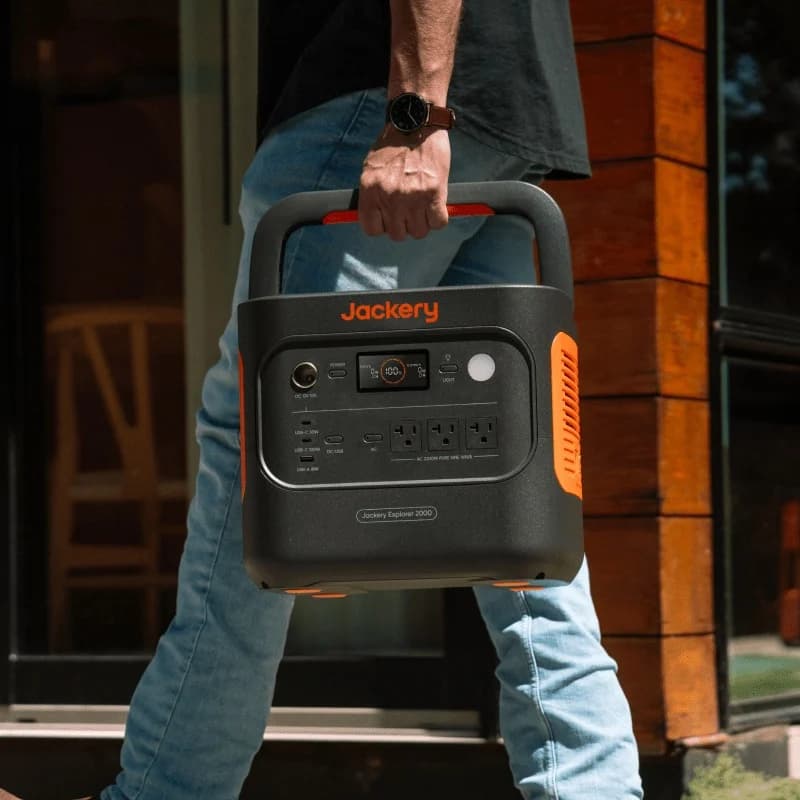
Jackery
A 2,042Wh LiFePO4 portable power station with 2,200W of AC output (4,400W surge peak), app-enabled 1.7-hour emergency charging and up to 400W of solar input.
Check package and model options
- 2,042 Wh capacity
- 2,200 W AC out
- LiFePO4
Jackery specifies 4,000 cycles to at least 70% capacity. That endpoint matters: do not rewrite it as 80%, or turn EcoFlow's estimated lifespan language into an unsupported cycle count. Jackery's US support lists a three-year warranty extendable by two years; confirm the extension requirements for your seller.
Exact models: Max, Max Plus, v2 and Plus
DELTA 3 Max Plus is different hardware. EcoFlow lists the same 2,048Wh built-in capacity but 3,000W rated output and extra-battery support. The standard Max's manual has no extra-battery interface; the Plus manual explicitly lists one. Our DELTA 3 model guide helps with the surrounding names.
Explorer 2000 v2 is JE-2000D. The older Explorer 2000 Plus has 2,042.8Wh, 3,000W output and expandable storage. Its page now says it is discontinued and points to HomePower 2000 Plus v2 as the successor. A listing containing “2000,” “Plus” or “v2” needs its complete name checked.
Same fridge-and-lights job: runtime estimates
Assume a fridge averaging 100W, plus 20W of lights: 120W combined. These are example loads, not claims about your appliances. Use average consumption over compressor cycles, then check starting demand separately; our refrigerator watts guide explains that distinction.
For a common planning model, borrow the structure of BLUETTI's runtime equation: hours ≈ Wh × depth of discharge × inverter efficiency ÷ (load W + station draw W). We assume 90% depth of discharge and 90% efficiency, then vary station draw. These are illustrative assumptions for this pair, not verified efficiencies.
For example, 2,048Wh × 90% × 90% ÷ (120W + 10W) ≈ thirteen hours. Substitute 2,042Wh for Jackery and it rounds to the same result.
Assume 10W station draw
- DELTA 3 Max estimate
- About thirteen hours
- Explorer 2000 v2 estimate
- About thirteen hours
Assume 18W station draw
- DELTA 3 Max estimate
- About twelve hours
- Explorer 2000 v2 estimate
- About twelve hours
Full comparison table
Swipe to compare. Row labels stay visible.
| Same 120W average appliance load | DELTA 3 Max estimate | Explorer 2000 v2 estimate |
|---|---|---|
| Assume 10W station draw | About thirteen hours | About thirteen hours |
| Assume 18W station draw | About twelve hours | About twelve hours |
Scroll horizontally to see every column
| Same 120W average appliance load | DELTA 3 Max estimate | Explorer 2000 v2 estimate |
|---|---|---|
| Assume 10W station draw | About thirteen hours | About thirteen hours |
| Assume 18W station draw | About twelve hours | About twelve hours |
BLUETTI's 10W figure describes its own station. Jackery publishes 18W standby consumption; EcoFlow's equivalent was not established here. Applying both scenarios equally shows the uncertainty without pretending to know either station's exact loaded losses. Battery condition, reserve settings and temperature also change usable energy. Neither calculation supports a full day at this assumed load without recharging.
For intermittent fridge loads, review EcoFlow's AC timeout and Jackery's Energy Saving Mode before relying on backup. Their manuals describe automatic output shutdown; EcoFlow specifically recommends setting AC timeout to never for intermittent loads.
Wall charging, bypass limits and winter use
EcoFlow's 68-minute claim stops at 80% and requires X-Stream Fast Charging under optimal conditions. Jackery's US support table quotes around two hours for AC charging; its manual also describes an app-enabled Emergency Charging Mode, recommending it only when needed. These are different charging descriptions and endpoints, so they do not establish a same-condition full-charge winner.
The bypass distinction matters more for a station left plugged in. EcoFlow's US manual specifies 13A total bypass output, but 12A continuous bypass input, allowing 15A input for up to three hours. Leave input headroom for charging and ask EcoFlow about demanding continuous pass-through loads.
Jackery's manual specifies 12A bypass input/output, while its UPS paragraph and US support also quote 1,500W before an outage, returning to 2,200W on battery. Those are not identical limits: have Jackery confirm a borderline load rather than assuming battery output applies while plugged in.
Both manuals specify charging at 0–45°C / 32–113°F and discharging at −10–45°C / 14–113°F. A station that can discharge below freezing is not thereby approved to charge there. Let a cold station return to its permitted charging temperature before expecting a fast refill.
These are 120V US stations. For a home wiring connection, use a licensed electrician and a permit where required; start with our home battery backup guide.
Solar: the panel and complete cable list
The EcoFlow manual specifies 11–60V, 13A, 500W and requires total panel Voc within 60V and Isc within 13A. Jackery specifies 16–60V solar operation, 12A / 200W per input, and 21A / 400W combined. Its lower 11–16V range is limited to 8A. A matching plug alone cannot establish compatibility.
Named panel option
- EcoFlow DELTA 3 Max path
- NextGen 220W Bifacial; confirm the complete arrangement with EcoFlow
- Jackery Explorer 2000 v2 path
- Two matching SolarSaga 200 JS-200E panels; station manual supports a 200W panel per input
Required solar cables
- EcoFlow DELTA 3 Max path
- EcoFlow Solar to XT60i Charging Cable; cited NextGen package includes an XT60i cable
- Jackery Explorer 2000 v2 path
- Two JS-200E multifunctional solar charging cables, one included with each panel, using DC8020 ends
Extra adapter for that Jackery pair
- EcoFlow DELTA 3 Max path
- Not applicable
- Jackery Explorer 2000 v2 path
- No SolarSaga combining adapter needed; the DC7909 adapter is for a different input size
Station-only package
- EcoFlow DELTA 3 Max path
- AC cable and documentation; budget for solar equipment separately
- Jackery Explorer 2000 v2 path
- AC cable and manual; budget for solar equipment separately
Full comparison table
Swipe to compare. Row labels stay visible.
| Shopping item | EcoFlow DELTA 3 Max path | Jackery Explorer 2000 v2 path |
|---|---|---|
| Named panel option | NextGen 220W Bifacial; confirm the complete arrangement with EcoFlow | Two matching SolarSaga 200 JS-200E panels; station manual supports a 200W panel per input |
| Required solar cables | EcoFlow Solar to XT60i Charging Cable; cited NextGen package includes an XT60i cable | Two JS-200E multifunctional solar charging cables, one included with each panel, using DC8020 ends |
| Extra adapter for that Jackery pair | Not applicable | No SolarSaga combining adapter needed; the DC7909 adapter is for a different input size |
| Station-only package | AC cable and documentation; budget for solar equipment separately | AC cable and manual; budget for solar equipment separately |
Scroll horizontally to see every column
| Shopping item | EcoFlow DELTA 3 Max path | Jackery Explorer 2000 v2 path |
|---|---|---|
| Named panel option | NextGen 220W Bifacial; confirm the complete arrangement with EcoFlow | Two matching SolarSaga 200 JS-200E panels; station manual supports a 200W panel per input |
| Required solar cables | EcoFlow Solar to XT60i Charging Cable; cited NextGen package includes an XT60i cable | Two JS-200E multifunctional solar charging cables, one included with each panel, using DC8020 ends |
| Extra adapter for that Jackery pair | Not applicable | No SolarSaga combining adapter needed; the DC7909 adapter is for a different input size |
| Station-only package | AC cable and documentation; budget for solar equipment separately | AC cable and manual; budget for solar equipment separately |
EcoFlow's NextGen panel specifications give 220W front / 175W rear, 21.5V Voc, and separate 12.4A front / 9.9A rear Isc figures. Those separate face ratings do not establish total current under simultaneous illumination. EcoFlow also advertises a two-panel 220W station kit; obtain confirmation of the exact panel revision, arrangement and supplied leads against the Max's current limit. Do not approve an improvised array using only the front-side figure.
For Jackery, the JS-200E manual identifies the included cable, its DC8020 connector and its panel-specific compatibility. Jackery's US support says the two inputs are parallel and requires matching panel models and counts across them. Two panels fill the 400W nameplate allowance; actual sunlight determines collection. For other panels, use our portable solar panel guide and confirm the complete electrical match.
November bundles: Black Friday and Cyber Monday checklist
Compare the exact contents of the cart before deciding which package fits. A station-only offer needs a different shopping list from a solar kit.
Read the full model name
Distinguish Max from Max Plus and Explorer from HomePower; confirm the US version and item condition.
Count every component
Identify the station, panel revision and quantity, plus the exact solar cables and any required adapters.
Check your actual job
Confirm battery and bypass limits, estimate runtime for your loads, and read the seller's warranty and return terms.
How we choose
We compared official US specifications, manuals, support information and panel documentation, checked November 2, 2026. The picks reflect carrying weight, continuous output, equivalent-load runtime estimates, charging conditions and accessory fit. This is document research; we have not physically tested these products. Conflicting or ambiguous maker figures are identified above, and calculations remain estimates.
Verdict
Buy the DELTA 3 Max for mostly stationary essential-appliance backup when you want its higher output and extra outlet. Buy the Explorer 2000 v2 for regular carrying when its lower output ceiling is sufficient. Choose a different model before checkout if battery expansion is part of your plan; the near-equal capacity here gives neither a meaningful runtime advantage on specifications alone.
Frequently asked questions
Jackery vs EcoFlow: which is better in this size?
Choose the DELTA 3 Max for mostly stationary backup where its 2,400W continuous output and four AC outlets help. Choose the Explorer 2000 v2 for frequent carrying: it weighs about 39.5 lb versus 44.8 lb. Capacity is effectively tied at 2,042Wh and 2,048Wh. These recommendations cover the US versions of this pair; they are not a ranking of every station from either brand.
Can you expand the DELTA 3 Max or Explorer 2000 v2?
Neither base station supports extra-battery expansion. EcoFlow's DELTA 3 Max Plus is a separate expandable model with 3,000W output and the same 2,048Wh built-in capacity. Jackery's Explorer 2000 Plus also supported expansion, but Jackery now marks it discontinued and names HomePower 2000 Plus v2 as its successor. Check the complete name rather than ordering a battery accessory for the wrong station.
How long will either station run a refrigerator and lights?
With a hypothetical 120W average combined load, a planning allowance of 90% depth of discharge and 90% inverter efficiency gives roughly thirteen hours with 10W of station draw, or twelve with 18W. These are estimates for either station, not measured runtimes. Jackery publishes 18W standby consumption; an equivalent EcoFlow figure was not established in the cited documents. Use your fridge's average energy consumption and check compressor starting demand separately.
Which solar charging cables do these stations need?
The DELTA 3 Max manual specifies an EcoFlow Solar to XT60i Charging Cable; the cited NextGen 220W bifacial panel package includes an XT60i cable. The Explorer 2000 v2 uses DC8020 inputs. SolarSaga 200 JS-200E panels include their own multifunctional charging cables with DC8020 connectors. For two matching panels, budget one cable per panel. Confirm panel revision and electrical limits before ordering adapters or a different kit.
Can either run appliances while charging from the wall?
Both support bypass operation, with lower limits than their battery-only continuous ratings. EcoFlow lists 13A bypass output and 12A continuous bypass input, allowing 15A input for up to three hours. Jackery lists 12A bypass input/output, while its UPS paragraph quotes 1,500W before an outage. Check the applicable limit with the maker for demanding continuous loads; neither battery-only wattage is a pass-through allowance.
Related guides
Comparison · Portable Power Stations
Anker SOLIX C2000 Gen 2 vs Jackery Explorer 2000 v2: Which to Buy?
Compare Anker C2000 Gen 2 and Jackery 2000 v2 for fridge backup, carrying, expansion and solar. Get runtime estimates, complete kit checks and buying picks.
Comparison · Portable Power Stations
Anker SOLIX C300X vs BLUETTI Elite 30 V2: Which Small Station?
Choose C300X or Elite 30 V2 for laptops, lights and small AC loads: compare USB-C sharing, runtime estimates, solar cables, model aliases and gift return traps.
Comparison · Portable Power Stations
AFERIY P280 vs Anker SOLIX C2000 Gen 2: Which Backup Kit Fits?

Compare the US AFERIY P280 and Anker C2000 Gen 2 for fridge backup: matching battery kits, runtime estimates, outlet limits, recharge needs and warranty gaps.