

Comparison
Jackery Explorer 2000 Plus vs 2000 v2
Expansion or Less Weight?
Choose between Jackery's Explorer 2000 Plus and 2000 v2 with equal-load runtime estimates, full carrying weights, battery compatibility and US model checks.
By thisWATT EditorialUpdated November 3, 20268 min read1 pick
Our recommendation: Jackery Explorer 2000 v2
2,042 Wh and 2,200 W continuous output at about 39.5 lb.
Limit: Not expandable; solar input tops out at 400 W and there are three AC outlets.
On this page · Our picks at a glance
Our picks at a glance
- 1
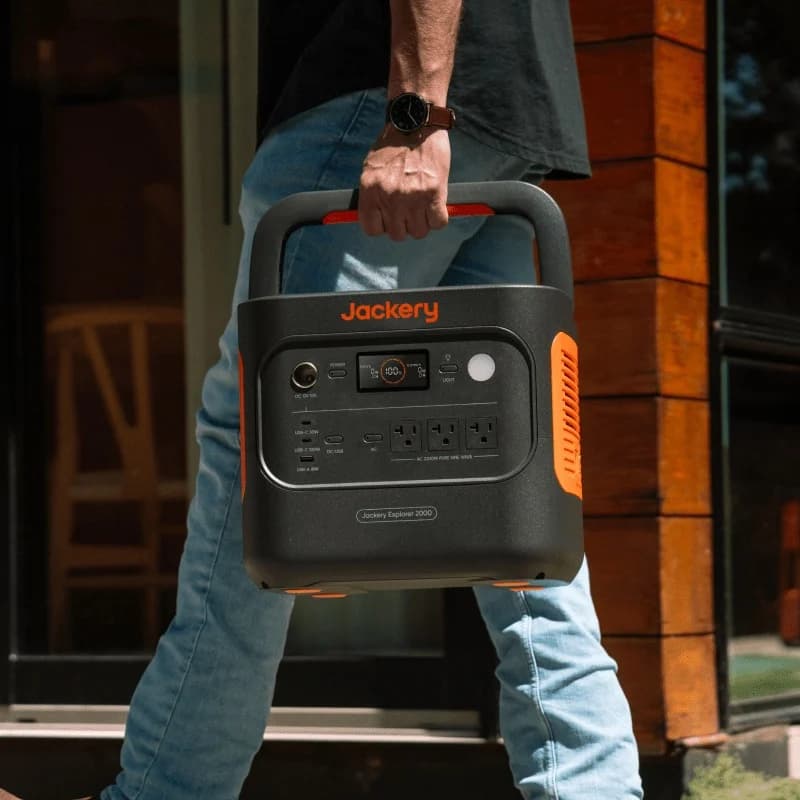
Choose for: 2,042 Wh and 2,200 W continuous output at about 39.5 lb.
Limit: Not expandable; solar input tops out at 400 W and there are three AC outlets.
Choose the Jackery Explorer 2000 v2 for a station you will carry: it stores almost the same energy as the original Plus in a lighter box. Keep or expand an Explorer 2000 Plus when you already own one and need more storage, higher output or a larger solar array. For a fresh purchase, Jackery now marks the original Plus discontinued and points to the separate HomePower 2000 Plus v2 successor.
Quick picks: decide before choosing a bundle
Compare specifications and all conditions
Carrying upstairs, loading a car, fixed storage needs
- Our choice
- Explorer 2000 v2
- Why
- Similar base energy with less weight
Already own an original Plus and need longer runtime
- Our choice
- Keep the Plus; consider its original battery pack
- Why
- Expansion preserves your existing system
Need more running watts than the v2 allows
- Our choice
- Original Plus has the stronger inverter
- Why
- Check the load against the limits below; legacy stock needs scrutiny
Starting an expandable system now
- Our choice
- Compare current models before buying legacy hardware
- Why
- HomePower is a separate platform, not a compatible battery upgrade
Full comparison table
Swipe to compare. Row labels stay visible.
| Your situation | Our choice | Why |
|---|---|---|
| Carrying upstairs, loading a car, fixed storage needs | Explorer 2000 v2 | Similar base energy with less weight |
| Already own an original Plus and need longer runtime | Keep the Plus; consider its original battery pack | Expansion preserves your existing system |
| Need more running watts than the v2 allows | Original Plus has the stronger inverter | Check the load against the limits below; legacy stock needs scrutiny |
| Starting an expandable system now | Compare current models before buying legacy hardware | HomePower is a separate platform, not a compatible battery upgrade |
Scroll horizontally to see every column
| Your situation | Our choice | Why |
|---|---|---|
| Carrying upstairs, loading a car, fixed storage needs | Explorer 2000 v2 | Similar base energy with less weight |
| Already own an original Plus and need longer runtime | Keep the Plus; consider its original battery pack | Expansion preserves your existing system |
| Need more running watts than the v2 allows | Original Plus has the stronger inverter | Check the load against the limits below; legacy stock needs scrutiny |
| Starting an expandable system now | Compare current models before buying legacy hardware | HomePower is a separate platform, not a compatible battery upgrade |
Availability checked November 2, 2026: the original Plus is discontinued; the v2 page labels both its standalone and panel packages sold out, despite generic purchase buttons elsewhere on that page. Check the exact seller's stock and authorization. For alternatives, start with our portable power station guide.
Explorer 2000 v2: our choice for carrying
The v2's US manual identifies JE-2000D, with 2,042Wh, 2,200W continuous output, 4,400W surge and 39.5 lb of weight. Its fixed capacity is the compromise: Jackery explicitly says it is not expandable. Buy it when your energy budget fits; don't plan on correcting an undersized purchase with an extra battery later.
Jackery
A 2,042Wh LiFePO4 portable power station with 2,200W of AC output (4,400W surge peak), app-enabled 1.7-hour emergency charging and up to 400W of solar input.
Check package and model options
- 2,042 Wh capacity
- 2,200 W AC out
- LiFePO4
For occasional high loads, distinguish battery operation from pass-through use. The v2 manual says UPS-mode output before an outage peaks at 1,500W, returning to the rated battery output during an outage. Don't size a permanently plugged-in setup solely around its inverter rating.
Explorer 2000 Plus: keep it for expansion and output
The original US JE-2000C has 2,042.8Wh, 3,000W continuous output and 6,000W surge, according to its US manual. Its advantage is power and expansion, rather than materially more energy in the base station. It weighs about 61.5 lb; the manual shows a retractable handle and warns against moving it with objects stacked on top.
This is a useful platform to retain if you need those capabilities. It is a less straightforward fresh purchase now that Jackery identifies a successor. Use the original Plus page to check the platform, and distinguish remaining new stock from refurbished stock before ordering.
Base-station comparison: original US models only
These are the figures in the Plus manual and v2 manual. AC wattages are shared totals, not an allowance per socket.
Explorer 2000 Plus
- Chemistry and cycle claim
- LiFePO4; 4,000 cycles to 70%+
- Continuous AC / surge
- 3,000W / 6,000W
- US model
- JE-2000C
All specifications
- Nominal stored energy
- 2,042.8Wh
- AC outlets
- Four 120V, 20A; one 120V, 25A
- Station weight
- About 61.5 lb
- Dimensions
- 18.6 × 14.1 × 14.7 in
- Maximum combined solar/DC input
- 1,400W
- USB-C maximums
- Two 100W ports
- Extra batteries
- Up to five original Plus packs
- Emergency switching
- Within 20ms
Explorer 2000 v2
- Chemistry and cycle claim
- LiFePO4; 4,000 cycles to 70%+
- Continuous AC / surge
- 2,200W / 4,400W
- US model
- JE-2000D
All specifications
- Nominal stored energy
- 2,042Wh
- AC outlets
- Three 120V, 18.3A
- Station weight
- About 39.5 lb
- Dimensions
- 13.2 × 10.4 × 11.5 in
- Maximum combined solar/DC input
- 400W
- USB-C maximums
- One 100W, one 30W
- Extra batteries
- Not expandable
- Emergency switching
- Within 20ms
Full comparison table
Swipe to compare. Row labels stay visible.
| Specification | Explorer 2000 Plus | Explorer 2000 v2 |
|---|---|---|
| US model | JE-2000C | JE-2000D |
| Nominal stored energy | 2,042.8Wh | 2,042Wh |
| Continuous AC / surge | 3,000W / 6,000W | 2,200W / 4,400W |
| AC outlets | Four 120V, 20A; one 120V, 25A | Three 120V, 18.3A |
| Station weight | About 61.5 lb | About 39.5 lb |
| Dimensions | 18.6 × 14.1 × 14.7 in | 13.2 × 10.4 × 11.5 in |
| Chemistry and cycle claim | LiFePO4; 4,000 cycles to 70%+ | LiFePO4; 4,000 cycles to 70%+ |
| Maximum combined solar/DC input | 1,400W | 400W |
| USB-C maximums | Two 100W ports | One 100W, one 30W |
| Extra batteries | Up to five original Plus packs | Not expandable |
| Emergency switching | Within 20ms | Within 20ms |
Scroll horizontally to see every column
| Specification | Explorer 2000 Plus | Explorer 2000 v2 |
|---|---|---|
| US model | JE-2000C | JE-2000D |
| Nominal stored energy | 2,042.8Wh | 2,042Wh |
| Continuous AC / surge | 3,000W / 6,000W | 2,200W / 4,400W |
| AC outlets | Four 120V, 20A; one 120V, 25A | Three 120V, 18.3A |
| Station weight | About 61.5 lb | About 39.5 lb |
| Dimensions | 18.6 × 14.1 × 14.7 in | 13.2 × 10.4 × 11.5 in |
| Chemistry and cycle claim | LiFePO4; 4,000 cycles to 70%+ | LiFePO4; 4,000 cycles to 70%+ |
| Maximum combined solar/DC input | 1,400W | 400W |
| USB-C maximums | Two 100W ports | One 100W, one 30W |
| Extra batteries | Up to five original Plus packs | Not expandable |
| Emergency switching | Within 20ms | Within 20ms |
Jackery's comparison blog gives different v2 figures: 2,042.8Wh and 39.4 lb, versus 2,042Wh and 39.5 lb in the US manual. Our table follows the model-specific manual.
Source: Jackery's US manuals linked above; approximate manufacturer weights
Both manuals exclude zero-interruption switching and warn about equipment requiring uninterrupted power. They also describe a default energy-saving cutoff after 12 hours when AC output is 25W or less. Review that setting for small overnight loads rather than assuming backup will stay active indefinitely.
Battery compatibility and total carrying weight
Read Explorer, HomePower, Plus and v2 as parts of the full product name. The HomePower successor page says it requires Battery Pack 2000 Plus v2 and cannot use the original pack. The original pack page identifies the original Explorer 2000 Plus as its match.
- Yes: Explorer 2000 Plus → original Battery Pack 2000 Plus
- No: Explorer 2000 v2 → no expansion battery support
- Yes: HomePower 2000 Plus v2 → Battery Pack 2000 Plus v2
- No: Original Battery Pack 2000 Plus → HomePower 2000 Plus v2
The original battery manual identifies JBP-2000A, with 2,042.8Wh and 41.9 lb. Adding one doubles nominal storage (2,042.8 + 2,042.8Wh, about four kilowatt-hours) and brings the equipment weight to just over one hundred pounds (61.5 + 41.9 lb before the expansion cable), calculated from the manufacturer figures. That is separate equipment to move, not a larger single carry handle. The pack includes an expansion cable.
Jackery specifies up to five packs per Plus station, advertising 12.256kWh for that arrangement. The calculated equipment weight is 61.5 + 5 × 41.9 lb, about two hundred seventy pounds before cables. Its 24.513kWh headline requires two stations and ten packs. Extra storage extends runtime; a pack does not replace the station's inverter or turn one Plus into that paired system.
Pairing stations: an unresolved power claim
The US Jackery Connector manual identifies JC-CO20A, shows two Plus stations and specifies 120/240V output. Its 7,200W maximum accessory rating is not the output rating of two Plus stations.
For any connection to home wiring, use a licensed electrician and obtain a permit where required. Jackery's home-backup guidance calls for an electrician working to local codes; our home battery backup guide covers the wider buying decision.
Equal-load runtime estimates: fridge and occasional high loads
For a fair comparison, use the same assumed losses. Jackery's published illustration uses hours = capacity in Wh × 0.85 ÷ load in W. We apply that factor to both models for comparison; it is not an efficiency measurement of either station or a separate model of inverter idle consumption.
Our chosen examples are a 100W average load for fridge planning and a 1,500W steady load for an occasional high-power appliance. These are planning inputs, not measured consumption of a particular appliance.
100W average
- v2: 2,042Wh
- About seventeen hours
- Plus: 2,042.8Wh
- About seventeen hours
- Plus + one pack: 2 × 2,042.8Wh
- About thirty-five hours
1,500W steady
- v2: 2,042Wh
- About seventy minutes
- Plus: 2,042.8Wh
- About seventy minutes
- Plus + one pack: 2 × 2,042.8Wh
- About two hours and twenty minutes
Full comparison table
Swipe to compare. Row labels stay visible.
| Chosen load; estimated runtime | v2: 2,042Wh | Plus: 2,042.8Wh | Plus + one pack: 2 × 2,042.8Wh |
|---|---|---|---|
| 100W average | About seventeen hours | About seventeen hours | About thirty-five hours |
| 1,500W steady | About seventy minutes | About seventy minutes | About two hours and twenty minutes |
Scroll horizontally to see every column
| Chosen load; estimated runtime | v2: 2,042Wh | Plus: 2,042.8Wh | Plus + one pack: 2 × 2,042.8Wh |
|---|---|---|---|
| 100W average | About seventeen hours | About seventeen hours | About thirty-five hours |
| 1,500W steady | About seventy minutes | About seventy minutes | About two hours and twenty minutes |
For example, 2,042.8Wh × 0.85 ÷ 100W gives roughly seventeen hours. The base stations are effectively tied under equal assumptions; the Plus's bigger inverter does not itself buy longer runtime. Expansion changes that result.
A refrigerator's compressor cycles, so use energy consumed over time to estimate its average load; nameplate watts alone are a poor runtime input. Use a plug-in energy monitor to work out your average load; Jackery also describes refrigerators as intermittent loads. Our refrigerator watts guide explains sizing. Allow for starting demand, other devices, temperature, battery condition and settings; actual runtime can differ substantially.
Solar bundles, cables and charging claims
Both manuals specify two DC 8mm inputs. The Plus's higher solar range is 17.5–60V working voltage, 12A per port, with 24A/1,400W combined. The v2 lists 16–60V, 12A per port, with 21A/400W combined. These are the manuals' input specifications, not a universal permission to connect any panel array; check panel voltage, current and the prescribed connector arrangement.
The v2 manual supports a direct 100W or 200W panel per port and requires a separately sold solar connector for two 100W panels on one input. The Plus manual also requires separate solar connectors for larger panel arrangements. Those solar connectors are different accessories from the station-pairing Jackery Connector.
The Plus's advertised two-hour solar charge uses six 200W panels. Two 200W panels provide the same nominal array wattage for either station; a higher input ceiling alone does not make that array larger. The v2 station-only package lists an AC cable; its two-panel package additionally lists two SolarSaga 200W panels and two multifunctional solar charging cables. Count the actual contents, including adapters, rather than buying on the words “solar generator.”
Charging conflicts: the v2 product table lists 1.75 hours by AC, its main feature text says about 1.7 hours in app-enabled Emergency Charge, and its navigation still says 1.3 hours. Use the model-specific table and treat the emergency figure as a maker claim; the manual recommends normal charging for routine use. Its feature text also says 4,000W surge, while the technical table and US manual agree on 4,400W, which we use above.
Winter, warranty and Black Friday bundle checks
Both original stations allow charging at 32–113°F and discharging at 14–113°F, per their US manuals. Being able to discharge below freezing does not mean either can recharge there; choose a storage and charging location accordingly.
The v2 FAQ lists three years plus a two-year extension through eligible official or authorized channels. Jackery's service policy directs buyers who ordered elsewhere to register for an extension; verify eligibility for your seller. The original Plus FAQ explicitly requires registration for the extra coverage on Amazon orders. Crucially, Jackery's refurbished Plus page specifies six months, rather than the new-unit warranty.
Match the full name
Confirm Explorer versus HomePower, Plus versus v2, and the US model.
Count every component
Separate the station, expansion batteries, panels, expansion cables and solar connectors.
Check condition and support
Confirm new versus refurbished, seller authorization and extension registration.
Compare the same configuration
Check the current offer only after matching components; a larger kit changes weight and storage.
How we choose
This comparison uses Jackery's US manuals, product pages and warranty policy. We separate base stations, expansion packs and paired systems; retain conflicts that could change a purchase; and calculate equal-load estimates from a disclosed assumption. This is document research, without physical product evaluation. For smaller systems, see our Explorer 1000 generation guide.
Verdict
Choose the Explorer 2000 v2 when portability matters and fixed capacity covers your needs, subject to stock from an eligible seller. Retain the original Explorer 2000 Plus for its expansion ecosystem and higher output if you already own it. Starting fresh with expansion in mind warrants comparing current platforms, rather than treating a discontinued Plus or the separate HomePower successor as interchangeable.
Frequently asked questions
Is the Jackery Explorer 2000 Plus better than the 2000 v2?
The original Plus has higher continuous output, more solar input and battery expansion, while the v2 is lighter with almost the same base capacity. Jackery now marks the original Plus discontinued. Choose the v2 for carrying if an authorized seller has stock; expanding a Plus makes most sense when you already own that system.
Can I add a battery to the Jackery Explorer 2000 v2?
No. Jackery explicitly says the Explorer 2000 v2 is not expandable. The original Battery Pack 2000 Plus belongs to the original Explorer 2000 Plus system. The separate HomePower 2000 Plus v2 uses Battery Pack 2000 Plus v2. Neither the word Explorer nor the v2 suffix alone establishes battery compatibility.
How long will either station run a refrigerator?
With a chosen average load of 100W and Jackery's illustrative 0.85 loss factor, either base station calculates to about seventeen hours. A Plus with one original expansion pack calculates to about thirty-five hours. These are estimates, not refrigerator guarantees: actual average consumption, inverter overhead, temperature, settings and compressor starts affect the result. Measure your fridge's energy use before sizing backup.
Can one Explorer 2000 Plus supply 240V?
A single US Explorer 2000 Plus supplies 120V. Jackery documents pairing two original Plus stations through its separate Connector for 120/240V, but the current Connector page gives conflicting power figures and says a 120V load draws from only one station and its packs. Confirm the intended load with Jackery before purchasing. Home wiring requires a licensed electrician and a permit where required.
Jackery Explorer 2000 v2
AmazonRelated guides
Best picks · Portable Power Stations
Best Battery Backup for Refrigerators: Picks by Outage Length

Choose a battery backup for your refrigerator by daily energy use, compressor starts and outage length, with clear picks, runtime estimates and kit checks.
Comparison · Portable Power Stations
AFERIY P280 vs Anker SOLIX C2000 Gen 2: Which Backup Kit Fits?
Compare the US AFERIY P280 and Anker C2000 Gen 2 for fridge backup: matching battery kits, runtime estimates, outlet limits, recharge needs and warranty gaps.
Comparison · Portable Power Stations
Anker SOLIX C2000 Gen 2 vs Jackery Explorer 2000 v2: Which to Buy?
Compare Anker C2000 Gen 2 and Jackery 2000 v2 for fridge backup, carrying, expansion and solar. Get runtime estimates, complete kit checks and buying picks.