

Comparison
Jackery Explorer 1000 Plus vs EcoFlow DELTA 3 Plus
Which Kit?
Compare Jackery Explorer 1000 Plus and EcoFlow DELTA 3 Plus for usable capacity, equal-load runtime, expansion, solar cables and the exact US kit to buy.
By thisWATT EditorialUpdated November 3, 20268 min read1 pick
On this page · Our picks at a glance
Our picks at a glance
- 1

Choose for: 1,024 Wh of storage and 1,800 W continuous AC output in one expandable station.
Limit: The IP65 rating covers the battery pack only; the complete station is not weatherproof.
The EcoFlow DELTA 3 Plus is our starting pick for a new expandable setup, provided its shipping date meets your deadline. Choose the Jackery Explorer 1000 Plus when its larger built-in battery or higher continuous output matters more, after confirming the exact US package and seller support. Jackery's matching expansion pack is discontinued, so judge that purchase by the capacity in the order you can actually secure.
Quick picks: compare the complete order
Compare specifications and all conditions
New setup with additional storage
- Our pick
- DELTA 3 Plus with DELTA 3 Series Extra Battery
- Purchase condition
- Confirm the named battery, connection cable and dispatch date
More power and energy in one box
- Our pick
- Explorer 1000 Plus
- Purchase condition
- Treat expansion as unavailable unless the exact matching packs are secured
Solar included
- Our pick
- Compare the actual panel packages
- Purchase condition
- Jackery lists two SolarSaga 100 Air panels; EcoFlow's generic 220W kit title does not establish the panel generation
Already own a working 1000 Plus
- Our pick
- Keep it if it meets your loads
- Purchase condition
- Pack discontinuation alone is not a reason to replace a useful station
Full comparison table
Swipe to compare. Row labels stay visible.
| Your priority | Our pick | Purchase condition |
|---|---|---|
| New setup with additional storage | DELTA 3 Plus with DELTA 3 Series Extra Battery | Confirm the named battery, connection cable and dispatch date |
| More power and energy in one box | Explorer 1000 Plus | Treat expansion as unavailable unless the exact matching packs are secured |
| Solar included | Compare the actual panel packages | Jackery lists two SolarSaga 100 Air panels; EcoFlow's generic 220W kit title does not establish the panel generation |
| Already own a working 1000 Plus | Keep it if it meets your loads | Pack discontinuation alone is not a reason to replace a useful station |
Scroll horizontally to see every column
| Your priority | Our pick | Purchase condition |
|---|---|---|
| New setup with additional storage | DELTA 3 Plus with DELTA 3 Series Extra Battery | Confirm the named battery, connection cable and dispatch date |
| More power and energy in one box | Explorer 1000 Plus | Treat expansion as unavailable unless the exact matching packs are secured |
| Solar included | Compare the actual panel packages | Jackery lists two SolarSaga 100 Air panels; EcoFlow's generic 220W kit title does not establish the panel generation |
| Already own a working 1000 Plus | Keep it if it meets your loads | Pack discontinuation alone is not a reason to replace a useful station |
Availability checked November 2, 2026: Jackery's US listing describes the station and Air-panel bundle; its official catalog marks the bundle available. We could not establish an exact supported Jackery Amazon package, so its recommendation remains conditional. EcoFlow's selected-package page combines an “Out of Stock” banner with a base-unit preorder shipping in late November and an extra-battery kit marked for mid-November. Those are listing statements, not confirmed delivery commitments.
Exact US models and the comparison table
The Jackery here is Explorer 1000 Plus, JE-1000C. Explorer 1000 v2 is a separate US model with 1,070Wh and 1,500W; HomePower 1000 Plus v2 is another name to exclude when matching an order. Use our Jackery generation guide for that naming decision. EcoFlow's manual identifies this Plus as EF-DL-H10-4; its standard DELTA 3 is a different selection.
Built-in nominal capacity
- Jackery Explorer 1000 Plus
- 1,264.64Wh; support rounds to 1,264Wh
- EcoFlow DELTA 3 Plus
- 1,024Wh
Continuous AC output, shared total
- Jackery Explorer 1000 Plus
- 2,000W
- EcoFlow DELTA 3 Plus
- 1,800W
Surge rating
- Jackery Explorer 1000 Plus
- 4,000W
- EcoFlow DELTA 3 Plus
- 3,600W
US AC outlets
- Jackery Explorer 1000 Plus
- Three, 120V
- EcoFlow DELTA 3 Plus
- Six, 120V
Station weight, without accessories
- Jackery Explorer 1000 Plus
- 32 lbs
- EcoFlow DELTA 3 Plus
- 27.6 lb
USB-C maximum
- Jackery Explorer 1000 Plus
- Two ports, 100W each
- EcoFlow DELTA 3 Plus
- Two ports, 140W each
Battery chemistry
- Jackery Explorer 1000 Plus
- LiFePO4
- EcoFlow DELTA 3 Plus
- LiFePO4
Stated cycle endpoint
- Jackery Explorer 1000 Plus
- 4,000 cycles to at least 70% capacity
- EcoFlow DELTA 3 Plus
- 4,000 cycles to at least 80% capacity
Maximum solar input
- Jackery Explorer 1000 Plus
- 800W combined
- EcoFlow DELTA 3 Plus
- 1,000W combined
Full wall recharge claim
- Jackery Explorer 1000 Plus
- About 1.7 hours
- EcoFlow DELTA 3 Plus
- 56 minutes with 1,500W input
Expansion purchase to evaluate
- Jackery Explorer 1000 Plus
- Matching pack discontinued
- EcoFlow DELTA 3 Plus
- Listed station-plus-battery kit: 2,048Wh
Station warranty wording
- Jackery Explorer 1000 Plus
- Three years plus two extended; confirm channel eligibility
- EcoFlow DELTA 3 Plus
- Five years
Full comparison table
Swipe to compare. Row labels stay visible.
| Maker-stated specification | Jackery Explorer 1000 Plus | EcoFlow DELTA 3 Plus |
|---|---|---|
| Built-in nominal capacity | 1,264.64Wh; support rounds to 1,264Wh | 1,024Wh |
| Continuous AC output, shared total | 2,000W | 1,800W |
| Surge rating | 4,000W | 3,600W |
| US AC outlets | Three, 120V | Six, 120V |
| Station weight, without accessories | 32 lbs | 27.6 lb |
| USB-C maximum | Two ports, 100W each | Two ports, 140W each |
| Battery chemistry | LiFePO4 | LiFePO4 |
| Stated cycle endpoint | 4,000 cycles to at least 70% capacity | 4,000 cycles to at least 80% capacity |
| Maximum solar input | 800W combined | 1,000W combined |
| Full wall recharge claim | About 1.7 hours | 56 minutes with 1,500W input |
| Expansion purchase to evaluate | Matching pack discontinued | Listed station-plus-battery kit: 2,048Wh |
| Station warranty wording | Three years plus two extended; confirm channel eligibility | Five years |
Scroll horizontally to see every column
| Maker-stated specification | Jackery Explorer 1000 Plus | EcoFlow DELTA 3 Plus |
|---|---|---|
| Built-in nominal capacity | 1,264.64Wh; support rounds to 1,264Wh | 1,024Wh |
| Continuous AC output, shared total | 2,000W | 1,800W |
| Surge rating | 4,000W | 3,600W |
| US AC outlets | Three, 120V | Six, 120V |
| Station weight, without accessories | 32 lbs | 27.6 lb |
| USB-C maximum | Two ports, 100W each | Two ports, 140W each |
| Battery chemistry | LiFePO4 | LiFePO4 |
| Stated cycle endpoint | 4,000 cycles to at least 70% capacity | 4,000 cycles to at least 80% capacity |
| Maximum solar input | 800W combined | 1,000W combined |
| Full wall recharge claim | About 1.7 hours | 56 minutes with 1,500W input |
| Expansion purchase to evaluate | Matching pack discontinued | Listed station-plus-battery kit: 2,048Wh |
| Station warranty wording | Three years plus two extended; confirm channel eligibility | Five years |
Sources: Jackery's model support, its US comparison table, EcoFlow specifications and the Plus manual. Charging claims come from different manufacturer conditions. The different retained-capacity endpoints also prevent treating the cycle claims as identical durability ratings.
Source: Jackery US model support and EcoFlow specifications linked above
Best new expandable setup: EcoFlow DELTA 3 Plus
EcoFlow is the stronger starting point if you plan to buy extra storage with the station. Its named DELTA 3 Plus + DELTA 3 Series Extra Battery package specifies 2,048Wh and 1,800W. The station alone is lighter than the Jackery, and its higher USB-C ceiling benefits devices and cables supporting that charging mode.
EcoFlow
A 1,024Wh LiFePO4 portable power station with 1,800W of AC output, 1,500W wall charging, two 500W solar inputs and expansion to about 5kWh with EcoFlow extra batteries.
Check package and model options
- 1,024 Wh capacity
- 1,800 W AC out
- LiFePO4
The card is the standalone station. Check the battery-kit selection separately; do not assume a base-unit order includes the accessory. EcoFlow's battery manual gives the extra battery's weight as 21.2 lb, in addition to the station's weight.
EcoFlow advertises expansion to about 5kWh using other named batteries, but the comparison below uses the smaller, explicitly listed kit. A possible future maximum is less useful than a complete order with a credible delivery date.
Check price on Amazon, matching the seller and exact station selection. See our DELTA 3 model guide for the wider family.
Conditional higher-output choice: Jackery Explorer 1000 Plus
The Jackery's advantage is useful without expansion: loads above EcoFlow's 1,800W continuous limit but within Jackery's 2,000W limit warrant investigating the Plus. Check appliance starting demand separately; surge ratings do not promise that a particular motor will start.
Its current Air-panel package contains the same station and two 100W SolarSaga 100 Air panels. Panels recharge storage; they do not add battery capacity. Jackery's catalog explicitly says Battery Pack 1000 Plus is discontinued, even while retaining the older expansion-to-5kWh description. Its pack support page confirms compatibility, not stock.
Buy the station for its standalone capability, or buy an expanded configuration only after the actual packs, cables, condition and warranty are confirmed together. Jackery's comparison page makes automatic warranty extension specific to purchases from its official website; confirm retailer eligibility before assigning the same coverage elsewhere.
Check the exact Jackery package. No Jackery Amazon offer is verified here.
Equal-load runtime: energy and output answer different questions
For a transparent planning comparison, use estimated hours = nominal Wh × 0.85 ÷ average load in W. Jackery publishes this loss allowance in its 1000 Plus runtime explanation. Applying the same 85% assumption to both brands is a model, not their measured AC efficiency.
Jackery station
- Estimated runtime
- About 10.7 hours
- Arithmetic at an assumed steady 100W
- 1,264.64Wh × 0.85 ÷ 100W
EcoFlow station
- Estimated runtime
- About 8.7 hours
- Arithmetic at an assumed steady 100W
- 1,024Wh × 0.85 ÷ 100W
EcoFlow station plus named extra battery
- Estimated runtime
- About 17.4 hours
- Arithmetic at an assumed steady 100W
- 2,048Wh × 0.85 ÷ 100W
Full comparison table
Swipe to compare. Row labels stay visible.
| Configuration, fully charged with no recharging | Arithmetic at an assumed steady 100W | Estimated runtime |
|---|---|---|
| Jackery station | 1,264.64Wh × 0.85 ÷ 100W | About 10.7 hours |
| EcoFlow station | 1,024Wh × 0.85 ÷ 100W | About 8.7 hours |
| EcoFlow station plus named extra battery | 2,048Wh × 0.85 ÷ 100W | About 17.4 hours |
Scroll horizontally to see every column
| Configuration, fully charged with no recharging | Arithmetic at an assumed steady 100W | Estimated runtime |
|---|---|---|
| Jackery station | 1,264.64Wh × 0.85 ÷ 100W | About 10.7 hours |
| EcoFlow station | 1,024Wh × 0.85 ÷ 100W | About 8.7 hours |
| EcoFlow station plus named extra battery | 2,048Wh × 0.85 ÷ 100W | About 17.4 hours |
These are calculations from the sourced capacities, assuming a full battery without a reserved charge floor. Temperature, aging, inverter consumption and settings change the result; a fixed percentage becomes less representative at small loads. For a cycling refrigerator, use average energy consumption and check starting power separately; our refrigerator watts guide explains that worksheet.
An extra battery extends duration while leaving the host's continuous output unchanged. Do not trade a required output rating for an attractive runtime estimate.
Charging and backup: the conditions that matter
Wall versus car: the table's fastest wall claims concern the standalone stations. Jackery's model support gives about 14.5 hours for car charging, while its older runtime article says 7 hours; that conflict remains unresolved. EcoFlow's 800W driving-charge claim requires the separate 800W Alternator Charger, not its ordinary cigarette-lighter charging cable.
X-Boost is not the continuous rating. EcoFlow's store specifies 2,200W with X-Boost, while the manual's 120V row says 2,600W. The manual restricts its suitability for voltage-sensitive equipment and says it is unavailable during AC charging/bypass. Use 1,800W continuous for this buying decision until the exact appliance and mode are confirmed.
Automatic backup has mode limits: Jackery describes EPS switching within 20ms, with 12A maximum during simultaneous charging and discharging. EcoFlow's store says under 10ms, whereas its manual states 10ms. Neither figure establishes compatibility with your equipment's interruption tolerance. EcoFlow also recommends AC timeout set to Never for intermittent refrigerator loads. Home wiring integration needs a licensed electrician and permits where required; see our home backup guide.
Solar ports, panel generations and the cable list
Explorer 1000 Plus
- Input requirements
- Two independent inputs; 12–60V, 11A and 400W maximum per port; 800W combined
- Solar connection
- DC8020
DELTA 3 Plus
- Input requirements
- Two inputs; 11–60V, 15A and 500W maximum per port; 1,000W combined
- Solar connection
- Solar to XT60i cable
Full comparison table
Swipe to compare. Row labels stay visible.
| Station | Input requirements | Solar connection |
|---|---|---|
| Explorer 1000 Plus | Two independent inputs; 12–60V, 11A and 400W maximum per port; 800W combined | DC8020 |
| DELTA 3 Plus | Two inputs; 11–60V, 15A and 500W maximum per port; 1,000W combined | Solar to XT60i cable |
Scroll horizontally to see every column
| Station | Input requirements | Solar connection |
|---|---|---|
| Explorer 1000 Plus | Two independent inputs; 12–60V, 11A and 400W maximum per port; 800W combined | DC8020 |
| DELTA 3 Plus | Two inputs; 11–60V, 15A and 500W maximum per port; 1,000W combined | Solar to XT60i cable |
Sources: Jackery support and EcoFlow's connection instructions. EcoFlow explicitly requires total panel Voc within 60V and Isc within 15A. Confirm voltage margins, current, tolerances and the approved arrangement before buying panels.
The current SolarSaga 200 lists 11.5A operating current and 12.5A short-circuit current, each ±5%, against the Plus's 11A port limit. Obtain Jackery's approval for that exact revision; do not infer compatibility from a familiar panel name or matching plug.
EcoFlow's NextGen 220W Bifacial lists 21.5V Voc and 12.4A front-side Isc and includes an XT60i cable. Front-side figures alone do not settle total bifacial current. A generic “220W panel” bundle title also does not confirm this NextGen model.
Before ordering, account for the whole charging path:
- Jackery wall/car: its station accessory list includes AC and DC8020 car cables.
- Jackery solar: require the correct panel-to-DC8020 lead for each panel. The Air panel description says cables are included; confirm the selected kit's lead quantity. Additional multi-panel arrangements may require Jackery adapters.
- EcoFlow wall: the standalone box lists an AC cable. Its manual sells the car and solar charging cables separately; the named NextGen panel separately includes a solar cable.
- EcoFlow expansion: the battery manual lists a supplied extra-battery cable, but the station store names an Alternator Charger XT150 Output Cable. Have EcoFlow confirm the cable for the exact pairing before adding accessories.
Black Friday and legacy-listing checks
Compare complete packages on the day. A battery-only listing, a two-station pack and a station-plus-panel kit solve different problems. Require seller authorization, warranty eligibility, package contents and a delivery date that fits your trip or outage preparation.
- Yes: Exact station name and US outlet version confirmed
- Yes: Panels, charging leads and any battery cable accounted for
- Partly: Delivery timing confirmed for the selected variant
- Partly: Jackery warranty extension confirmed for the purchase channel
- No: Discontinued pack pictured as an assumed inclusion
How we choose
We use official US specifications, model support and manuals, with manufacturer catalog data where storefront retrieval fails. This is document research without physical product testing. Calculations show their assumptions; conflicting maker statements remain visible. The Jackery recommendation remains conditional until the exact supported package is established; catalog availability does not guarantee delivery.
Verdict
Start with DELTA 3 Plus for a new expandable setup, checking its actual delivery date and battery cable. Choose Explorer 1000 Plus for the higher standalone output and storage only when the supported package is confirmed; value future expansion only when matching packs are secured. If your existing Jackery already covers the load and duration, keeping it is a sensible outcome.
Frequently asked questions
Is Jackery Explorer 1000 Plus better than EcoFlow DELTA 3 Plus?
The Jackery has more built-in energy and higher continuous output, so it is the conditional choice when those limits decide the purchase. EcoFlow is our starting pick for a new expandable setup because its current catalog includes a station-and-extra-battery configuration. Compare the selected kit's delivery date, battery cable and seller support before paying; an expansion specification alone does not establish stock.
Is the Jackery Explorer 1000 Plus discontinued?
Jackery explicitly says its Battery Pack 1000 Plus is discontinued. That is the expansion accessory, rather than a discontinuation notice for the station itself. Its US catalog still lists the Explorer 1000 Plus and a bundle with two SolarSaga 100 Air panels. Confirm the exact order and warranty channel; the pack's support page remaining online does not mean new packs are available.
Does a DELTA 3 Plus extra battery increase output?
The listed DELTA 3 Plus and DELTA 3 Series Extra Battery kit has 2,048Wh of nominal storage while retaining 1,800W continuous AC output. It adds energy for longer use, rather than a larger inverter. Make sure the order contains a complete station as well as the battery, and have EcoFlow confirm the connection cable because its store and battery-manual descriptions differ.
Can either station run a refrigerator overnight?
Possibly, but neither the battery capacity nor the surge figure establishes that result for your refrigerator. Check its starting demand and average energy use, including compressor cycling, against the station's limits and your required hours. The runtime table uses an assumed steady load, not a refrigerator measurement. EcoFlow also advises setting AC timeout to Never for intermittent refrigerator loads and checking battery level.
Can I use a Jackery solar panel with EcoFlow DELTA 3 Plus?
Do not assume a connector adapter establishes compatibility. EcoFlow's manual requires an appropriate Solar to XT60i charging cable and limits the connected panels' total open-circuit voltage and short-circuit current. Match the exact panel generation, tolerances and bifacial conditions to those requirements with the maker. Check the complete cable path before buying a cross-brand setup.
Related guides
Comparison · Portable Power Stations
Anker SOLIX C2000 Gen 2 vs Jackery Explorer 2000 v2: Which to Buy?
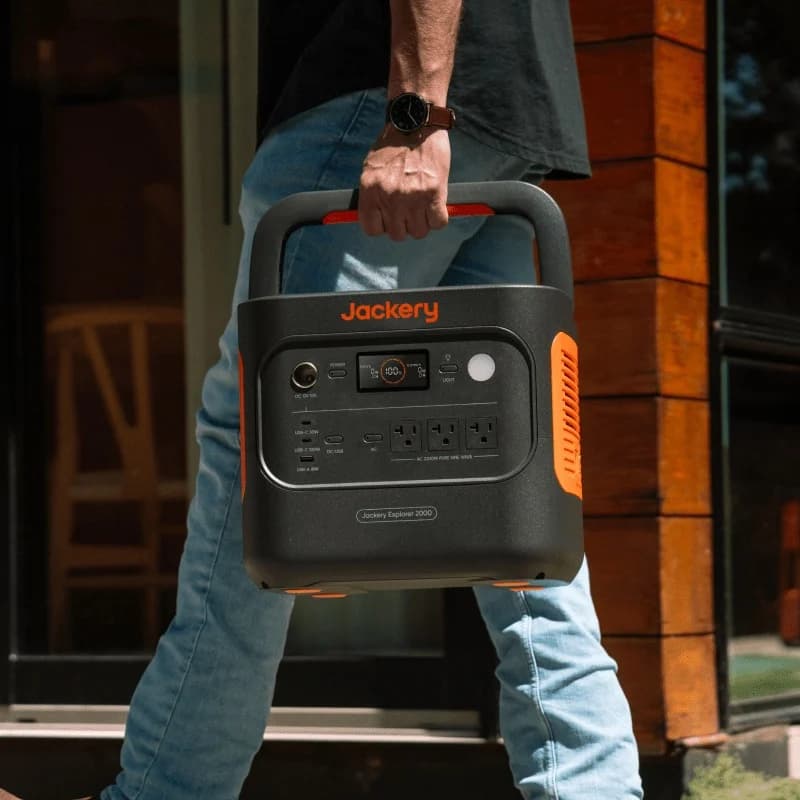
Compare Anker C2000 Gen 2 and Jackery 2000 v2 for fridge backup, carrying, expansion and solar. Get runtime estimates, complete kit checks and buying picks.
Comparison · Portable Power Stations
Anker SOLIX C300X vs BLUETTI Elite 30 V2: Which Small Station?
Choose C300X or Elite 30 V2 for laptops, lights and small AC loads: compare USB-C sharing, runtime estimates, solar cables, model aliases and gift return traps.
Comparison · Portable Power Stations
AFERIY P280 vs Anker SOLIX C2000 Gen 2: Which Backup Kit Fits?

Compare the US AFERIY P280 and Anker C2000 Gen 2 for fridge backup: matching battery kits, runtime estimates, outlet limits, recharge needs and warranty gaps.