

Buying guide
How Many Watts Does a Window Air Conditioner Use?
Find your window AC's running watts, check compressor startup, and estimate battery runtime. Compare three power stations and avoid the wrong backup package.
By thisWATT EditorialUpdated November 3, 20268 min read3 picks
On this page · Quick picks: choose storage after checking the AC
A window air conditioner's watts depend on the exact model: GE lists 695W cooling input for its 8,000 BTU AHEK08AC and 900W for its 10,300 BTU inverter PHNT10CC. For backup of a household 120V window unit, start with the Anker SOLIX C2000 Gen 2 shortlist, then verify compressor startup and the connection before buying. Its 2,048Wh storage and 2,400W continuous output address different needs; neither establishes compatibility by itself.
- 695WGE AHEK08AC rated cooling input
- 900WGE PHNT10CC rated cooling input
Quick picks: choose storage after checking the AC
These are station candidates, not manufacturer-approved AC-and-battery pairings. All three have continuous inverter ratings above the two example cooling loads; startup remains unverified for those pairings.
Compare specifications and all conditions
Anker SOLIX C2000 Gen 2
- Nominal storage
- 2,048Wh
- Continuous / published peak
- 2,400W / 4,000W
- Maximum solar input
- 800W
All specifications
- Choose it when…
- You want a manageable base station with an expansion option.
Jackery Explorer 2000 v2
- Nominal storage
- 2,042Wh
- Continuous / published peak
- 2,200W / 4,400W in specifications*
- Maximum solar input
- 400W
All specifications
- Choose it when…
- Carrying weight matters and fixed capacity is enough.
EcoFlow DELTA Pro 3
- Nominal storage
- 4,096Wh
- Continuous / published peak
- 4,000W total / 8,000W
- Maximum solar input
- 2,600W across separate inputs
All specifications
- Choose it when…
- You need more energy and can accommodate a much heavier station.
Full comparison table
Swipe to compare. Row labels stay visible.
| Pick | Nominal storage | Continuous / published peak | Maximum solar input | Choose it when… |
|---|---|---|---|---|
| Anker SOLIX C2000 Gen 2 | 2,048Wh | 2,400W / 4,000W | 800W | You want a manageable base station with an expansion option. |
| Jackery Explorer 2000 v2 | 2,042Wh | 2,200W / 4,400W in specifications* | 400W | Carrying weight matters and fixed capacity is enough. |
| EcoFlow DELTA Pro 3 | 4,096Wh | 4,000W total / 8,000W | 2,600W across separate inputs | You need more energy and can accommodate a much heavier station. |
Scroll horizontally to see every column
| Pick | Nominal storage | Continuous / published peak | Maximum solar input | Choose it when… |
|---|---|---|---|---|
| Anker SOLIX C2000 Gen 2 | 2,048Wh | 2,400W / 4,000W | 800W | You want a manageable base station with an expansion option. |
| Jackery Explorer 2000 v2 | 2,042Wh | 2,200W / 4,400W in specifications* | 400W | Carrying weight matters and fixed capacity is enough. |
| EcoFlow DELTA Pro 3 | 4,096Wh | 4,000W total / 8,000W | 2,600W across separate inputs | You need more energy and can accommodate a much heavier station. |
Figures: Anker specifications, Jackery specifications, and EcoFlow's US manual. *Jackery's feature copy also says 4,000W surge; its technical table says 4,400W. Confirm that conflict and the supported surge duration with Jackery before relying on either figure for a compressor.
Source: Manufacturer specifications linked above; storage does not establish startup compatibility.
What window-AC watts actually mean
BTU/h describes cooling capacity. Electrical input in watts describes the load on the power source. Use the latter for the inverter check and watt-hours for the energy budget; the EIA explains the distinction between power and energy.
GE AHEK08AC, conventional cycling example
- Cooling capacity
- 8,000 BTU/h
- Rated cooling input
- 695W
- Electrical specification
- 115V, 60Hz; 6.1A rated cooling current
All specifications
- Startup evidence
- Manual describes compressor cycling and approximately three minutes before restarting cooling; no model-specific starting watts found.
GE Profile PHNT10CC, inverter example
- Cooling capacity
- 10,300 BTU/h
- Rated cooling input
- 900W
- Electrical specification
- 115V; 9.8A rated cooling current
All specifications
- Startup evidence
- Manual specifies a 115/120V, 60Hz supply and restart delay; no model-specific starting watts found.
Full comparison table
Swipe to compare. Row labels stay visible.
| Exact US load reference | Cooling capacity | Rated cooling input | Electrical specification | Startup evidence |
|---|---|---|---|---|
| GE AHEK08AC, conventional cycling example | 8,000 BTU/h | 695W | 115V, 60Hz; 6.1A rated cooling current | Manual describes compressor cycling and approximately three minutes before restarting cooling; no model-specific starting watts found. |
| GE Profile PHNT10CC, inverter example | 10,300 BTU/h | 900W | 115V; 9.8A rated cooling current | Manual specifies a 115/120V, 60Hz supply and restart delay; no model-specific starting watts found. |
Scroll horizontally to see every column
| Exact US load reference | Cooling capacity | Rated cooling input | Electrical specification | Startup evidence |
|---|---|---|---|---|
| GE AHEK08AC, conventional cycling example | 8,000 BTU/h | 695W | 115V, 60Hz; 6.1A rated cooling current | Manual describes compressor cycling and approximately three minutes before restarting cooling; no model-specific starting watts found. |
| GE Profile PHNT10CC, inverter example | 10,300 BTU/h | 900W | 115V; 9.8A rated cooling current | Manual specifies a 115/120V, 60Hz supply and restart delay; no model-specific starting watts found. |
The AHEK manual covers AHEK08AC; the PHNT manual covers PHNT10 and PHNT12. These are load references for owners, not AC purchase recommendations. They have different cooling capacities, so the table is not an efficiency contest between compressor types.
For the fixed-speed example, the manual describes the compressor cycling off while the fan can continue running. The PHNT manual additionally describes changing compressor speeds. Record its energy across changing operation rather than assuming it draws its rated input continuously. A restart delay is time protection, not a starting-watt specification.
Do not multiply BTU by a universal factor. Nor should you treat volts × amps as measured watts: P3's meter manual distinguishes active power in W from apparent power in VA. Use the maker's watts and retain its current rating for the outlet check.
Best starting point: Anker SOLIX C2000 Gen 2
Anker specifies 2,048Wh, 2,400W continuous and 4,000W peak, at 41.7 lb. We would start here for a window unit whose starting requirements the makers confirm: it offers more continuous output and solar input than the Jackery without moving to the EcoFlow's weight.

Anker SOLIX
A 2,048Wh LiFePO4 power station with 2,400W of AC output (4,000W peak), a TT-30R RV outlet, 1,800W wall charging, 800W of solar input and expansion to 4kWh with one BP2000 (Gen 2) battery.
Check package and model options
- 2,048 Wh capacity
- 2,400 W AC out
- LiFePO4
Buy the exact generation. The optional BP2000 Expansion Battery (Gen 2) brings this pairing to 4,096Wh and includes its battery-to-host cable. Anker explicitly says that battery is not compatible with F2000. Select the station alone, expansion kit or solar kit deliberately; extra storage and recharge equipment solve different problems.
Anker lists 1,800W wall input and 800W solar input. Its 58-minute full-recharge claim combines AC and solar, so do not budget that time from a wall socket alone.
Lighter fixed-capacity option: Jackery Explorer 2000 v2
The Explorer 2000 v2 gives you 2,042Wh, 2,200W rated output and about 39.5 lb. Choose it over the Anker when that lighter carry matters more than expansion or solar throughput; it has 400W maximum solar input and cannot add expansion batteries.
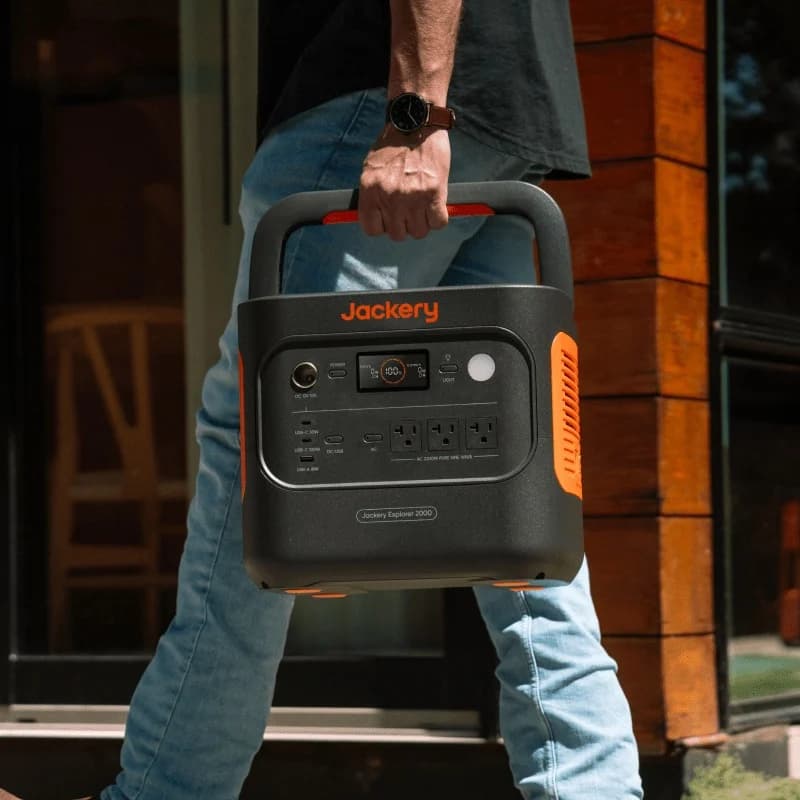
Jackery
A 2,042Wh LiFePO4 portable power station with 2,200W of AC output (4,400W surge peak), app-enabled 1.7-hour emergency charging and up to 400W of solar input.
Check package and model options
- 2,042 Wh capacity
- 2,200 W AC out
- LiFePO4
The 2000 v2 and 2000 Plus are different models: Jackery points buyers wanting expansion toward the Plus. A panel bundle does not make the v2 expandable. Jackery's direct-store options currently show sold out, so verify availability before making it your outage plan.
For automatic backup, check operating mode separately: Jackery lists 12A maximum in bypass, distinct from its battery-mode output. Settle the conflicting peak claims above before treating this as a compressor-starting solution.
Best for more stored energy: EcoFlow DELTA Pro 3
With 4,096Wh and 4,000W total continuous output, DELTA Pro 3 is our energy-first choice when the smaller stations miss your runtime budget. Its manual specifies approximately 113.54 lb, so plan where it will stay before buying.
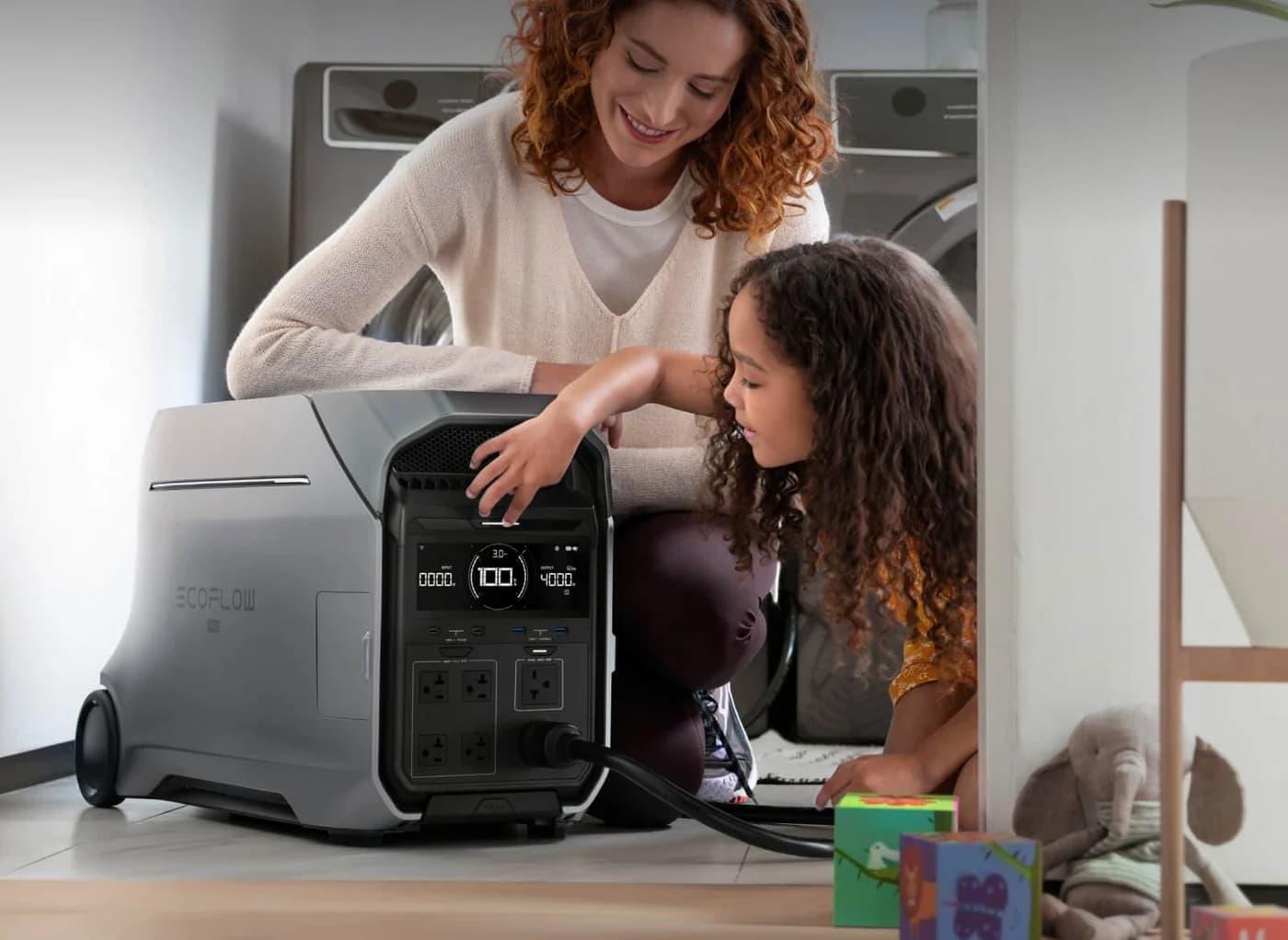
EcoFlow
A 4,096Wh LFP home-backup power station with 4,000W of 120V/240V output (8,000W surge), 2,600W of dual solar input and expansion to 12kWh per unit, listed by EcoFlow as UL 9540 certificated.
Check package and model options
- 4,096 Wh capacity
- 4,000 W AC out
- LiFePO4
The total inverter rating is not the allowance per socket. The US manual lists ordinary 120V, 20A NEMA 5-20R outlets separately from its other sockets. Match the AC's plug and current requirements; do not buy a plug adapter to reach a bigger number.
Use normal rated output for selection. EcoFlow says X-Boost can leave voltage-protected devices unable to operate because of low voltage; it does not establish compressor compatibility. The manual also warns that intermittent air-conditioner loads can trigger AC timeout: review that setting in the app before relying on backup.
Buying guide: fill in the load worksheet
GE's generator guidance requires the right voltage, frequency and power, warns of compressor surge, and says it does not specifically test appliances on generators. Our comparison therefore separates documented running capability from the remaining startup check.
Read the label
Record the exact AC model, supply voltage and frequency, cooling watts, current and plug requirements.
Confirm the start
Obtain model-specific starting demand and duration; ask the station maker whether its outlet and inverter support that load alongside your other devices.
Record energy
Establish average consumption over a representative cooling period using an appliance-maker-approved measurement method.
Budget the outage
Apply usable-energy and station-overhead assumptions, then choose a recharge route and approved connection.
The P3 Kill A Watt P4400 records cumulative kWh and elapsed time, with a 15A maximum current rating. It is not a blanket recommendation to insert a meter into either AC's cord. Both GE manuals prohibit adapter plugs, extension cords, surge protectors and multi-outlet adapters and require a properly grounded individual outlet. Obtain approval for any inline meter or battery connection; otherwise ask for manufacturer-supported consumption data or professional measurement. GE advertises energy reports for the PHNT10CC; check whether their units and reporting period suit the worksheet. The P4400's documented watt display does not establish an inrush-capture capability.
For an approved energy log, average W = kWh used × 1,000 ÷ elapsed hours. Include compressor-off periods and fan operation. Use a representative hot period for your intended cooling setting; do not size an outage battery from a brief low-load reading. Keep the running and startup checks separate from that average.
Estimate runtime, including losses and overhead
Use estimated hours = nominal Wh × usable fraction ÷ (average appliance W + station overhead W). BLUETTI's published runtime equation explicitly includes discharge allowance, inverter efficiency and self-consumption.
Estimates are rounded to about a quarter-hour. For the worksheet below, we assume 80% usable energy and 10W station overhead across all picks. These are our planning assumptions, not measured efficiencies or idle-draw specifications for these stations; actual results depend on settings, battery condition, temperature and load.
695W throughout: fixed-unit rated-input scenario
- Anker, 2,048Wh
- About 2¼ hours
- Jackery, 2,042Wh
- About 2¼ hours
- EcoFlow, 4,096Wh
- About 4¾ hours
900W throughout: inverter rated-input scenario
- Anker, 2,048Wh
- About 1¾ hours
- Jackery, 2,042Wh
- About 1¾ hours
- EcoFlow, 4,096Wh
- About 3½ hours
300W average: illustrative energy-log scenario
- Anker, 2,048Wh
- About 5¼ hours
- Jackery, 2,042Wh
- About 5¼ hours
- EcoFlow, 4,096Wh
- About 10½ hours
Full comparison table
Swipe to compare. Row labels stay visible.
| Assumed average AC load | Anker, 2,048Wh | Jackery, 2,042Wh | EcoFlow, 4,096Wh |
|---|---|---|---|
| 695W throughout: fixed-unit rated-input scenario | About 2¼ hours | About 2¼ hours | About 4¾ hours |
| 900W throughout: inverter rated-input scenario | About 1¾ hours | About 1¾ hours | About 3½ hours |
| 300W average: illustrative energy-log scenario | About 5¼ hours | About 5¼ hours | About 10½ hours |
Scroll horizontally to see every column
| Assumed average AC load | Anker, 2,048Wh | Jackery, 2,042Wh | EcoFlow, 4,096Wh |
|---|---|---|---|
| 695W throughout: fixed-unit rated-input scenario | About 2¼ hours | About 2¼ hours | About 4¾ hours |
| 900W throughout: inverter rated-input scenario | About 1¾ hours | About 1¾ hours | About 3½ hours |
| 300W average: illustrative energy-log scenario | About 5¼ hours | About 5¼ hours | About 10½ hours |
Example arithmetic: 2,048 × 80% ÷ (900 + 10) ≈ 1¾ hours. The low-load row is a hypothetical average, not a claim that either reference AC will average 300W. A fan-only interval still consumes energy; an inverter's reduced-power operation is not necessarily an off interval.
For an illustrative eight-hour target at that 300W average, storage required is 8 × (300 + 10) ÷ 80%, or just over three kilowatt-hours nominal. The base Anker and Jackery fall short under these assumptions; the EcoFlow or the Anker with the documented expansion battery clears the energy calculation. That does not clear the startup or connection checks.
Complete the purchase and check the next recharge
Choose the exact US station and package, its charging equipment, any approved expansion battery, and the permitted appliance connection. Anker's standalone box includes an AC charging cable; its expansion battery includes a battery-to-host cable. Verify panel model, quantity and solar cable in a solar kit. For the electrical match, check panel open-circuit voltage, current and connector against the station manual; see our portable solar panel guide.
Panel ratings are not guaranteed harvest: EcoFlow identifies weather, panel angle and temperature as influences on solar charging. Do not assume a panel will both run the AC and refill the battery; compare incoming power with the ongoing load and allow for losses.
If the appliance cord cannot reach an approved outlet without an extension, or the grounding requirements cannot be established, pause the purchase. If your cooling needs 240V or a house connection, move to home backup. Home wiring integration needs a licensed electrician and a permit where required; start with our home battery backup guide. For rooftop RV cooling, use our separate RV power station guide.
How we choose
We compare manufacturer specifications and exact-model manuals, checking electrical input, inverter output, storage, recharge inputs and connection limits. GE's support pages identify the manual links; the downloadable manuals cover the model families named above. The GE specification tables and EcoFlow manual content were also checked in page scripts. This is document research; no AC-and-station pairing here has been physically evaluated by thisWATT. Unpublished startup data and conflicting maker claims remain explicit limits.
Verdict
Start with Anker C2000 Gen 2 for a window-unit shortlist, Jackery 2000 v2 for the lighter carry if available, and DELTA Pro 3 when more stored energy matters. Buy only after the running, startup, energy and connection checks all fit. Compare the wider trade-offs in our power station comparison.
Our picks at a glance
- 1
Choose for: More stored energy with an option to add a battery.
Limit: Expansion stops at one extra battery, for 4,096 Wh total.
- 2
Choose for: 2,042 Wh and 2,200 W continuous output at about 39.5 lb.
Limit: Not expandable; solar input tops out at 400 W and there are three AC outlets.
- 3
Choose for: Expandable storage with a choice of appliance or installed circuit backup.
Limit: It cannot pair with DELTA Pro Ultra; circuit backup requires compatible connection hardware and an electrician.
Frequently asked questions
How many watts does an 8,000 BTU window air conditioner use?
GE specifies 695W cooling input for the AHEK08AC, an 8,000 BTU window unit. That is one exact model, not a wattage rule for every air conditioner of that cooling capacity. Read your own electrical rating label, then obtain its starting requirement separately. The running-watt figure does not establish the battery inverter's ability to start the compressor.
Will a 2,000W power station run a window air conditioner?
It is a candidate only if your unit's running load, compressor starting demand, outlet rating and connection requirements all fit. Both documented AC examples have rated cooling inputs below 2,000W, but their reviewed documents do not supply model-specific starting watts. Also distinguish output from storage: a large inverter does not by itself provide enough watt-hours for the cooling period you want.
Does an inverter window AC need less starting power?
Do not turn the inverter label into a guaranteed starting-watt figure. GE identifies the PHNT10CC as an inverter model and publishes 900W cooling input, but the reviewed specifications and manual do not establish its startup watts or surge duration. Obtain those requirements for the exact model and compare them with the station's supported surge, voltage and outlet limits before buying.
Can I run a window AC from a battery all night?
Possibly, after checking startup and connection compatibility, but capacity must cover the average electrical load across the whole night. Our illustrative eight-hour worksheet at 300W average load, 10W station overhead and an assumed 80% usable-energy allowance requires just over three kilowatt-hours of nominal storage. Those are planning assumptions, not measured consumption or a cooling-runtime promise for your room.
Related guides
Comparison · Portable Power Stations
Anker SOLIX C2000 Gen 2 vs Jackery Explorer 2000 v2: Which to Buy?
Compare Anker C2000 Gen 2 and Jackery 2000 v2 for fridge backup, carrying, expansion and solar. Get runtime estimates, complete kit checks and buying picks.
Comparison · Portable Power Stations
Anker SOLIX C300X vs BLUETTI Elite 30 V2: Which Small Station?
Choose C300X or Elite 30 V2 for laptops, lights and small AC loads: compare USB-C sharing, runtime estimates, solar cables, model aliases and gift return traps.
Comparison · Portable Power Stations
AFERIY P280 vs Anker SOLIX C2000 Gen 2: Which Backup Kit Fits?
Compare the US AFERIY P280 and Anker C2000 Gen 2 for fridge backup: matching battery kits, runtime estimates, outlet limits, recharge needs and warranty gaps.