

Explainer
How Many Watts Does a House Use? Size Your Essential Backup
Separate household energy use from running watts, motor starts and outage hours. Build an essential-loads worksheet and choose a home backup battery that fits.
By thisWATT EditorialUpdated November 3, 20269 min read3 picks
On this page · Quick picks: match the job before the battery
A house averages roughly 1,200W using EIA's household illustration of about 10,500kWh per year, but that average cannot size home backup power. For readers backing up a fridge, internet, lights and charging, the Anker SOLIX C2000 Gen 2 is our starting pick after those loads pass the worksheet below. Choose the EcoFlow DELTA Pro 3 when the actual load needs 240V; consider the Anker SOLIX F3800 Plus when simultaneous demand calls for more output.
Quick picks: match the job before the battery
These are standalone US stations. Capacities and output limits below are manufacturer specifications, not measured results. Solar figures are input ceilings, not expected generation.
Compare specifications and all conditions
Selected plug-in essentials
- Pick
- Anker SOLIX C2000 Gen 2
- Capacity (Wh)
- 2,048
- Continuous AC output (W)
- 2,400
All specifications
- US output voltage
- 120V
- Maximum solar input (W)
- 800
A necessary 240V load
- Pick
- EcoFlow DELTA Pro 3
- Capacity (Wh)
- 4,096
- Continuous AC output (W)
- 4,000
All specifications
- US output voltage
- 120V/240V on battery
- Maximum solar input (W)
- 2,600
Higher simultaneous demand
- Pick
- Anker SOLIX F3800 Plus
- Capacity (Wh)
- 3,840
- Continuous AC output (W)
- 6,000
All specifications
- US output voltage
- 120V/240V on battery
- Maximum solar input (W)
- 3,200
Full comparison table
Swipe to compare. Row labels stay visible.
| Your requirement | Pick | Capacity (Wh) | Continuous AC output (W) | US output voltage | Maximum solar input (W) |
|---|---|---|---|---|---|
| Selected plug-in essentials | Anker SOLIX C2000 Gen 2 | 2,048 | 2,400 | 120V | 800 |
| A necessary 240V load | EcoFlow DELTA Pro 3 | 4,096 | 4,000 | 120V/240V on battery | 2,600 |
| Higher simultaneous demand | Anker SOLIX F3800 Plus | 3,840 | 6,000 | 120V/240V on battery | 3,200 |
Scroll horizontally to see every column
| Your requirement | Pick | Capacity (Wh) | Continuous AC output (W) | US output voltage | Maximum solar input (W) |
|---|---|---|---|---|---|
| Selected plug-in essentials | Anker SOLIX C2000 Gen 2 | 2,048 | 2,400 | 120V | 800 |
| A necessary 240V load | EcoFlow DELTA Pro 3 | 4,096 | 4,000 | 120V/240V on battery | 2,600 |
| Higher simultaneous demand | Anker SOLIX F3800 Plus | 3,840 | 6,000 | 120V/240V on battery | 3,200 |
Sources: C2000 Gen 2 specifications, DELTA Pro 3 US manual and solar specification, F3800 Plus specifications.
Best starting point for plug-in essentials: Anker SOLIX C2000 Gen 2
Its 2,048Wh battery and 2,400W continuous output cover the example's calculated energy and running demand on paper; Anker also specifies 4,000W peak output. That makes it a sensible candidate for a measured essentials list, rather than a recommendation based on national household consumption.

Anker SOLIX
A 2,048Wh LiFePO4 power station with 2,400W of AC output (4,000W peak), a TT-30R RV outlet, 1,800W wall charging, 800W of solar input and expansion to 4kWh with one BP2000 (Gen 2) battery.
Check package and model options
- 2,048 Wh capacity
- 2,400 W AC out
- LiFePO4
Check the variant: the standalone station and BP2000 Gen 2 expansion bundle are different purchases. Anker lists expansion to about 4kWh; a solar-panel bundle instead adds a recharge path. This US station lists 120V AC outputs, so reject it for a required 240V appliance. Anker's product page flags delayed dispatch for new orders; verify the order-specific timing if backup is urgent.
Best step up for a 240V requirement: EcoFlow DELTA Pro 3
The US manual specifies 4,096Wh and, while discharging, 4,000W continuous with 8,000W surge at 120V/240V. Choose it for a verified voltage or energy requirement. Neither that surge figure nor the model name proves that a particular pump or air conditioner will start.
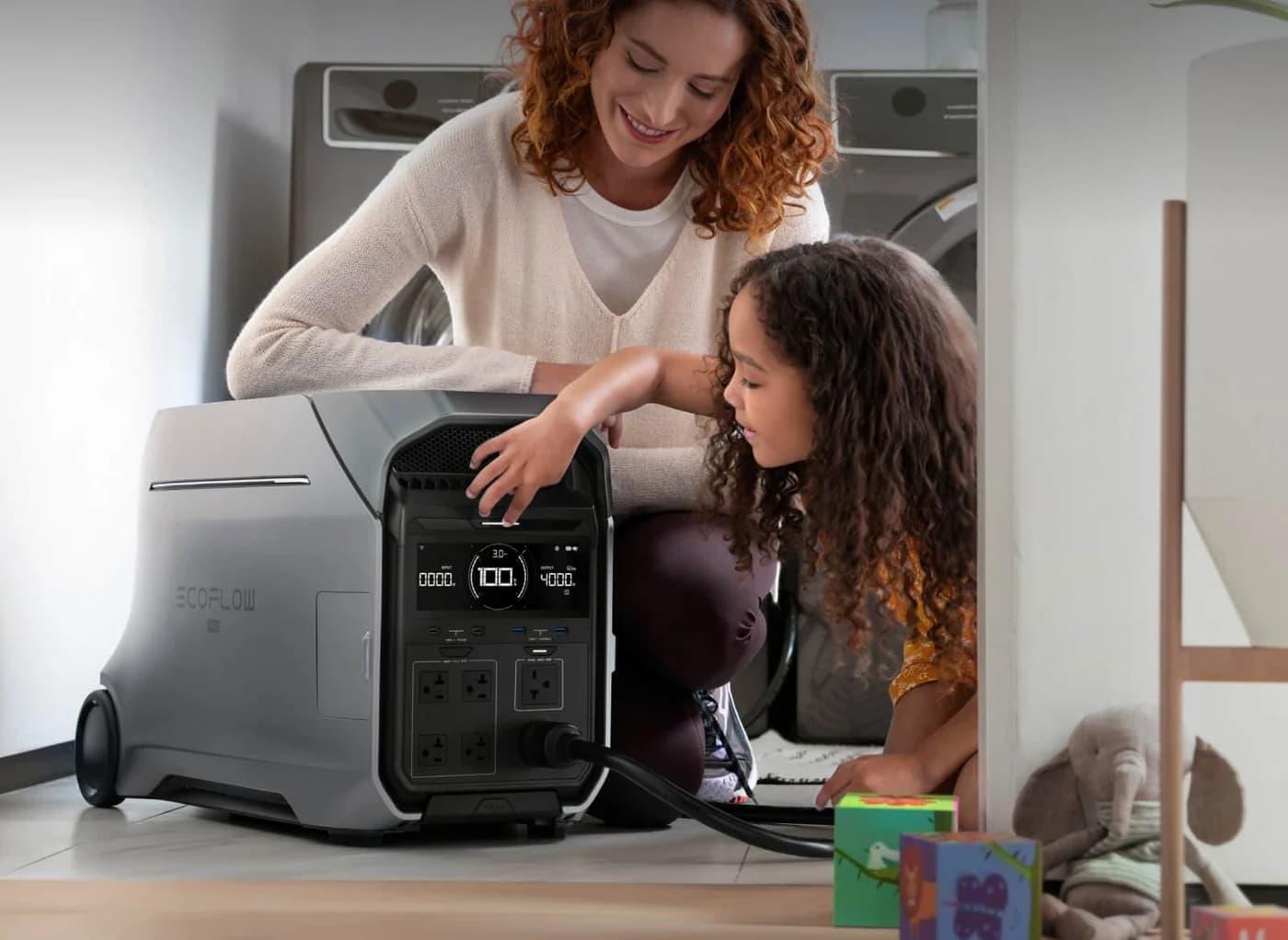
EcoFlow
A 4,096Wh LFP home-backup power station with 4,000W of 120V/240V output (8,000W surge), 2,600W of dual solar input and expansion to 12kWh per unit, listed by EcoFlow as UL 9540 certificated.
Check package and model options
- 4,096 Wh capacity
- 4,000 W AC out
- LiFePO4
Check the variant: the station supports up to two extra batteries; an extra battery alone is not the standalone power station. A home-panel package adds connection equipment. For simultaneous charging and output, check the exact port and mode: the US manual's bypass row lists 100–120V, so do not assume battery-mode 240V availability while charging. Compare complete configurations in DELTA Pro 3 vs F3800 Plus.
Source conflict: EcoFlow's X-Fusion charging copy says both 3,600W and 4,000W on its product page. Our comparison uses the US manual's battery-discharge rating.
For higher simultaneous demand: Anker SOLIX F3800 Plus
Anker specifies 6,000W total output and 3,840Wh storage. Compared with the DELTA Pro 3, it offers more continuous watts but less nominal energy: choose it because your simultaneous load needs that output, not because you expect a longer outage runtime.
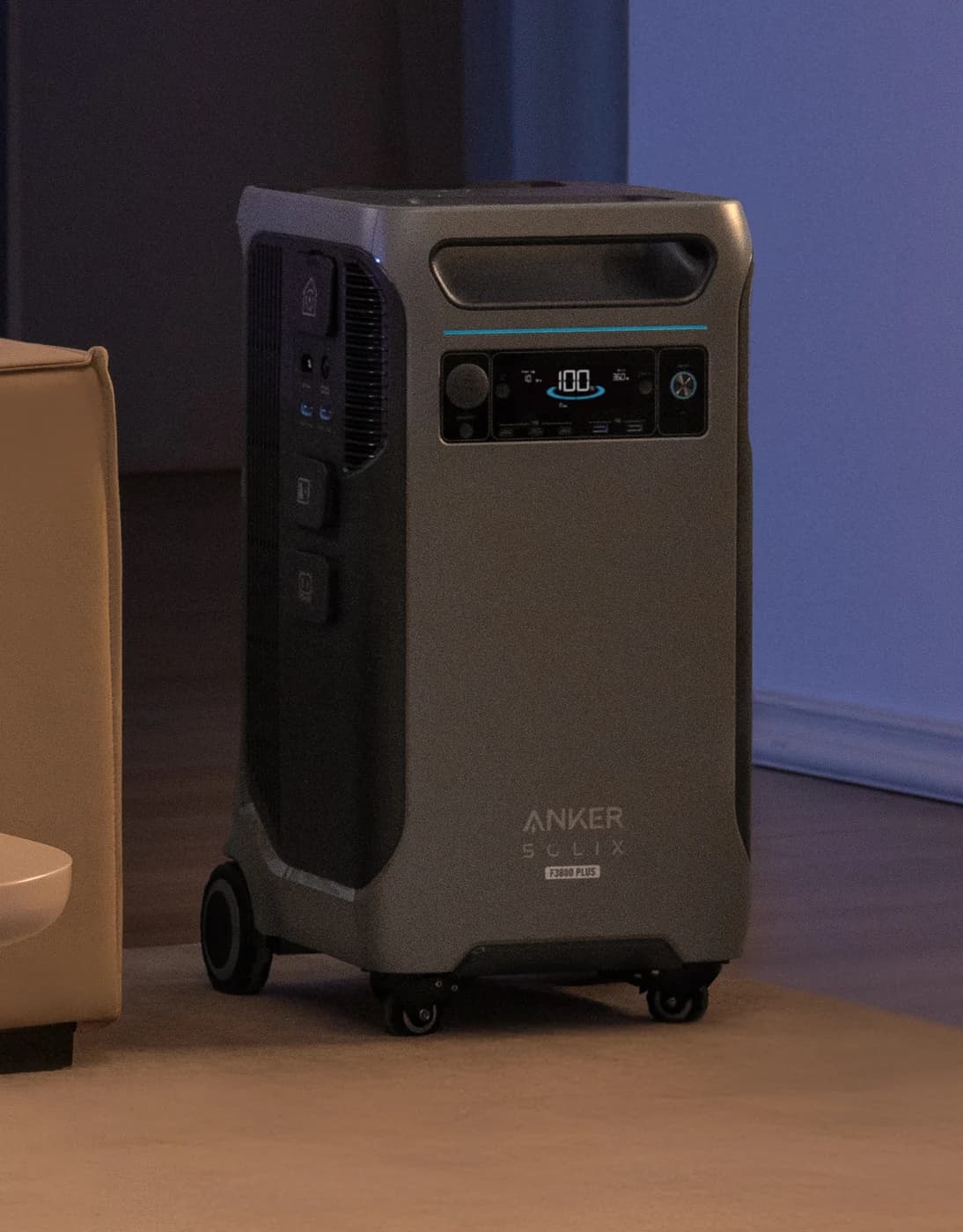
Anker SOLIX
A 3,840Wh LFP home-backup power station on wheels with 6,000W of 120V/240V output, up to 3,200W of solar input, a 6,000W generator/HPP bypass port and expansion with up to six BP3800 batteries.
Check package and model options
- 3,840 Wh capacity
- 6,000 W AC out
- LiFePO4
Check the variant: the older F3800 has different inputs; Anker's comparison lists 2,400W solar input for that model versus 3,200W for the Plus, and generator bypass only for the Plus. A BP3800 expansion package, solar kit and Smart Home Power Kit add different equipment. Both Anker stores say 240V output is unavailable during charging through the standard 120V AC input.
Availability conflict: the Anker store shows in stock, while the SOLIX store shows sold out. Confirm the selected package's availability before ordering.
Read the bill without turning it into an inverter rating
EIA distinguishes watts from watt-hours: watts describe power at a moment, while Wh describe energy over time. One kWh equals 1,000Wh.
The opening average is calculated as 10,500 × 1,000 ÷ 365 ÷ 24 ≈ 1,200W. EIA's illustration appears on a page updated in 2023; it is context, not a current-year peak-demand measurement. Your bill gives a better starting point for your own energy use:
Average watts = billing-period kWh × 1,000 ÷ billing days ÷ 24.
That still cannot reveal a compressor's brief start. If you have rooftop solar, billing purchases may also understate total household consumption, as EIA explains. Use appliance measurements and, where available, utility interval data to refine the plan. Square footage alone does not determine the loads you want to preserve.
Build an essential-loads worksheet
Write down what must work through the outage, then separate the power check from the energy calculation. Generac's sizing guidance likewise starts with essential appliances, their nameplate data and motor starts.
Choose the outage goal
List essentials and decide how long each must operate.
Check simultaneous demand
Add running watts and evaluate motor starting events separately.
Calculate energy
Multiply each load's watts by its active hours, then allow for losses and reserve.
Check replenishment and connection
Confirm a realistic recharge source and have circuit connections assessed professionally.
Copy this blank worksheet for each appliance or group. Mark unknown starting demand as unknown, not zero.
______
- Plug-in or hardwired; voltage
- ______
- Running W
- ______
- Total starting W or additional starting W?
- ______
All specifications
- Active hours during outage
- ______
- Energy: W × hours = Wh
- ______
______
- Plug-in or hardwired; voltage
- ______
- Running W
- ______
- Total starting W or additional starting W?
- ______
All specifications
- Active hours during outage
- ______
- Energy: W × hours = Wh
- ______
______
- Plug-in or hardwired; voltage
- ______
- Running W
- ______
- Total starting W or additional starting W?
- ______
All specifications
- Active hours during outage
- ______
- Energy: W × hours = Wh
- ______
Full comparison table
Swipe to compare. Row labels stay visible.
| Load and priority | Plug-in or hardwired; voltage | Running W | Total starting W or additional starting W? | Active hours during outage | Energy: W × hours = Wh |
|---|---|---|---|---|---|
| ______ | ______ | ______ | ______ | ______ | ______ |
| ______ | ______ | ______ | ______ | ______ | ______ |
| ______ | ______ | ______ | ______ | ______ | ______ |
Scroll horizontally to see every column
| Load and priority | Plug-in or hardwired; voltage | Running W | Total starting W or additional starting W? | Active hours during outage | Energy: W × hours = Wh |
|---|---|---|---|---|---|
| ______ | ______ | ______ | ______ | ______ | ______ |
| ______ | ______ | ______ | ______ | ______ | ______ |
| ______ | ______ | ______ | ______ | ______ | ______ |
Measure energy for cycling loads. For a suitable plug-in appliance, the P3 Kill A Watt P4400 displays watts and cumulative kWh. Record consumption over a representative day, including normal use, then divide the recorded Wh by elapsed hours for average watts. Keep the compressor's running watts separately for the inverter check; do not multiply those watts by every elapsed outage hour unless it actually runs continuously.
P3 specifies 115 VAC operating voltage, 125 VAC maximum, 15A maximum and 1,875 VA maximum. Stay within every limit; it is unsuitable for 240V loads. Obtain motor starting requirements from the appliance maker or a qualified professional rather than treating a steady meter display as proof of startup demand. For refrigeration detail, use our fridge measurement guide.
Worked example: essentials through a twelve-hour outage
Every appliance wattage, operating time and starting demand in this example is an illustrative assumption, not a measurement or a specification for your equipment. Assume no recharge during the outage and a fully charged station. Use EIA's energy relationship to calculate each row.
Refrigerator compressor
- Running power (W)
- 200
- Active time within the outage (hours)
- 4
- Calculated energy (Wh)
- 800
Router and modem together
- Running power (W)
- 20
- Active time within the outage (hours)
- 12
- Calculated energy (Wh)
- 240
Selected lights together
- Running power (W)
- 20
- Active time within the outage (hours)
- 6
- Calculated energy (Wh)
- 120
Phone charging together
- Running power (W)
- 20
- Active time within the outage (hours)
- 2
- Calculated energy (Wh)
- 40
Total energy
- Running power (W)
- —
- Active time within the outage (hours)
- —
- Calculated energy (Wh)
- 1,200
Full comparison table
Swipe to compare. Row labels stay visible.
| Assumed load | Running power (W) | Active time within the outage (hours) | Calculated energy (Wh) |
|---|---|---|---|
| Refrigerator compressor | 200 | 4 | 800 |
| Router and modem together | 20 | 12 | 240 |
| Selected lights together | 20 | 6 | 120 |
| Phone charging together | 20 | 2 | 40 |
| Total energy | — | — | 1,200 |
Scroll horizontally to see every column
| Assumed load | Running power (W) | Active time within the outage (hours) | Calculated energy (Wh) |
|---|---|---|---|
| Refrigerator compressor | 200 | 4 | 800 |
| Router and modem together | 20 | 12 | 240 |
| Selected lights together | 20 | 6 | 120 |
| Phone charging together | 20 | 2 | 40 |
| Total energy | — | — | 1,200 |
The fridge assumption is four compressor-on hours within twelve elapsed hours. Whirlpool notes that warm rooms and door openings can extend operation; replace the assumed duty cycle with your recorded consumption. Keep any freezer, sump pump or furnace blower as a separate row rather than silently treating it as part of the fridge.
Running-power check: 200 + 20 + 20 + 20 = 260W if all listed loads operate together.
Starting check: assume the fridge needs 1,000W total while starting. The event is 1,000W plus 60W for the other loads, not the running total plus another full fridge-start allowance. If the appliance maker instead gives additional starting watts, add those to the running total. Check the inverter's permitted surge duration and actual motor compatibility; avoid assuming all motors start separately after an outage.
Energy check: 800 + 240 + 120 + 40 = 1,200Wh. We use Anker's general runtime heuristic, which applies a 0.8 factor for approximate conversion losses. This is a planning assumption, not a measured usable-capacity rating for these picks:
Nominal capacity starting point (Wh) = 1,200 ÷ 0.8 = 1,500. Add reserve for uncertainty, battery condition, temperature and station consumption; low loads can make idle consumption particularly consequential.
- 260 WExample simultaneous running demand
- 1,200 WhExample energy through the outage
- 1,500Nominal capacity in Wh before extra reserve
For the C2000 Gen 2, the same simplified assumptions give average load = 1,200Wh ÷ 12 = 100W; estimated hours = 2,048Wh × 0.8 ÷ 100W ≈ 16. That estimate explains the pick's fit for this example, without promising your fridge or household the same runtime. Recalculate your own plan with the watt and runtime calculator.
What changes with heating, cooking or other heavy loads?
Suppose you add an assumed 1,500W electric heater for eight hours. That alone consumes 1,500 × 8 = 12,000 watt-hours, ten times the example's essential energy, before losses. The combined calculation becomes nominal capacity (Wh) = (1,200 + 12,000) ÷ 0.8 before reserve, exceeding every standalone battery here. More inverter watts cannot make its energy last longer.
A cooking appliance used briefly may add less energy, but its input power still joins the simultaneous load. Check electrical input on the label rather than treating a microwave's cooking-output figure as its consumption; Panasonic lists those separately. Keep furnace fans as their own worksheet row. For central AC, well pumps and other necessary hardwired equipment, obtain running, starting and voltage requirements before selecting a system; see our home backup guide.
Buy the capacity, output and recharge path together
For an extended outage, list how much energy you must replace each day and where it will come from. The table's solar ceilings require a compatible array and suitable conditions; panel wattage alone does not establish charging energy. EcoFlow's manual specifically warns that panel open-circuit voltage changes with temperature and must stay within the receiving input's limits. Follow the maker's compatibility guidance rather than choosing by matching plugs.
Extra batteries add storage. A solar kit adds replenishment equipment. Home connection equipment adds access to selected circuits. Check the exact included equipment and charging/output restrictions before comparing complete kits.
- Yes: Running demand fits the station and the individual outlets
- Yes: Actual motor starts and their duration have been checked
- Yes: Required voltage is available in the intended operating mode
- Yes: Energy covers the outage goal with an explicit reserve
- Partly: Solar replenishment depends on the array and conditions
- No: A household average used as the sole purchase criterion
Bring the completed worksheet to that electrician: appliance labels, essential versus optional loads, desired outage hours, starting-demand uncertainties, required voltage, proposed recharge method and the exact station configuration. Ask them to confirm circuit selection, isolation equipment, outlet limits and the required permits. This worksheet supplies planning inputs, not installation instructions.
How we choose
We compare official US specifications and manuals against the job: continuous output, motor starts, voltage, nominal energy, expansion and recharge restrictions. The arithmetic is transparent; the appliance example is hypothetical. These recommendations are based on published specifications, not physical product testing. Unconfirmed motor starts remain an open requirement rather than an assumed pass.
Verdict
Start with the worksheet, then shortlist the C2000 Gen 2 for plug-in essentials. Move to the DELTA Pro 3 when voltage or energy requires it, or the F3800 Plus for greater simultaneous output after checking availability and charging restrictions. For fridge-led shopping, continue to battery backups for refrigerators; for system packages, use the complete-kit comparison.
Our picks at a glance
- 1
Choose for: More stored energy with an option to add a battery.
Limit: Expansion stops at one extra battery, for 4,096 Wh total.
- 2
Choose for: Expandable storage with a choice of appliance or installed circuit backup.
Limit: It cannot pair with DELTA Pro Ultra; circuit backup requires compatible connection hardware and an electrician.
- 3
Choose for: A larger backup system with solar and generator input options.
Limit: 240 V output is unavailable while charging from a 120 V outlet; no surge rating is published in the cited specs.
Frequently asked questions
How many watts does a house use on average?
EIA's household illustration of about 10,500kWh annually converts to roughly 1,200W averaged across a year. That is an energy average, not the demand when several appliances run together. For backup, add the running watts of the loads you actually need, check motor starting demand separately, and calculate the energy needed over your chosen outage duration.
How many watts does a house use per hour?
Watts describe power at a moment; watt-hours describe energy over time. A steady 1,000W load uses 1,000Wh, or one kWh, in an hour. Your household's demand changes as equipment switches on and off, so an hourly energy total is an average over that interval, not proof that a battery can cover every brief peak.
Will a 2,000W power station run a house?
It may run a selected collection of appliances whose combined running demand stays within that rating, provided it also meets their starting demand, voltage and outlet requirements. It cannot be selected from the house's annual average alone. Separately check battery capacity in Wh and the energy required through the outage. A connection to household circuits needs professionally installed isolation equipment.
What size battery do I need for the essentials overnight?
In our illustrative twelve-hour plan, selected appliances consume 1,200Wh. Applying Anker's general 0.8 runtime heuristic gives a nominal-capacity starting point of 1,500 watt-hours, before extra reserve. These are planning calculations, not measured appliance consumption or guaranteed runtime. Replace the example with your own energy readings, and check continuous watts and motor starts before choosing a station.
Related guides
Comparison · Home Backup Batteries
Goal Zero Yeti PRO 4000 vs EcoFlow DELTA Pro 3: Complete Systems
Compare Yeti PRO 4000 and DELTA Pro 3 by voltage, batteries, solar and home connection kits. Choose the complete backup system that fits your loads and space.
Comparison · Home Backup Batteries
BLUETTI Apex 300 vs EcoFlow DELTA Pro 3: Essential Backup Compared
Choose BLUETTI Apex 300 or EcoFlow DELTA Pro 3 for essential backup with matched battery kits, outlet limits, runtime estimates and home connection checks.
Comparison · Home Backup Batteries
EcoFlow DELTA Pro 3 vs Anker SOLIX F3800 Plus: Complete Backup Kits
Choose the right EcoFlow or Anker backup kit with matched battery and panel lists, overnight energy estimates, charging restrictions and checks before you buy.