

Comparison
Goal Zero Yeti PRO 4000 vs EcoFlow DELTA Pro 3
Complete Systems
Compare Yeti PRO 4000 and DELTA Pro 3 by voltage, batteries, solar and home connection kits. Choose the complete backup system that fits your loads and space.
By thisWATT EditorialUpdated November 3, 20268 min read1 pick
Our recommendation: EcoFlow DELTA Pro 3
Expandable storage with a choice of appliance or installed circuit backup.
Limit: It cannot pair with DELTA Pro Ultra; circuit backup requires compatible connection hardware and an electrician.
On this page · Our picks at a glance
Our picks at a glance
- 1
Choose for: Expandable storage with a choice of appliance or installed circuit backup.
Limit: It cannot pair with DELTA Pro Ultra; circuit backup requires compatible connection hardware and an electrician.
Choose the EcoFlow DELTA Pro 3 for a new backup system needing 240V: one US station supplies 4,000W, while the Goal Zero Yeti PRO 4000 supplies 3,600W at 120V. Choose the Yeti for an existing Haven 10 setup or a 120V system you want to expand toward 20kWh with Tank PRO batteries. Those recommendations follow the EcoFlow US manual and Goal Zero US manual.
Quick picks: choose the job first
Compare specifications and all conditions
New backup with a 240V load
- Pick
- DELTA Pro 3
- Reason
- Documented split-phase output from one station
Extend an existing Haven 10 system
- Pick
- Yeti PRO 4000
- Reason
- The documented Goal Zero pairing
Maximum storage behind one inverter
- Pick
- Yeti PRO 4000
- Reason
- Up to four Tanks, versus two matching extra batteries on Pro 3
Carry upstairs regularly
- Pick
- Reconsider both
- Reason
- Each station exceeds 100 lb before expansion batteries
Full comparison table
Swipe to compare. Row labels stay visible.
| Your job | Pick | Reason |
|---|---|---|
| New backup with a 240V load | DELTA Pro 3 | Documented split-phase output from one station |
| Extend an existing Haven 10 system | Yeti PRO 4000 | The documented Goal Zero pairing |
| Maximum storage behind one inverter | Yeti PRO 4000 | Up to four Tanks, versus two matching extra batteries on Pro 3 |
| Carry upstairs regularly | Reconsider both | Each station exceeds 100 lb before expansion batteries |
Scroll horizontally to see every column
| Your job | Pick | Reason |
|---|---|---|
| New backup with a 240V load | DELTA Pro 3 | Documented split-phase output from one station |
| Extend an existing Haven 10 system | Yeti PRO 4000 | The documented Goal Zero pairing |
| Maximum storage behind one inverter | Yeti PRO 4000 | Up to four Tanks, versus two matching extra batteries on Pro 3 |
| Carry upstairs regularly | Reconsider both | Each station exceeds 100 lb before expansion batteries |
Exact US specifications
These are manufacturer figures for the standalone stations. Expansion batteries and installed connection equipment are separate purchases.
Yeti PRO 4000, SKU 37500
- Nominal battery capacity
- 3,993.6Wh
- Chemistry
- LiFePO4
- Continuous AC / surge
- 3,600W / 7,200W
All specifications
- AC output voltage
- 120V
- Relevant larger outlets
- 120V TT-30R
- Published cycle endpoint
- 4,000 to 80% original capacity, climate controlled, 0.5C discharge
- Solar input
- 3,000W high-voltage input; separate 275W low-voltage input
- Weight
- 115.74 lb; 125.73 lb with cart
- Station warranty
- 5 years
DELTA Pro 3, US version
- Nominal battery capacity
- 4,096Wh
- Chemistry
- LiFePO4
- Continuous AC / surge
- 4,000W / 8,000W
All specifications
- AC output voltage
- 120V or 120/240V
- Relevant larger outlets
- 120V TT-30R; 120/240V L14-30R; 240V 6-20R
- Published cycle endpoint
- 4,000 to 80%+ health, 0.5C charge/discharge at 25°C
- Solar input
- 2,600W combined across two inputs
- Weight
- Approximately 113.54 lb
- Station warranty
- Maker advertises 5 years
Full comparison table
Swipe to compare. Row labels stay visible.
| Specification | Yeti PRO 4000, SKU 37500 | DELTA Pro 3, US version |
|---|---|---|
| Nominal battery capacity | 3,993.6Wh | 4,096Wh |
| Continuous AC / surge | 3,600W / 7,200W | 4,000W / 8,000W |
| AC output voltage | 120V | 120V or 120/240V |
| Relevant larger outlets | 120V TT-30R | 120V TT-30R; 120/240V L14-30R; 240V 6-20R |
| Chemistry | LiFePO4 | LiFePO4 |
| Published cycle endpoint | 4,000 to 80% original capacity, climate controlled, 0.5C discharge | 4,000 to 80%+ health, 0.5C charge/discharge at 25°C |
| Solar input | 3,000W high-voltage input; separate 275W low-voltage input | 2,600W combined across two inputs |
| Weight | 115.74 lb; 125.73 lb with cart | Approximately 113.54 lb |
| Station warranty | 5 years | Maker advertises 5 years |
Scroll horizontally to see every column
| Specification | Yeti PRO 4000, SKU 37500 | DELTA Pro 3, US version |
|---|---|---|
| Nominal battery capacity | 3,993.6Wh | 4,096Wh |
| Continuous AC / surge | 3,600W / 7,200W | 4,000W / 8,000W |
| AC output voltage | 120V | 120V or 120/240V |
| Relevant larger outlets | 120V TT-30R | 120V TT-30R; 120/240V L14-30R; 240V 6-20R |
| Chemistry | LiFePO4 | LiFePO4 |
| Published cycle endpoint | 4,000 to 80% original capacity, climate controlled, 0.5C discharge | 4,000 to 80%+ health, 0.5C charge/discharge at 25°C |
| Solar input | 3,000W high-voltage input; separate 275W low-voltage input | 2,600W combined across two inputs |
| Weight | 115.74 lb; 125.73 lb with cart | Approximately 113.54 lb |
| Station warranty | 5 years | Maker advertises 5 years |
Sources: Yeti manual, Pro 3 manual and EcoFlow product information. Warranty terms and eligibility still need checking for the seller and region.
Source: Manufacturer US manuals linked above; surge and X-Boost are excluded
Best starting point for 240V backup: EcoFlow DELTA Pro 3
Buy Pro 3 when the appliance voltage decides the purchase. Its US manual documents split-phase output and a compatible home connection through Smart Home Panel 2. Check the appliance's continuous demand, motor startup requirement and outlet rating before choosing it; a surge headline alone cannot establish compatibility.
EcoFlow
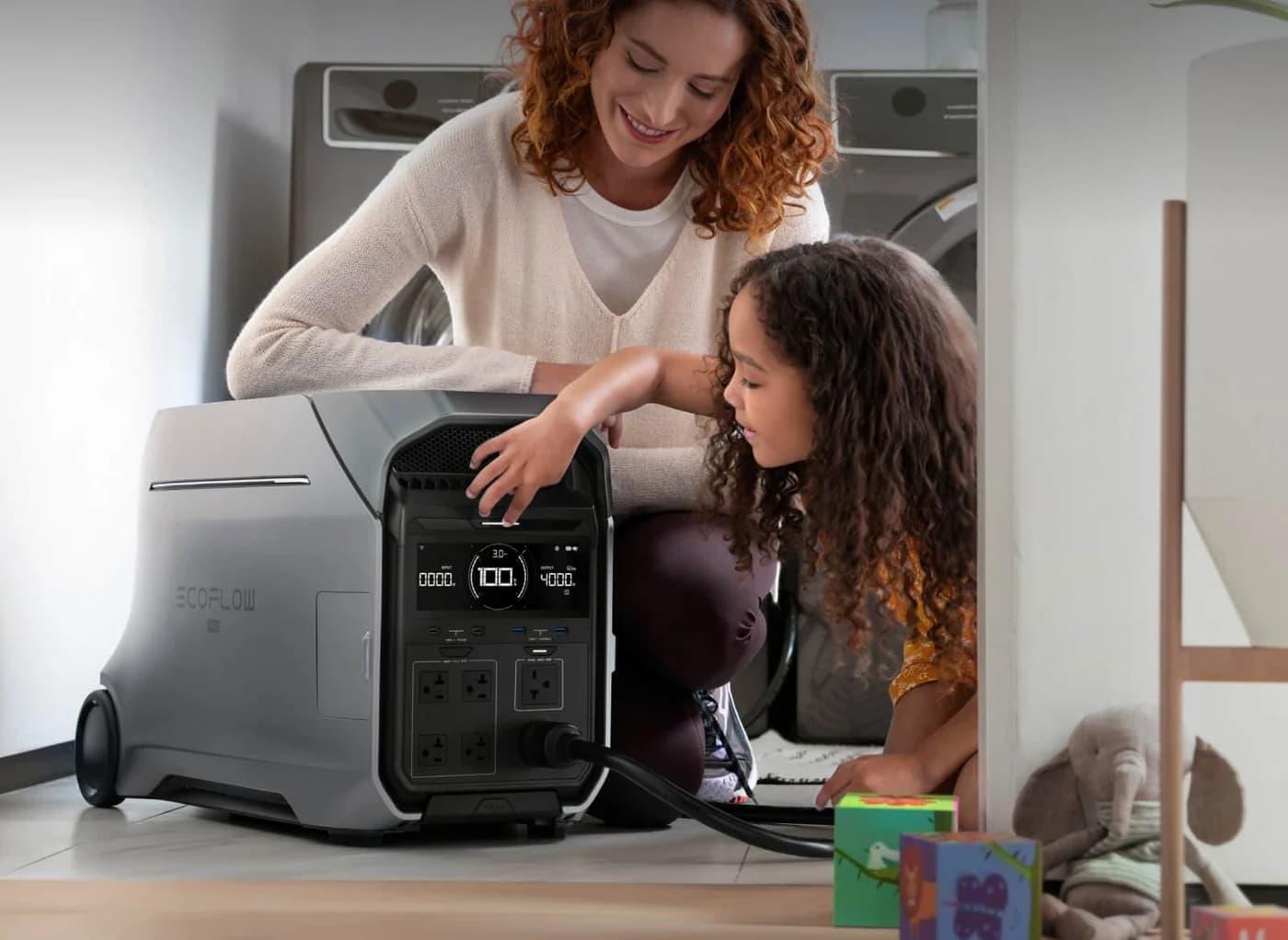
A 4,096Wh LFP home-backup power station with 4,000W of 120V/240V output (8,000W surge), 2,600W of dual solar input and expansion to 12kWh per unit, listed by EcoFlow as UL 9540 certificated.
Check package and model options
- 4,096 Wh capacity
- 4,000 W AC out
- LiFePO4
The outlet limitation matters. EcoFlow's manual says the high-voltage and low-voltage AC outlet groups cannot operate together. Selecting the high-voltage group does not leave the separate household outlets available. With the AC POWER IN/OUT connection to Panel 2, all station AC output sockets and its AC input socket are disabled. Have an installer plan mixed-voltage household loads around the supported circuit connection. These restrictions appear in the station manual and Panel 2 manual.
X-Boost's 6,000W figure is a separate appliance-support mode. EcoFlow warns that voltage-protected devices may stop because of low voltage. Use the normal continuous rating when sizing a backup system.
Best for Haven 10 owners and a larger battery stack: Yeti PRO 4000
The Yeti's advantage is storage expansion behind its existing inverter: Goal Zero documents up to four Tank PRO batteries, marketed as about 20kWh. Adding Tanks extends the energy budget; the station retains its 3,600W AC limit. This is useful when your essential loads fit that output but need longer backup.
The exact station is US SKU 37500. Its matching Tank PRO 4000 manual identifies SKU 23110, another 3,993.6Wh battery requiring the Yeti. A Tank is not an independent AC power station. The older Yeti family name is insufficient to establish accessory compatibility.
Check the Yeti PRO 4000 and its bundle contents at Goal Zero.
Compare complete orders at equivalent capacity
The capacity classes below are rounded buying labels. Both makers' manuals support the expansion pairings; batteries add capacity while the station sets AC output.
About 4kWh, direct appliances
- Goal Zero order
- Yeti PRO 4000; cart and AC charging cable included
- EcoFlow order
- DELTA Pro 3; AC charging cable included
About 8kWh
- Goal Zero order
- Yeti + one Tank PRO 4000
- EcoFlow order
- Pro 3 + one Pro 3 Smart Extra Battery
About 12kWh
- Goal Zero order
- Yeti + two Tanks
- EcoFlow order
- Pro 3 + two matching extra batteries
Largest battery configuration per station here
- Goal Zero order
- Yeti + four Tanks: about 20kWh
- EcoFlow order
- Pro 3 + two matching extra batteries: about 12kWh
Installed circuit backup
- Goal Zero order
- Add Haven 10 kit and professional installation
- EcoFlow order
- Add Smart Home Panel 2, battery connection box, Power Input/Output Cable and professional installation
Full comparison table
Swipe to compare. Row labels stay visible.
| Configuration | Goal Zero order | EcoFlow order |
|---|---|---|
| About 4kWh, direct appliances | Yeti PRO 4000; cart and AC charging cable included | DELTA Pro 3; AC charging cable included |
| About 8kWh | Yeti + one Tank PRO 4000 | Pro 3 + one Pro 3 Smart Extra Battery |
| About 12kWh | Yeti + two Tanks | Pro 3 + two matching extra batteries |
| Largest battery configuration per station here | Yeti + four Tanks: about 20kWh | Pro 3 + two matching extra batteries: about 12kWh |
| Installed circuit backup | Add Haven 10 kit and professional installation | Add Smart Home Panel 2, battery connection box, Power Input/Output Cable and professional installation |
Scroll horizontally to see every column
| Configuration | Goal Zero order | EcoFlow order |
|---|---|---|
| About 4kWh, direct appliances | Yeti PRO 4000; cart and AC charging cable included | DELTA Pro 3; AC charging cable included |
| About 8kWh | Yeti + one Tank PRO 4000 | Pro 3 + one Pro 3 Smart Extra Battery |
| About 12kWh | Yeti + two Tanks | Pro 3 + two matching extra batteries |
| Largest battery configuration per station here | Yeti + four Tanks: about 20kWh | Pro 3 + two matching extra batteries: about 12kWh |
| Installed circuit backup | Add Haven 10 kit and professional installation | Add Smart Home Panel 2, battery connection box, Power Input/Output Cable and professional installation |
The EcoFlow extra-battery manual specifies 4,096Wh and an included extra-battery cable. Keep the exact Pro 3 Smart Extra Battery name on the order. Larger EcoFlow output systems require additional stations and supported connection hardware, described in our EcoFlow backup-system comparison.
Identify loads
Record voltage, simultaneous running demand and startup requirements.
Choose storage
Compare the station plus the specified number of compatible batteries.
Complete the connection
For house circuits, obtain an electrician's quote covering the supported panel or transfer switch, cables, protection and permits where required.
Direct appliances versus installed home circuits
Direct appliance use means plugging compatible equipment into the station's supported outlets. House circuits need a licensed electrician and a permit where required. EcoFlow explicitly requires an isolation switch between backup power and the building's electrical system. See our home battery backup guide before commissioning either system.
The Haven 10 quick-start guide identifies kit SKU 70050: a manual transfer switch for ten 120V circuits, a Yeti extension cable and a 3,600W passthrough cable. It describes automatic switching in less than ten milliseconds with the passthrough arrangement and the specified switch positions. Have the electrician confirm that configuration: buying a manual transfer switch alone does not establish automatic operation. Its 7,500W switch rating does not increase the Yeti's output.
Smart Home Panel 2 has twelve load branches and a separate battery connection box. Its manual specifies a 20ms transition with EPS mode enabled; the station's standalone UPS headline describes a different connection. Panel 2 also offers app-based circuit priorities. Confirm breakers, connection cable and commissioning in the quote. EcoFlow also documents a conventional inlet-and-transfer-switch route for Pro 3; an inlet alone does not provide grid isolation.
Runtime: use the same load and assumptions
Goal Zero explains that capacity divided by average load gives theoretical hours, before conversion losses. For an illustrative planning example, assume 80% of nominal capacity reaches the appliances, including an allowance for losses and reserve, and a steady 200W average load. This allowance is our assumption, not measured efficiency.
- Yeti estimate: 3,993.6Wh × 80% ÷ 200W gives about sixteen hours.
- Pro 3 estimate: 4,096Wh × 80% ÷ 200W gives about sixteen and a half hours.
Those estimates are too close to make capacity the main buying reason. Actual runtime changes with settings, temperature, battery condition and station consumption. For cycling appliances, use average energy consumption over time; check starting demand separately. Our refrigerator energy guide explains that distinction. Extra batteries are the next purchase when output is sufficient and duration is the problem.
Solar generators and wall charging: check the whole path
A standalone station order does not include solar panels in either manual's box list. For a Yeti PRO 4000 solar generator, identify the panels, combiner or adapter and cable contents before comparing an offer with a Pro 3 solar bundle.
EcoFlow specifies 30–150V, 15A, 1,600W on high-PV and 11–60V, 20A, 1,000W on low-PV, using Solar to XT60 and Solar to XT60i cables respectively. Reaching the combined ceiling requires both inputs. The manual illustrates its 400W Portable Solar Panel and requires array open-circuit voltage to stay within the input maximum. A single panel's nameplate watts do not equal the station's charging ceiling.
Goal Zero's published limits conflict. Its product data gives high-PV as 13.3–150V, 30A; the manual's specification table gives 13.3–150V, 40A, while its solar prose says up to 145V. All specify a 3,000W high-PV maximum. Get Goal Zero's confirmation for the intended array and hardware before buying custom panels. The separate low-voltage input is 275W at 12.3–28V; do not assume both input maxima add together.
For a documented portable-panel path, the Yeti manual permits up to 600W using its 4:1 HPP Parallel Combiner Cable, SKU 98061. Higher-input arrangements require different documented combiners. Our solar-panel guide covers selection questions.
For wall charging, Yeti lists 1,800W and about three hours to full. EcoFlow lists 1,800W grid charging; its advertised 0–80% in 50 minutes requires sustained 4,000W input at 25°C, per the product-page footnote. Do not budget that time from an ordinary wall connection. Charging while supplying loads also needs checking against the chosen connection's limits.
Winter placement, listings and warranty
Both station manuals start charging at 32°F. The Yeti permits discharge down to -4°F, versus 14°F for Pro 3. Check every attached battery's limits too.
There is another Goal Zero documentation conflict: the Yeti manual gives 104°F as its upper charging/discharging limit, while product data says 125.6°F charging and 140°F discharging. Obtain confirmation before planning a hot enclosure. EcoFlow's manual gives 113°F as both upper limits. Neither a station's wheels nor its battery pack's protection rating makes an exposed or cramped installation suitable.
The Yeti manual lists UL 2743; EcoFlow's product information claims UL 9540 certification. UL Solutions explains that UL 2743 covers portable power packs and UL 9540 applies to stationary residential storage systems. Before buying an installed system, ask the electrician to verify the complete configuration's required listing and local acceptance. Both station makers state five-year warranties; check seller eligibility, registration and storage obligations before purchase.
Black Friday and Cyber Monday order checklist
- Compare station-only orders with station-only orders, then add the same storage class.
- Keep PRO 4000, Tank PRO 4000 and DELTA Pro 3 distinct from similarly named products.
- Check panel quantity, solar cables, battery cables and home-connection equipment individually.
- Include the electrician's scope and permits in an installed-system comparison; read delivery and return terms for every component.
How we choose
We compared official US manuals, manufacturer product data and supported accessory pairings. These are specification-based picks, with calculated runtime estimates. Manufacturer disagreements are disclosed where they change a buying decision. This page compares direct appliances and complete circuit-backup configurations; it cannot establish suitability for an unlisted appliance or a specific electrical installation. The disclosure explains how qualifying purchases support thisWATT.
Verdict
DELTA Pro 3 is our default for new 240V backup. Yeti PRO 4000 is the focused choice for Haven 10 owners or a larger 120V battery stack. Choose voltage and connection method first, then buy enough compatible storage for the outage you need to cover.
Frequently asked questions
Which is better: Goal Zero Yeti PRO 4000 or EcoFlow DELTA Pro 3?
For a new system needing 240V, choose DELTA Pro 3: its US specifications list 4,000W continuous output at 120V or 120/240V. Yeti PRO 4000 is a better fit for an existing Haven 10 installation or a 120V system needing more storage from one station. It accepts four Tank PRO batteries; Pro 3 accepts two matching extra batteries.
Does the Goal Zero Yeti PRO 4000 provide 240V output?
The US SKU 37500 manual specifies 120V AC output and 3,600W continuous power. Its Power+ specification also mentions 240V charging input; that is not a 240V output specification. The Haven 10 quick-start guide describes ten 120V circuits. For a 240V appliance, DELTA Pro 3 is the supported standalone option in this comparison, subject to the appliance's running and starting requirements.
What comes with a Yeti PRO 4000 solar generator?
Check the exact bundle contents. The standalone Yeti PRO 4000 manual lists the station, cart and AC charging cable, with solar input equipment sold separately. A solar order should identify the panels and required cables or combiners. Tank PRO adds storage, while Haven 10 adds a home connection; neither accessory is a solar panel.
Can either system recharge in a freezing garage?
Both station manuals specify a minimum charging temperature of 32°F. Their discharge limits differ: Yeti PRO 4000 lists a minimum of -4°F and DELTA Pro 3 lists 14°F. Being able to discharge below freezing does not establish that the battery can recharge there. Plan the station and every expansion battery's location around their own manuals.
EcoFlow DELTA Pro 3
AmazonRelated guides
Comparison · Home Backup Batteries
BLUETTI Apex 300 vs EcoFlow DELTA Pro 3: Essential Backup Compared
Choose BLUETTI Apex 300 or EcoFlow DELTA Pro 3 for essential backup with matched battery kits, outlet limits, runtime estimates and home connection checks.
Comparison · Home Backup Batteries
EcoFlow DELTA Pro 3 vs Anker SOLIX F3800 Plus: Complete Backup Kits
Choose the right EcoFlow or Anker backup kit with matched battery and panel lists, overnight energy estimates, charging restrictions and checks before you buy.
Explainer · Home Backup Batteries
How Many Watts Does a House Use? Size Your Essential Backup

Separate household energy use from running watts, motor starts and outage hours. Build an essential-loads worksheet and choose a home backup battery that fits.