

Explainer
How Many Watts Does a Freezer Use? Size Your Backup
Measure your freezer's energy use, check compressor startup separately, and compare backup sizes for chest freezers, uprights, and fridge-plus-freezer outages.
By thisWATT EditorialUpdated November 3, 20268 min read3 picks
On this page · Quick picks: measure first, then choose storage
For a concrete freezer-wattage answer, GE's documented examples average about 28 watts for a chest freezer and 50 watts for an upright across the day; these are calculated energy averages, not compressor running or starting watts. Use your own label and a plug-in meter before buying backup. For longer outages, our starting pick is the Anker SOLIX C2000 Gen 2, conditional on your startup check and required runtime; start the measurement with the P3 Kill A Watt P4400.
Quick picks: measure first, then choose storage
The P4400 is the measurement tool; the stations below supply backup. Their figures are manufacturer ratings for US standalone units, with solar panels and expansion batteries treated as separate purchases.
Compare specifications and all conditions
Anker SOLIX C2000 Gen 2
- Capacity (Wh)
- 2,048
- Continuous / surge output (W)
- 2,400 / 4,000
- Max solar input (W)
- 800
All specifications
- Choose it when…
- You want longer backup and documented expansion
EcoFlow DELTA 3 Plus
- Capacity (Wh)
- 1,024
- Continuous / surge output (W)
- 1,800 / 3,600
- Max solar input (W)
- 1,000
All specifications
- Choose it when…
- Your measured outage target fits the smaller battery
Jackery Explorer 2000 v2
- Capacity (Wh)
- 2,042
- Continuous / surge output (W)
- 2,200 / 4,400
- Max solar input (W)
- 400
All specifications
- Choose it when…
- You prefer a lighter fixed-capacity alternative to the Anker
Full comparison table
Swipe to compare. Row labels stay visible.
| Pick | Capacity (Wh) | Continuous / surge output (W) | Max solar input (W) | Choose it when… |
|---|---|---|---|---|
| Anker SOLIX C2000 Gen 2 | 2,048 | 2,400 / 4,000 | 800 | You want longer backup and documented expansion |
| EcoFlow DELTA 3 Plus | 1,024 | 1,800 / 3,600 | 1,000 | Your measured outage target fits the smaller battery |
| Jackery Explorer 2000 v2 | 2,042 | 2,200 / 4,400 | 400 | You prefer a lighter fixed-capacity alternative to the Anker |
Scroll horizontally to see every column
| Pick | Capacity (Wh) | Continuous / surge output (W) | Max solar input (W) | Choose it when… |
|---|---|---|---|---|
| Anker SOLIX C2000 Gen 2 | 2,048 | 2,400 / 4,000 | 800 | You want longer backup and documented expansion |
| EcoFlow DELTA 3 Plus | 1,024 | 1,800 / 3,600 | 1,000 | Your measured outage target fits the smaller battery |
| Jackery Explorer 2000 v2 | 2,042 | 2,200 / 4,400 | 400 | You prefer a lighter fixed-capacity alternative to the Anker |
Sources: Anker specifications, EcoFlow US manual, and Jackery US manual. For the broader buying decision, use our refrigerator battery-backup roundup.
Chest versus upright: what the energy numbers mean
GE documents the FCM11SRWW as a 10.7-cubic-foot manual-defrost chest freezer using 245 kWh/year and the FUF17DLRWW as a 17.3-cubic-foot automatic-defrost upright using 441 kWh/year. These are examples for interpreting your freezer's documentation, not freezer purchase recommendations or an equal-size comparison. See the chest model's specifications and upright EnergyGuide.
Calculate daily Wh = annual kWh × 1,000 ÷ 365. Then average W = daily Wh ÷ 24. Applying those conversions gives the rounded averages above; EIA explains power versus energy.
- 28 wattsCalculated daily average: GE FCM11SRWW chest example
- 50 wattsCalculated daily average: GE FUF17DLRWW upright example
Chest design generally saves energy because less cold air escapes when opened, according to federal freezer buying guidance. Defrost type also matters: GE explains that frost-free uprights use automatic defrost, including a heater. A short compressor-only observation can therefore miss part of the load. Do not assign a universal defrost wattage or schedule to every upright.
Best first purchase for measurement: P3 Kill A Watt P4400
The P4400 displays active watts separately from VA and accumulates kWh and elapsed time. Its ratings are 115 VAC operating voltage, 125 VAC maximum, 15 A maximum and 1,875 VA maximum; check every limit against the appliance. VA is apparent power, not the same reading as active watts.
Use several normal days as your measurement window, extending it if you have not included the freezer's defrost behavior. Record room temperature, thermostat setting and unusual loading alongside the reading. GE's chest-freezer manual says warm food and frequent lid openings increase running, so recheck after major restocking rather than treating that period as the everyday baseline.
Identify the appliance
Record its exact model, defrost type, annual label energy and allowed room temperatures.
Measure normal operation
Use a suitably rated meter through normal compressor cycles and automatic defrost, where fitted.
Save energy and elapsed time
Write down both readings before disconnecting the P4400; power removal resets its counters.
Convert to a daily budget
Daily Wh = recorded kWh × 1,000 × 24 ÷ elapsed hours; average W = recorded kWh × 1,000 ÷ elapsed hours.
The P4400 manual specifies those displays and the reset behavior; it does not specify an inrush-capture function. Use it for energy, and obtain the freezer's starting requirement separately. The P4460 Kill A Watt EZ is a different model with built-in battery backup, per P3's page; do not assume its features apply to the P4400.
Starting watts are a separate pass/fail check
GE's freezer support guidance describes startup current as approximately twice running current, but specifically directs auxiliary-power users to the individual freezer's rating plate. That broad guidance is not a guaranteed multiplier for your compressor. If starting demand is undocumented, ask the freezer maker for compatible inverter requirements or arrange an appropriate inrush measurement.
Multiplying volts by amps gives VA; it does not establish active watts without power factor. Read the P4400's W display for energy calculations. For two appliances, allow for a compressor starting while the other runs, and consider overlapping starts when confirming inverter compatibility.
- Yes: Continuous output covers the appliances running together, including defrost demand
- Yes: Startup compatibility is confirmed separately from average energy use
- Partly: An advertised surge rating needs to match the compressor's actual starting requirement
- No: A small daily average alone proves neither startup compatibility nor runtime
Worked runtime estimates: freezer alone or with a fridge
For illustration, assume a freezer uses 600 watt-hours/day: 600 ÷ 24 = 25 watts average. Add a hypothetical fridge using 1,200 watt-hours/day: 1,200 ÷ 24 = 50 watts average, giving 75 watts combined. These are chosen worksheet inputs, not measurements or claims about typical appliances.
We use the same comparison approach as our watt and runtime calculator: estimated hours = capacity Wh × 90% × 90% ÷ (average load W + 10 W). The first allowance is depth of discharge; the second is inverter efficiency. BLUETTI's published runtime formula supplies the framework and describes about 10 W self-consumption for its own model. These assumptions are a comparison scenario, not verified performance figures for our picks.
Freezer only
- Estimated hours
- About 24
- Estimated hours
- About 47
- Average load (W)
- 25
- Arithmetic with 1,024 Wh
- 1,024 × 90% × 90% ÷ (25 + 10)
All specifications
- Arithmetic with 2,048 Wh
- 2,048 × 90% × 90% ÷ (25 + 10)
Fridge plus freezer
- Estimated hours
- About 10
- Estimated hours
- About 20
- Average load (W)
- 75
- Arithmetic with 1,024 Wh
- 1,024 × 90% × 90% ÷ (75 + 10)
All specifications
- Arithmetic with 2,048 Wh
- 2,048 × 90% × 90% ÷ (75 + 10)
Full comparison table
Swipe to compare. Row labels stay visible.
| Illustrative load | Average load (W) | Arithmetic with 1,024 Wh | Estimated hours | Arithmetic with 2,048 Wh | Estimated hours |
|---|---|---|---|---|---|
| Freezer only | 25 | 1,024 × 90% × 90% ÷ (25 + 10) | About 24 | 2,048 × 90% × 90% ÷ (25 + 10) | About 47 |
| Fridge plus freezer | 75 | 1,024 × 90% × 90% ÷ (75 + 10) | About 10 | 2,048 × 90% × 90% ÷ (75 + 10) | About 20 |
Scroll horizontally to see every column
| Illustrative load | Average load (W) | Arithmetic with 1,024 Wh | Estimated hours | Arithmetic with 2,048 Wh | Estimated hours |
|---|---|---|---|---|---|
| Freezer only | 25 | 1,024 × 90% × 90% ÷ (25 + 10) | About 24 | 2,048 × 90% × 90% ÷ (25 + 10) | About 47 |
| Fridge plus freezer | 75 | 1,024 × 90% × 90% ÷ (75 + 10) | About 10 | 2,048 × 90% × 90% ÷ (75 + 10) | About 20 |
The combined example falls short of a full day even with the larger battery. Choose more storage or recharge before depletion. Replace the worksheet loads with your readings; for the fridge, follow our refrigerator measurement guide. Include the whole fridge-freezer appliance once, rather than counting its freezer compartment again.
Best for longer backup and expansion: Anker SOLIX C2000 Gen 2
Anker lists 2,048Wh, 2,400W continuous, 4,000W peak and 800W solar input. Its documented BP2000 Gen 2 expansion adds another 2,048Wh, making 4,096Wh total. Choose it when the smaller capacity misses your target or you expect to add storage.

Anker SOLIX
A 2,048Wh LiFePO4 power station with 2,400W of AC output (4,000W peak), a TT-30R RV outlet, 1,800W wall charging, 800W of solar input and expansion to 4kWh with one BP2000 (Gen 2) battery.
Check package and model options
- 2,048 Wh capacity
- 2,400 W AC out
- LiFePO4
Anker advertises 9W idle consumption; actual runtime still depends on operating conditions. Its published maximum wall input is 1,800W. A panel bundle adds charging equipment, while a BP2000 Gen 2 bundle adds stored energy: match the accessory name to the problem you need to solve.
Anker's stores disagree on availability: the SOLIX page warns of delayed shipping while anker.com says in stock. Confirm delivery if backup is urgent.
Best smaller expandable option: EcoFlow DELTA 3 Plus
Choose the DELTA 3 Plus when 1,024Wh meets your measured target. EcoFlow specifies 1,800W continuous, 3,600W surge, 1,000W total solar input and compatible extra batteries. Its US page states a 1,500W wall input and a maker-rated full recharge in 56 minutes under its stated conditions.

EcoFlow
A 1,024Wh LiFePO4 portable power station with 1,800W of AC output, 1,500W wall charging, two 500W solar inputs and expansion to about 5kWh with EcoFlow extra batteries.
Check package and model options
- 1,024 Wh capacity
- 1,800 W AC out
- LiFePO4
The DELTA 3 and DELTA 3 Plus names matter: EcoFlow lists 500W solar input for the non-Plus version versus the Plus model's higher total. A solar-panel kit adds a recharge source; an extra-battery kit increases storage. Check which package you are ordering.
Lighter fixed-capacity alternative: Jackery Explorer 2000 v2
The US JE-2000D manual lists 2,042Wh, 2,200W continuous, 4,400W surge and 400W combined solar input. Its listed weight is 39.5 lb, below Anker's 41.7 lb. Jackery's own current comparison article instead lists the v2 at 39.4 lb; allow for that published discrepancy.
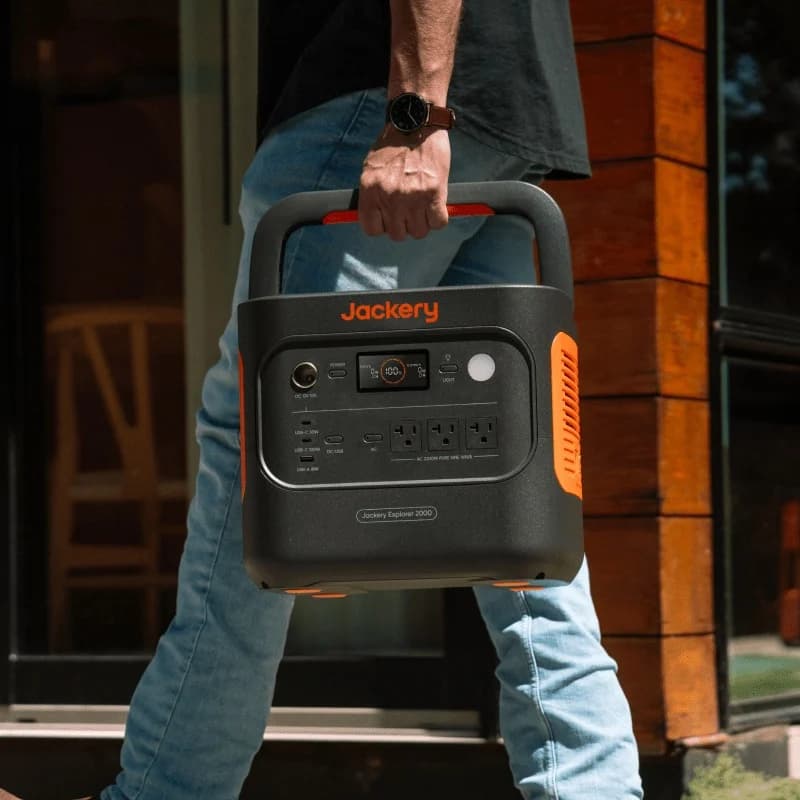
Jackery
A 2,042Wh LiFePO4 portable power station with 2,200W of AC output (4,400W surge peak), app-enabled 1.7-hour emergency charging and up to 400W of solar input.
Check package and model options
- 2,042 Wh capacity
- 2,200 W AC out
- LiFePO4
That comparison explicitly says the v2 is not expandable; the Explorer 2000 Plus and HomePower 2000 Plus v2 are different products. Pick the v2 for a fixed-capacity job, and compare its lower solar-input ceiling with your recharge plan.
Garage placement, recharge and automatic shutoff
GE documents garage-ready operation from 0°F to 110°F for the freezer examples. That is a permitted ambient range, not a promise that winter reduces consumption. Measure in the actual location and follow its ventilation requirements.
The station has separate temperature limits: Jackery permits 32°F to 113°F charging and 14°F to 113°F discharge. A freezer's garage rating therefore does not establish that its battery can recharge beside it.
Treat maximum solar watts as an input ceiling, not expected all-day production. Budget daily recharge energy to replace appliance consumption plus station losses, check panel compatibility, and identify a fallback for poor solar conditions. Use the existing calculator for revised loads and capacities.
How we choose
We compare official manuals, specification tables and government energy guidance, checked November 2, 2026. Picks follow measured-energy requirements, output compatibility, expansion and recharge options; all runtimes here are arithmetic estimates. The existing catalog's verified station records supply the product links; the unverified meter links to its maker.
Verdict
Measure the freezer with the P4400, clear the startup check, then buy the capacity your outage target requires. Choose DELTA 3 Plus for the smaller expandable option, C2000 Gen 2 for more storage and expansion, or Explorer 2000 v2 for the lighter fixed-capacity alternative. If you are protecting both a fridge and freezer, calculate them together before choosing.
Battery runtime is separate from food safety. FDA guidance says a closed full freezer holds temperature approximately 48 hours, or 24 hours if half full; use appliance thermometers and its food-safety guidance rather than adding those times to a battery estimate.
Our picks at a glance
- 1
Choose for: More stored energy with an option to add a battery.
Limit: Expansion stops at one extra battery, for 4,096 Wh total.
- 2
Choose for: 1,024 Wh of storage and 1,800 W continuous AC output in one expandable station.
Limit: The IP65 rating covers the battery pack only; the complete station is not weatherproof.
- 3
Choose for: 2,042 Wh and 2,200 W continuous output at about 39.5 lb.
Limit: Not expandable; solar input tops out at 400 W and there are three AC outlets.
Frequently asked questions
How many watts does a chest freezer use compared with an upright?
Model matters more than a generic range. The GE FCM11SRWW chest freezer lists 245 kWh/year; the FUF17DLRWW upright lists 441 kWh/year. Those convert to roughly 28 and 50 watts averaged over time, respectively. Their sizes and defrost systems differ, so this is an example comparison, not a controlled efficiency test. Running and starting requirements must be checked separately.
Will a 1,000-watt power station run a freezer?
Possibly, but output watts alone cannot answer it. Check the freezer's running and starting requirements against the station's continuous and surge specifications, then calculate runtime from watt-hours and measured average consumption. GE warns that freezers draw extra current at startup and directs auxiliary-power users to the actual appliance rating plate. A low daily average does not establish that a particular inverter will start it.
Can I run a fridge and freezer on the same battery?
Add their measured daily energy for the runtime calculation, and check their simultaneous running demand and possible overlapping starts separately. In our illustrative scenario, the freezer averages 25 watts and the fridge 50 watts, making 75 watts combined. A 2,048Wh station estimates about twenty hours with the stated loss and overhead assumptions. Choose more storage or plan a recharge if that does not cover your outage target.
Does a garage freezer need less battery in winter?
Do not assume it. Check the exact freezer's permitted ambient temperatures and measure consumption in that location. GE documents garage-ready operation between 0°F and 110°F for the examples here, but that is an operating range, not a guaranteed energy saving. The battery has separate limits: Jackery's US manual permits charging only from 32°F to 113°F, despite allowing discharge at lower temperatures.
Related guides
Comparison · Portable Power Stations
Anker SOLIX C2000 Gen 2 vs Jackery Explorer 2000 v2: Which to Buy?
Compare Anker C2000 Gen 2 and Jackery 2000 v2 for fridge backup, carrying, expansion and solar. Get runtime estimates, complete kit checks and buying picks.
Comparison · Portable Power Stations
Anker SOLIX C300X vs BLUETTI Elite 30 V2: Which Small Station?
Choose C300X or Elite 30 V2 for laptops, lights and small AC loads: compare USB-C sharing, runtime estimates, solar cables, model aliases and gift return traps.
Comparison · Portable Power Stations
AFERIY P280 vs Anker SOLIX C2000 Gen 2: Which Backup Kit Fits?
Compare the US AFERIY P280 and Anker C2000 Gen 2 for fridge backup: matching battery kits, runtime estimates, outlet limits, recharge needs and warranty gaps.