

Comparison
GRECELL T-1000 vs Jackery Explorer 1000 v2
Which Exact Model to Buy?
Compare the exact US GRECELL T-1000 and Jackery Explorer 1000 v2: real output, battery differences, charging limits, runtime estimates and bundle buying traps.
By thisWATT EditorialUpdated November 3, 20268 min read
On this page · Quick picks
Choose the Jackery Explorer 1000 v2 for frequent use or higher appliance loads: its US manual documents LiFePO4 cells, a cycle rating and 1,500W rated output. Choose the GRECELL T-1000 when carrying weight matters more: GRECELL lists 17.9 lb, 999Wh and 1,000W rated output. The shared “1000” label does not make their batteries, charging paths or appliance limits equivalent.
Quick picks
Compare specifications and all conditions
Frequent use and more AC headroom
- Our pick
- Jackery Explorer 1000 v2
- Why it fits
- Documented LiFePO4 cycle rating; higher continuous output
Carrying between car and campsite
- Our pick
- GRECELL T-1000
- Why it fits
- Lower stated station weight
Refilling during a short wall-power opportunity
- Our pick
- Jackery Explorer 1000 v2
- Why it fits
- App-enabled emergency charging; GRECELL's documented wall refill takes hours
A listing called T1000L or simply “GRECELL 1000W”
- Our pick
- Verify the model first
- Why it fits
- This guide's GRECELL specifications apply to T-1000 only
Full comparison table
Swipe to compare. Row labels stay visible.
| Your priority | Our pick | Why it fits |
|---|---|---|
| Frequent use and more AC headroom | Jackery Explorer 1000 v2 | Documented LiFePO4 cycle rating; higher continuous output |
| Carrying between car and campsite | GRECELL T-1000 | Lower stated station weight |
| Refilling during a short wall-power opportunity | Jackery Explorer 1000 v2 | App-enabled emergency charging; GRECELL's documented wall refill takes hours |
| A listing called T1000L or simply “GRECELL 1000W” | Verify the model first | This guide's GRECELL specifications apply to T-1000 only |
Scroll horizontally to see every column
| Your priority | Our pick | Why it fits |
|---|---|---|
| Frequent use and more AC headroom | Jackery Explorer 1000 v2 | Documented LiFePO4 cycle rating; higher continuous output |
| Carrying between car and campsite | GRECELL T-1000 | Lower stated station weight |
| Refilling during a short wall-power opportunity | Jackery Explorer 1000 v2 | App-enabled emergency charging; GRECELL's documented wall refill takes hours |
| A listing called T1000L or simply “GRECELL 1000W” | Verify the model first | This guide's GRECELL specifications apply to T-1000 only |
The exact models and their limits
Our GRECELL reference is the US T-1000 product listing and its GR-SE0003 manual. The Jackery reference is the US JE-1000D, identified in its official manual; that manual's cover calls it “Explorer 1000.” The identifier matters when the marketing names are similar.
GRECELL T-1000, US
- Stored energy
- 999Wh
- Battery
- NCM lithium-ion
- Published cycle endpoint
- Not stated in the cited T-1000 documents
All specifications
- AC bank
- 1,000W rated; two outlets; 2,000W peak
- AC voltage
- 100–120V, 60Hz
- USB-C
- 60W maximum
- Other outputs
- USB-A 18W; wireless 10W; car outlet; two DC barrels
- Solar/DC input
- 155W overall charging ceiling; 12–26V solar; manual says 8A max
- Stated station weight
- 17.9 lb
- Warranty
- Two-year limited warranty, accessories excluded
Jackery Explorer 1000 v2, US JE-1000D
- Stored energy
- 1,070Wh in US manual; product description says 1,024Wh
- Battery
- LiFePO4
- Published cycle endpoint
- 4,000 cycles to 70%+ capacity
All specifications
- AC bank
- 1,500W rated; three outlets; 3,000W surge
- AC voltage
- 120V, 60Hz
- USB-C
- One 30W and one 100W port
- Other outputs
- USB-A 18W; 12V/10A car outlet
- Solar/DC input
- Two DC8020 inputs; 400W combined maximum; voltage-dependent current limits
- Stated station weight
- About 23.8 lb
- Warranty
- Three years standard plus two extended, subject to eligibility and activation
Full comparison table
Swipe to compare. Row labels stay visible.
| Maker's specification | GRECELL T-1000, US | Jackery Explorer 1000 v2, US JE-1000D |
|---|---|---|
| Stored energy | 999Wh | 1,070Wh in US manual; product description says 1,024Wh |
| Battery | NCM lithium-ion | LiFePO4 |
| Published cycle endpoint | Not stated in the cited T-1000 documents | 4,000 cycles to 70%+ capacity |
| AC bank | 1,000W rated; two outlets; 2,000W peak | 1,500W rated; three outlets; 3,000W surge |
| AC voltage | 100–120V, 60Hz | 120V, 60Hz |
| USB-C | 60W maximum | One 30W and one 100W port |
| Other outputs | USB-A 18W; wireless 10W; car outlet; two DC barrels | USB-A 18W; 12V/10A car outlet |
| Solar/DC input | 155W overall charging ceiling; 12–26V solar; manual says 8A max | Two DC8020 inputs; 400W combined maximum; voltage-dependent current limits |
| Stated station weight | 17.9 lb | About 23.8 lb |
| Warranty | Two-year limited warranty, accessories excluded | Three years standard plus two extended, subject to eligibility and activation |
Scroll horizontally to see every column
| Maker's specification | GRECELL T-1000, US | Jackery Explorer 1000 v2, US JE-1000D |
|---|---|---|
| Stored energy | 999Wh | 1,070Wh in US manual; product description says 1,024Wh |
| Battery | NCM lithium-ion | LiFePO4 |
| Published cycle endpoint | Not stated in the cited T-1000 documents | 4,000 cycles to 70%+ capacity |
| AC bank | 1,000W rated; two outlets; 2,000W peak | 1,500W rated; three outlets; 3,000W surge |
| AC voltage | 100–120V, 60Hz | 120V, 60Hz |
| USB-C | 60W maximum | One 30W and one 100W port |
| Other outputs | USB-A 18W; wireless 10W; car outlet; two DC barrels | USB-A 18W; 12V/10A car outlet |
| Solar/DC input | 155W overall charging ceiling; 12–26V solar; manual says 8A max | Two DC8020 inputs; 400W combined maximum; voltage-dependent current limits |
| Stated station weight | 17.9 lb | About 23.8 lb |
| Warranty | Two-year limited warranty, accessories excluded | Three years standard plus two extended, subject to eligibility and activation |
Watts limit the load; watt-hours size the reserve. The GRECELL page's ambiguous “2 x 1000W” outlet wording does not authorize double the running load: its manual gives 1,000W rated output, and its product warning excludes devices above that. Jackery's 1,500W rating is also a shared allowance, not a separate allowance at every socket. Treat surge as a separate starting specification, never sustained output.
Source: GRECELL and Jackery US manuals linked above; these are maker ratings.
Best for frequent use: Jackery Explorer 1000 v2
The Jackery is our stronger choice when the station will work regularly: the US manual states 4,000 cycles to 70%+ capacity. That endpoint matters; it does not mean full original capacity throughout those cycles. GRECELL's cited T-1000 documents do not supply a comparable cycle count and retention endpoint, so we cannot make an equivalent longevity calculation for it.
Its higher AC rating also changes what you can consider. A hypothetical steady 1,200W appliance exceeds the T-1000's continuous limit but sits within Jackery's rated allowance, provided the total load and starting demand fit. That is a load-sizing example, not certification that a particular appliance will work.
For electronics, use the manual's 30W plus 100W USB-C specification. The product description's “Dual 100W” wording should not be read as two 100W USB-C ports. For automatic backup, the manual specifies switching within 20ms, warns that switching is not instantaneous, and requires compatibility checks for sensitive equipment.
See the Explorer 1000 v2 at Jackery
Best for carrying: GRECELL T-1000
The GRECELL is the carrying pick on the makers' stated station weights. Its 60W USB-C, 10W wireless pad and DC barrel outputs can suit a collection of smaller devices, if their individual requirements fit. The barrels are rated 12V/5A each, 10A total; count the shared limit rather than multiplying the maximum current by every connection.
Choose it with time to recharge. The included equipment is an AC power adapter, car cable and MC4-7909 solar cable, plus a manual and cable bag. A solar charging cable does not mean a solar panel is included in the standalone package.
GRECELL describes pass-through operation, but its FAQ discourages simultaneous charging and discharging to protect battery cycle life. The cited T-1000 documents do not establish a transfer time. Pass-through support alone is insufficient reason to buy it as an automatic UPS replacement.
There is a practical caveat for tiny overnight loads: the manual says output below 5W triggers hibernation after more than eight hours. Jackery also has an automatic cutoff: its default Energy Saving Mode turns outputs off after 12 hours for qualifying low loads, including AC loads at or below 25W. Check these settings before relying on either for low-draw backup.
Runtime at the same load: estimates, not promises
GRECELL publishes the estimate 999Wh × 0.85 ÷ device watts. For a transparent comparison, we apply that same 0.85 usable-energy assumption to both capacities; it is not a measured Jackery efficiency. For a steady 100W total load:
GRECELL
- Estimated runtime
- About 8.5 hours
- Arithmetic
- 999Wh × 0.85 ÷ 100W
Jackery
- Estimated runtime
- About 9.1 hours
- Arithmetic
- 1,070Wh × 0.85 ÷ 100W
Full comparison table
Swipe to compare. Row labels stay visible.
| Station | Arithmetic | Estimated runtime |
|---|---|---|
| GRECELL | 999Wh × 0.85 ÷ 100W | About 8.5 hours |
| Jackery | 1,070Wh × 0.85 ÷ 100W | About 9.1 hours |
Scroll horizontally to see every column
| Station | Arithmetic | Estimated runtime |
|---|---|---|
| GRECELL | 999Wh × 0.85 ÷ 100W | About 8.5 hours |
| Jackery | 1,070Wh × 0.85 ÷ 100W | About 9.1 hours |
These estimates assume a full battery and no incoming charge. They do not separately model idle draw, temperature, battery aging or a changing load. GRECELL explicitly warns that leaving AC output on consumes energy even without other loads. Jackery's manual says temperature can change charging power and battery capacity. The small calculated runtime advantage is less decisive than whether your appliance fits the output limit.
For a refrigerator, establish its own average energy demand and starting requirement before choosing. Our refrigerator watts guide explains how to build that load estimate; the arithmetic here does not assign a universal runtime to a fridge.
Recharging: the charger and panel matter
Wall power: GRECELL's own manual disagrees with itself: the charging illustration says about 7–8 hours, while the AC-adapter instructions say about 6–7 hours. Retain both claims and allow a substantial refill window. Jackery advertises 0–100% in 50 minutes with Emergency Super Charge; its US manual confirms that the app controls emergency mode and recommends normal-speed charging for routine use. Do not treat that special-mode claim as an ordinary wall-charge time.
Solar: GRECELL's FAQ explicitly caps the 1000W station's charging input at 155W. The manual's support for a 200W panel does not turn that into 200W charging. There is also a current conflict: the manual says 8A maximum, while the product table says 8–8.5A. Confirm the exact panel and cable with GRECELL rather than designing around the higher figure.
Jackery's US manual specifies 12–16V at 8A maximum shared across both inputs, or 16–60V at 10.5A per input, with 21A/400W maximum combined. Its sockets are DC8020; GRECELL's supplied solar cable is MC4-7909. A similar-looking barrel plug is insufficient evidence of compatibility. Check voltage, current and the correct cable together; our solar panel guide covers that selection process.
The GRECELL manual estimates 6–9 hours from a 150W solar charger, depending on conditions. That is a maker estimate, not a same-weather comparison with Jackery. A solar-input ceiling alone cannot promise a full-charge time.
Buying checks: variants, winter and sale bundles
Exact name first. Require T-1000 in the GRECELL model documentation. We have not established an official specification match for T1000L, so this guide assigns it no chemistry, runtime or charging figures. Likewise, select Explorer 1000 v2 deliberately: the Jackery generation guide handles the broader family. Jackery's product page separately promotes HomePower 1000 v2; do not assume that name identifies this Explorer.
Standalone or kit: GRECELL's selector distinguishes the station from a package with a solar panel. Jackery lists standalone, SolarSaga 200W, and two-station options. A second complete station is a different purchase from an expansion battery. For the standalone Jackery, the manual's package list contains the station, AC charging cable and manual; confirm additional solar or car hardware in the selected bundle.
Match the model
Read the station identifier and outlet region before comparing the offer.
Inventory the kit
Confirm the panel, adapter and required cables in the selected package.
Check condition and support
Identify the seller, keep proof of purchase and verify warranty eligibility for that condition.
Cold-weather charging: GRECELL specifies charging at 0–40°C and discharging at −10–40°C. Jackery specifies charging at 0–45°C and discharging at −10–45°C. Neither cited charging range includes below-freezing temperatures; a discharge rating does not authorize charging at that same temperature. See our battery chemistry guide for the broader battery decision.
Seller support: GRECELL lists service@grecell.com for customer support and support@grecell.com for Amazon order support and warranty. Its FAQ excludes unauthorized resellers and requires proof of purchase. Jackery limits warranty coverage to eligible channels; its manual requires registration or customer-service activation for the extra two years. Jackery's registration page says official-website orders receive the extension automatically. Check these conditions before treating a used or unfamiliar-seller offer as equivalent to a new eligible purchase.
How we choose
This is document research, using official model pages, manuals and support policies. We compare rated output, stored energy, port limits, charging equipment and warranty conditions; uncertainty remains visible rather than becoming a favorable specification. Recommendations are editorial judgments from those documents, and runtime figures are labeled arithmetic. We have not physically evaluated these stations. For alternatives across sizes, see our portable power station guide.
Verdict
Buy the Jackery Explorer 1000 v2 for documented battery cycling, higher AC headroom and its emergency refill option. Buy the GRECELL T-1000 for lower carrying weight when your loads fit its rating and you can allow its longer documented refill window. If the listing says T1000L, a different Jackery generation or an unclear solar kit, resolve the exact model and contents before applying this comparison.
Frequently asked questions
Is the GRECELL T-1000 a LiFePO4 power station?
The exact T-1000 on GRECELL's cited product page uses an NCM lithium-ion battery, not LiFePO4. Jackery's US JE-1000D manual specifies LiFePO4 for the Explorer 1000 v2. Do not transfer battery claims from a similarly named GRECELL listing: a T1000L name alone does not establish that its battery, charging limits or manual match this T-1000.
Is the Jackery Explorer 1000 v2 1,024Wh or 1,070Wh?
Jackery's product description says 1,024Wh, while the US JE-1000D manual specifies 30.4Ah at 35.2V, or 1,070Wh. This comparison retains that conflict and uses the US manual's capacity for its calculations. Match the model identifier and US output specification before ordering; a regional manual or a HomePower listing should not silently replace the Explorer unit described here.
Can either station run a refrigerator?
Check the refrigerator's running and starting demand against the station's continuous and surge limits, then estimate energy separately. GRECELL documents 1,000W rated output and a 2,000W peak; Jackery documents 1,500W rated output and a 3,000W surge. Our same-load arithmetic illustrates stored energy, but it does not establish your refrigerator's average draw or guarantee that its compressor will start.
Can a larger solar panel make the GRECELL T-1000 charge faster?
GRECELL's FAQ caps input to its 1000W station at 155W and says exceeding the input limit will not shorten charging. Its manual specifies a 12–26V solar input and 8A maximum; the product page instead lists 8–8.5A. Ask GRECELL to confirm the panel and cable for your exact unit. A panel's advertised watts alone do not establish compatibility or charging speed.
Does Jackery's 50-minute charging claim apply without the app?
Jackery advertises a full emergency charge in 50 minutes, and the US manual says Emergency Charging Mode is enabled or disabled through the Jackery app. Treat that as a special mode rather than the default wall-charge time. The manual recommends normal-speed charging to maximize battery life and reserves emergency charging for when it is necessary.
Related guides
Comparison · Portable Power Stations
Anker SOLIX C2000 Gen 2 vs Jackery Explorer 2000 v2: Which to Buy?
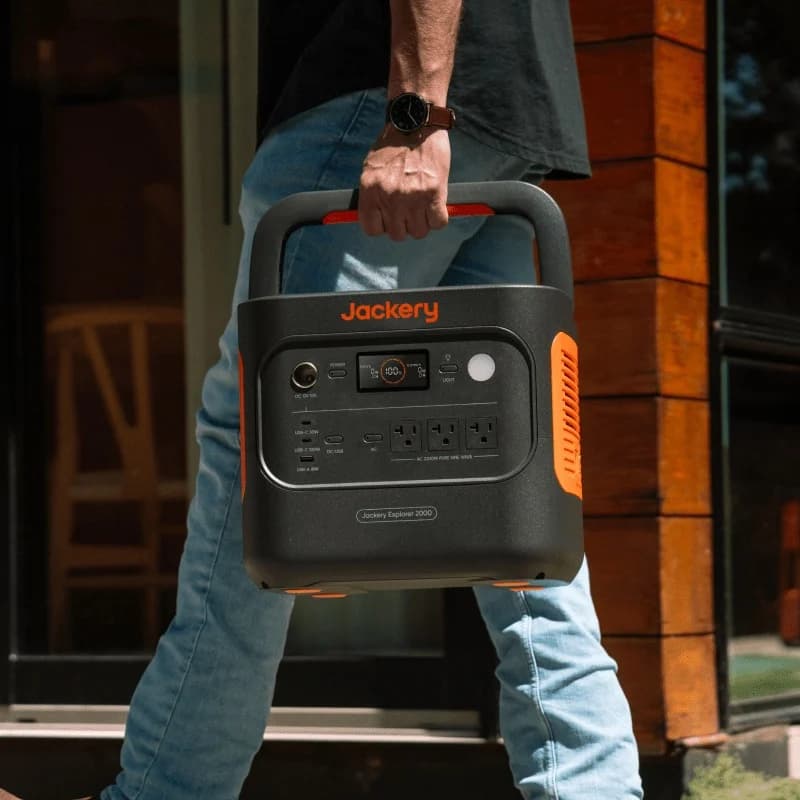
Compare Anker C2000 Gen 2 and Jackery 2000 v2 for fridge backup, carrying, expansion and solar. Get runtime estimates, complete kit checks and buying picks.
Comparison · Portable Power Stations
Anker SOLIX C300X vs BLUETTI Elite 30 V2: Which Small Station?
Choose C300X or Elite 30 V2 for laptops, lights and small AC loads: compare USB-C sharing, runtime estimates, solar cables, model aliases and gift return traps.
Comparison · Portable Power Stations
AFERIY P280 vs Anker SOLIX C2000 Gen 2: Which Backup Kit Fits?

Compare the US AFERIY P280 and Anker C2000 Gen 2 for fridge backup: matching battery kits, runtime estimates, outlet limits, recharge needs and warranty gaps.