

Comparison
BLUETTI AC180 vs Elite 100 V2
Capacity, Weight and Solar
Choose between BLUETTI AC180 and Elite 100 V2 with equal-load runtime estimates, US ports, solar modes, included cables and battery accessory limits explained.
By thisWATT EditorialUpdated November 3, 20268 min read1 pick
Our recommendation: BLUETTI Elite 100 V2
Up to 1,000 W solar input in Turbo mode.
Limit: Solar input defaults to 600 W; the higher limit needs Turbo mode and a compatible panel arrangement.
On this page · Our picks at a glance
Our picks at a glance
- 1
Choose for: Up to 1,000 W solar input in Turbo mode.
Limit: Solar input defaults to 600 W; the higher limit needs Turbo mode and a compatible panel arrangement.
Choose the BLUETTI Elite 100 V2 for frequent carrying, more USB-C flexibility and larger solar arrays; choose the AC180 when extra nominal battery capacity and supplied charging cables matter more than carrying weight. Keep a working AC180 unless one of those Elite upgrades solves a specific problem: both provide 1,800W continuous AC output.
Quick picks
Compare specifications and all conditions
Carrying between home, car and campsite
- Our choice
- Elite 100 V2
- Why
- Its manual lists about 25.3 lb; the AC180 manual lists 36.16 lb.
More stored energy; keeping existing equipment
- Our choice
- AC180
- Why
- 1,152Wh rather than 1,024Wh, with solar and car cables in its standard packaging.
A larger solar array
- Our choice
- Elite 100 V2
- Why
- Up to 1,000W in Turbo; 600W in default Standard, versus AC180's 500W ceiling.
Running a larger continuous AC load
- Our choice
- Neither is an upgrade over the other
- Why
- Both stop at 1,800W continuous.
Full comparison table
Swipe to compare. Row labels stay visible.
| Your priority | Our choice | Why |
|---|---|---|
| Carrying between home, car and campsite | Elite 100 V2 | Its manual lists about 25.3 lb; the AC180 manual lists 36.16 lb. |
| More stored energy; keeping existing equipment | AC180 | 1,152Wh rather than 1,024Wh, with solar and car cables in its standard packaging. |
| A larger solar array | Elite 100 V2 | Up to 1,000W in Turbo; 600W in default Standard, versus AC180's 500W ceiling. |
| Running a larger continuous AC load | Neither is an upgrade over the other | Both stop at 1,800W continuous. |
Scroll horizontally to see every column
| Your priority | Our choice | Why |
|---|---|---|
| Carrying between home, car and campsite | Elite 100 V2 | Its manual lists about 25.3 lb; the AC180 manual lists 36.16 lb. |
| More stored energy; keeping existing equipment | AC180 | 1,152Wh rather than 1,024Wh, with solar and car cables in its standard packaging. |
| A larger solar array | Elite 100 V2 | Up to 1,000W in Turbo; 600W in default Standard, versus AC180's 500W ceiling. |
| Running a larger continuous AC load | Neither is an upgrade over the other | Both stop at 1,800W continuous. |
These choices use the AC180 specifications, Elite product page and their US manuals linked below. For the broader brand ranking, use our six-brand power-station comparison.
Elite 100 V2: our pick for carrying and solar
The Elite trades some battery capacity for a lighter body and a different port mix. Its USB-C outputs are rated at 140W and 100W; the AC180 has one 100W USB-C output. It also adds DC5521 outputs and Wi-Fi alongside Bluetooth. Those are useful reasons to choose it for laptop-heavy trips or remote monitoring, rather than replacing an AC180 simply because it is older.
BLUETTI
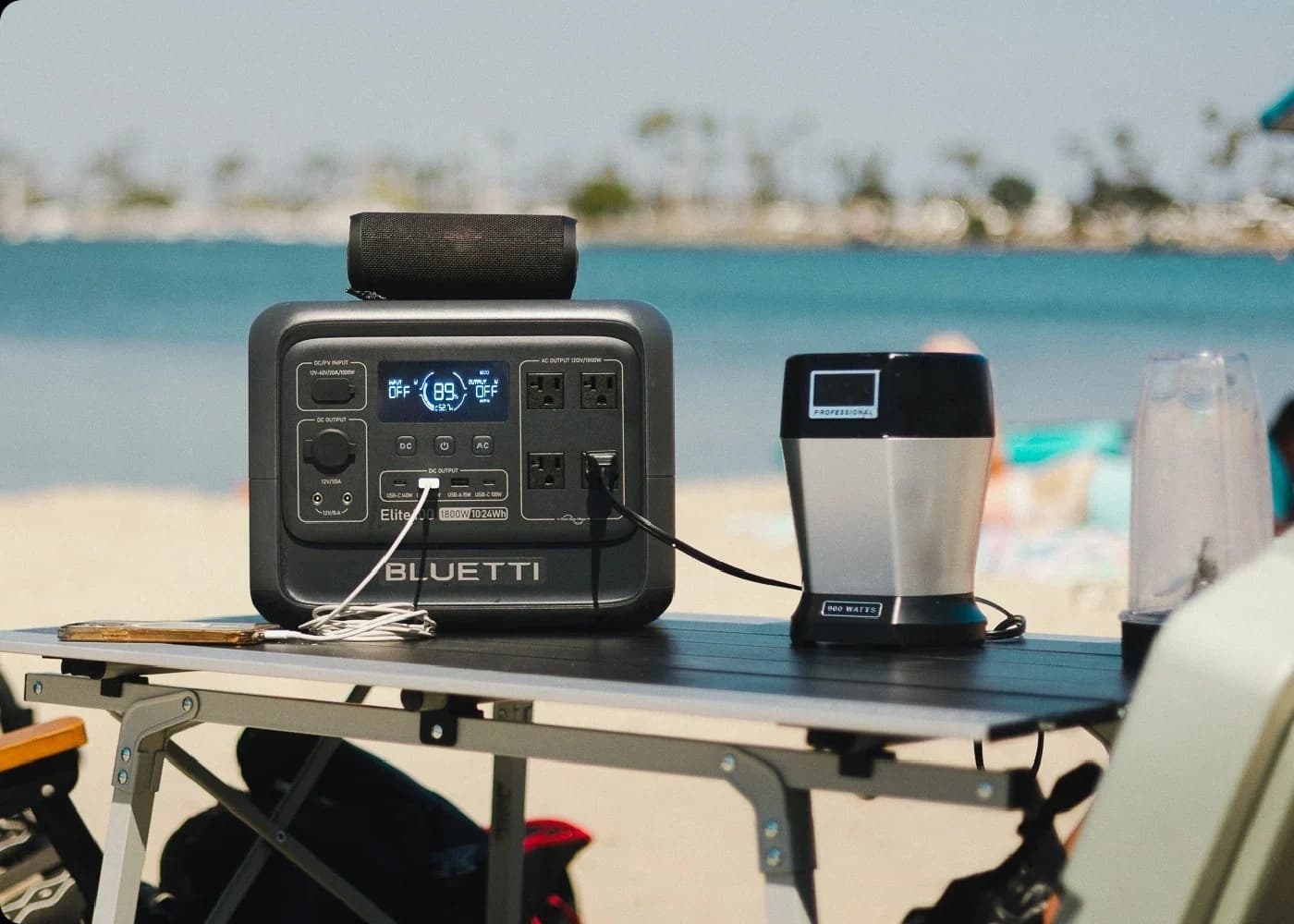
A 25 lb, 1,024Wh LiFePO4 portable power station with 1,800W of AC output, up to 1,000W of solar input in Turbo mode and a 10 ms UPS switchover.
Check package and model options
- 1,024 Wh capacity
- 1,800 W AC out
- LiFePO4
AC180: our pick for extra capacity and keeping what works
AC180 has one eighth more nominal capacity than the Elite: (1,152 − 1,024) ÷ 1,024. It retains four USB-A ports and a wireless pad, and its manual includes solar and car charging cables. Choose it when those features suit your equipment and the complete package is better value to you; nominal capacity alone does not settle runtime.
Check the AC180 configuration and availability at BLUETTI.
Identify the variant first. AC180P is a separate 1,440Wh model, not another name for this 1,152Wh AC180. Elite 100 V2 Bio-based names an alternative shell edition; it is not presented as a capacity upgrade. Station-only, solar-panel and vehicle-charger bundles need separate contents checks.
US capacity, weight and ports compared
AC180, US
- Nominal battery / chemistry
- 1,152Wh / LiFePO4
- Cycle claim to 80% capacity
- 3,500+ cycles
- Continuous AC output
- 1,800W total, four 120V outlets
All specifications
- USB-C
- One, 100W maximum
- USB-A
- Four; two pairs sharing 15W per pair
- Other outputs
- 12V/10A car socket; 15W wireless pad
- UPS switchover claim
- ≤20 ms
- Manual weight
- About 36.16 lb / 16.4kg
- Dimensions, inches
- 13.39 × 9.72 × 12.48
- Stated warranty
- Five years
Elite 100 V2, US
- Nominal battery / chemistry
- 1,024Wh / LiFePO4
- Cycle claim to 80% capacity
- 4,000+ cycles
- Continuous AC output
- 1,800W total, four 120V outlets
All specifications
- USB-C
- One 100W and one 140W maximum
- USB-A
- Two; 15W maximum per port
- Other outputs
- 12V/10A car socket; two DC5521 ports, 5A each, 8A combined
- UPS switchover claim
- ≤10 ms
- Manual weight
- About 25.3 lb / 11.5kg
- Dimensions, inches
- 12.6 × 8.5 × 9.8
- Stated warranty
- Five years
Full comparison table
Swipe to compare. Row labels stay visible.
| Specification | AC180, US | Elite 100 V2, US |
|---|---|---|
| Nominal battery / chemistry | 1,152Wh / LiFePO4 | 1,024Wh / LiFePO4 |
| Continuous AC output | 1,800W total, four 120V outlets | 1,800W total, four 120V outlets |
| USB-C | One, 100W maximum | One 100W and one 140W maximum |
| USB-A | Four; two pairs sharing 15W per pair | Two; 15W maximum per port |
| Other outputs | 12V/10A car socket; 15W wireless pad | 12V/10A car socket; two DC5521 ports, 5A each, 8A combined |
| Cycle claim to 80% capacity | 3,500+ cycles | 4,000+ cycles |
| UPS switchover claim | ≤20 ms | ≤10 ms |
| Manual weight | About 36.16 lb / 16.4kg | About 25.3 lb / 11.5kg |
| Dimensions, inches | 13.39 × 9.72 × 12.48 | 12.6 × 8.5 × 9.8 |
| Stated warranty | Five years | Five years |
Scroll horizontally to see every column
| Specification | AC180, US | Elite 100 V2, US |
|---|---|---|
| Nominal battery / chemistry | 1,152Wh / LiFePO4 | 1,024Wh / LiFePO4 |
| Continuous AC output | 1,800W total, four 120V outlets | 1,800W total, four 120V outlets |
| USB-C | One, 100W maximum | One 100W and one 140W maximum |
| USB-A | Four; two pairs sharing 15W per pair | Two; 15W maximum per port |
| Other outputs | 12V/10A car socket; 15W wireless pad | 12V/10A car socket; two DC5521 ports, 5A each, 8A combined |
| Cycle claim to 80% capacity | 3,500+ cycles | 4,000+ cycles |
| UPS switchover claim | ≤20 ms | ≤10 ms |
| Manual weight | About 36.16 lb / 16.4kg | About 25.3 lb / 11.5kg |
| Dimensions, inches | 13.39 × 9.72 × 12.48 | 12.6 × 8.5 × 9.8 |
| Stated warranty | Five years | Five years |
Sources: AC180 manual, specifications and outputs, Elite US manual, specifications, product pages and BLUETTI's comparison. The Elite's car socket and DC5521 ports share a 10A total limit, so their individual ratings are not additive.
Weight conflict: AC180's product specification says 35.27 lb, its manual says 36.16 lb, and BLUETTI's comparison says 37 pounds. Elite's manual says 25.3 lb while its product page rounds to 25 lb. We use the manuals below; confirm the delivered revision if carrying weight is decisive.
Source: BLUETTI's AC180 and Elite 100 V2 US manuals, linked above
Continuous output, surge and Power Lifting
Continuous output is the shared running allowance: 1,800W across the AC sockets, not per socket. Surge is separately stated: the AC180 manual says it can handle 2,700W surge, while BLUETTI lists 3,600W for Elite. Neither figure is a promise that your particular appliance will start.
Power Lifting is another mode, despite sharing the AC180's 2,700W number. Both manuals restrict it to pure resistive heating loads and say actual output remains 1,800W. Do not use it to qualify a fridge compressor. The AC180 manual also says Power Lifting is unavailable during AC charging. Add running loads, then check the appliance's starting requirement separately; BLUETTI warns some motors and compressors start at two to four times rated power.
Equal-load runtime estimates, with losses shown
BLUETTI's equation is hours ≈ capacity in Wh × depth of discharge × inverter efficiency ÷ (load W + station draw W). Its AC180 FAQ uses 90% discharge depth, 85% efficiency and about 15W self-consumption. The Elite manual uses 90% discharge depth, efficiency over 90% and about 10W self-consumption; we conservatively use 90% efficiency.
50W
- AC180 estimate, hours:minutes
- 13:30
- Elite estimate, hours:minutes
- 13:50
100W
- AC180 estimate, hours:minutes
- 7:40
- Elite estimate, hours:minutes
- 7:30
300W
- AC180 estimate, hours:minutes
- 2:50
- Elite estimate, hours:minutes
- 2:40
Full comparison table
Swipe to compare. Row labels stay visible.
| Assumed steady AC load | AC180 estimate, hours:minutes | Elite estimate, hours:minutes |
|---|---|---|
| 50W | 13:30 | 13:50 |
| 100W | 7:40 | 7:30 |
| 300W | 2:50 | 2:40 |
Scroll horizontally to see every column
| Assumed steady AC load | AC180 estimate, hours:minutes | Elite estimate, hours:minutes |
|---|---|---|
| 50W | 13:30 | 13:50 |
| 100W | 7:40 | 7:30 |
| 300W | 2:50 | 2:40 |
For example, AC180: 1,152 × 90% × 85% ÷ (100 + 15) gives roughly seven hours, forty minutes; Elite: 1,024 × 90% × 90% ÷ (100 + 10) gives roughly seven hours, thirty minutes. Results are rounded to the nearest ten minutes. These are calculations using maker assumptions, not measured comparisons. Different idle draw can offset a larger battery at small loads. The AC180 manual illustrates its formula with a fridge, although the product FAQ excludes compressor loads; use our refrigerator energy guide for that planning. Check ECO settings, which can shut outputs off under low loads.
Solar charging: Standard versus Turbo matters
The Elite manual's charging-mode table qualifies the headline solar number. Its AC and solar maxima also cannot simply be added together.
AC180
- Solar ceiling
- 500W
- Panel Voc / current limit
- 12–60V / 10A
- AC charging ceiling
- 1,440W Turbo; 1,000W Standard
All specifications
- Combined charging ceiling
- 1,440W maximum input
Elite Standard, default
- Solar ceiling
- 600W
- Panel Voc / current limit
- 12–60V / 20A
- AC charging ceiling
- 600W
All specifications
- Combined charging ceiling
- 600W
Elite Turbo
- Solar ceiling
- 1,000W
- Panel Voc / current limit
- 12–60V / 20A
- AC charging ceiling
- 1,200W
All specifications
- Combined charging ceiling
- 1,200W
Full comparison table
Swipe to compare. Row labels stay visible.
| Station / mode | Solar ceiling | Panel Voc / current limit | AC charging ceiling | Combined charging ceiling |
|---|---|---|---|---|
| AC180 | 500W | 12–60V / 10A | 1,440W Turbo; 1,000W Standard | 1,440W maximum input |
| Elite Standard, default | 600W | 12–60V / 20A | 600W | 600W |
| Elite Turbo | 1,000W | 12–60V / 20A | 1,200W | 1,200W |
Scroll horizontally to see every column
| Station / mode | Solar ceiling | Panel Voc / current limit | AC charging ceiling | Combined charging ceiling |
|---|---|---|---|---|
| AC180 | 500W | 12–60V / 10A | 1,440W Turbo; 1,000W Standard | 1,440W maximum input |
| Elite Standard, default | 600W | 12–60V / 20A | 600W | 600W |
| Elite Turbo | 1,000W | 12–60V / 20A | 1,200W | 1,200W |
AC180's product page gives a full wall recharge of 1.3–1.8 hours in Turbo and solar recharge of 2.8–3.3 hours at 500W under ideal conditions. Elite's page claims 80% in 45 minutes on AC Turbo and a full solar charge in 70 minutes at 1,000W. These are maker claims with different input conditions, not a matched charging test. Elite's manual puts Standard AC charging at about two hours.
At the Elite's 20A ceiling, 1,000W requires 50 volts at the operating point: 1,000 ÷ 20. That is not panel open-circuit voltage, and it does not approve an array design.
Check voltage first
Both manuals require panel open-circuit voltage within 12–60V. Do not exceed 60V.
Check current and cable
AC180 has a 10A limit and DC7909 input; Elite has a 20A limit and specifies an MC4-to-XT60 solar cable.
Select the Elite mode
Default Standard caps solar at 600W; Turbo allows up to 1,000W. Available sunlight and the array still determine actual input.
A panel example, not a compatibility endorsement: EcoFlow's NextGen 220W bifacial panel lists 21.5V Voc and front-side operating current of 11.9A. Voltage fits these windows, but that current already exceeds AC180's input limit. Check rear-side contribution against Elite's limit too. EcoFlow includes an XT60i cable; that name alone does not verify the BLUETTI connection. Confirm the panel, array and station-specific cable before purchase; our portable panel guide covers selection.
Included cables and optional accessories
AC charging cable
- AC180 manual
- Included
- Elite manual
- Included
Solar charging cable
- AC180 manual
- Included; DC7909 station input
- Elite manual
- Optional; MC4 to XT60
Car charging cable
- AC180 manual
- Included
- Elite manual
- Optional; cigarette-lighter plug to XT60-F
Other contents
- AC180 manual
- Station, grounding screw and documentation
- Elite manual
- Station, grounding screw and documentation
Full comparison table
Swipe to compare. Row labels stay visible.
| Standalone package | AC180 manual | Elite manual |
|---|---|---|
| AC charging cable | Included | Included |
| Solar charging cable | Included; DC7909 station input | Optional; MC4 to XT60 |
| Car charging cable | Included | Optional; cigarette-lighter plug to XT60-F |
| Other contents | Station, grounding screw and documentation | Station, grounding screw and documentation |
Scroll horizontally to see every column
| Standalone package | AC180 manual | Elite manual |
|---|---|---|
| AC charging cable | Included | Included |
| Solar charging cable | Included; DC7909 station input | Optional; MC4 to XT60 |
| Car charging cable | Included | Optional; cigarette-lighter plug to XT60-F |
| Other contents | Station, grounding screw and documentation | Station, grounding screw and documentation |
Battery and vehicle accessory map:
AC180 + B80
- What it does / what to verify
- External charging through Power Bank Mode; BLUETTI specifies Aviation to DC7909.
AC180 + B230 or B300
- What it does / what to verify
- External charging through Power Bank Mode; BLUETTI specifies a P090D cable.
Elite + B80
- What it does / what to verify
- The comparison blog lists B80 charging, but the reviewed Elite manual does not identify that battery/cable pairing. Obtain confirmation rather than reuse an AC180 cable.
Elite + Charger 1
- What it does / what to verify
- Vehicle charging, not added storage; BLUETTI claims 560W and a full refill in 1.8 hours.
Elite's optional lead-acid clamp accessory
- What it does / what to verify
- Charges a car battery from the Elite's output; it is not a storage-expansion connection.
Full comparison table
Swipe to compare. Row labels stay visible.
| Accessory arrangement | What it does / what to verify |
|---|---|
| AC180 + B80 | External charging through Power Bank Mode; BLUETTI specifies Aviation to DC7909. |
| AC180 + B230 or B300 | External charging through Power Bank Mode; BLUETTI specifies a P090D cable. |
| Elite + B80 | The comparison blog lists B80 charging, but the reviewed Elite manual does not identify that battery/cable pairing. Obtain confirmation rather than reuse an AC180 cable. |
| Elite + Charger 1 | Vehicle charging, not added storage; BLUETTI claims 560W and a full refill in 1.8 hours. |
| Elite's optional lead-acid clamp accessory | Charges a car battery from the Elite's output; it is not a storage-expansion connection. |
Scroll horizontally to see every column
| Accessory arrangement | What it does / what to verify |
|---|---|
| AC180 + B80 | External charging through Power Bank Mode; BLUETTI specifies Aviation to DC7909. |
| AC180 + B230 or B300 | External charging through Power Bank Mode; BLUETTI specifies a P090D cable. |
| Elite + B80 | The comparison blog lists B80 charging, but the reviewed Elite manual does not identify that battery/cable pairing. Obtain confirmation rather than reuse an AC180 cable. |
| Elite + Charger 1 | Vehicle charging, not added storage; BLUETTI claims 560W and a full refill in 1.8 hours. |
| Elite's optional lead-acid clamp accessory | Charges a car battery from the Elite's output; it is not a storage-expansion connection. |
The AC180 page's “Capacity Grows” marketing conflicts with its own FAQ, which explicitly says B80/B230/B300 do not provide capacity expansion. Follow that narrower description: they recharge the station. Do not present their added nameplate watt-hours as one integrated battery capacity.
App, winter use and listing checks
AC180 uses Bluetooth; Elite adds Wi-Fi. Elite's manual asks for a firmware update before first use. Both list charging at 0–40°C and discharging at −20–40°C: cold-weather discharge permission is not permission to recharge below freezing. AC180 also derates to 1,500W at 30–40°C.
The faster UPS figure is not universal device compatibility: Elite's manual excludes servers or workstations requiring high-performance UPS, despite broader product-page marketing. AC180's manual says to check the switchover function before relying on it.
Listing check, November 2, 2026: BLUETTI's AC180 page says out of stock with late-November restock expected; the Elite page says the standard station ships from November 12. These are dated maker notices, not delivery guarantees or checks of Amazon inventory. Before ordering, confirm the full model, US outlets, standalone versus panel/charger bundle, cable inventory, dispatch date and seller's warranty eligibility.
How we choose
We compared official US specifications, manuals and BLUETTI's own comparison, checked November 2, 2026. This is document research, without physical comparative testing. We expose conflicting weights and accessory lists, calculate runtimes with stated assumptions, and favour features that change a purchase or keep decision. The LiFePO4 guide explains battery terminology; cycle figures here remain maker claims.
Verdict
Buy Elite 100 V2 when carrying weight, USB-C ports or a suitable larger solar array justify the change, allowing for optional cables and dispatch timing. Keep or choose AC180 when its extra nominal capacity, wireless pad and included cables suit your needs. Neither is the answer to needing more than 1,800W continuous AC power.
Frequently asked questions
Should I replace my BLUETTI AC180 with an Elite 100 V2?
Keep an AC180 that already meets your needs. Both stations provide 1,800W continuous AC output, and the AC180 has 1,152Wh against the Elite's 1,024Wh. Moving to the Elite buys easier carrying, two USB-C ports, Wi-Fi and a higher solar-input ceiling in Turbo mode. It does not buy a larger battery or more continuous AC power.
Is the BLUETTI AC180P the same as the AC180?
No. BLUETTI lists 1,152Wh for AC180 and 1,440Wh for AC180P. This comparison covers the US 120V AC180, not the AC180P. Check the full model name and capacity on a seasonal listing; a panel bundle also changes what arrives in the box without necessarily changing the station. Do not apply this page's AC180 runtime calculations to an AC180P.
Can the Elite 100 V2 take 1,000W solar charging by default?
No. Its US manual says Standard is the default and caps solar input at 600W in that mode. Turbo raises the solar ceiling to 1,000W, with the same 12–60V panel open-circuit-voltage requirement and 20A maximum current. A suitable array and conditions are still necessary; buying panels whose rated watts add up to the ceiling does not establish the input they will deliver.
Can I expand the AC180 with a B80, B230 or B300?
BLUETTI's AC180 FAQ says these batteries charge the station through Power Bank Mode rather than provide capacity expansion. It specifies an Aviation-to-DC7909 cable for B80 and a P090D cable for B230/B300. Treat that as an external recharge arrangement, not an integrated battery stack. Confirm the exact cable before buying; the Elite's XT60 input does not establish compatibility with those AC180 cables.
Can either station run a 2,700W appliance continuously?
Both have 1,800W continuous AC output. Their Power Lifting mode supports certain pure resistive heating loads labelled up to 2,700W, while actual output remains 1,800W. That is a different claim from surge power and does not qualify a compressor, motor or mixed-electronics appliance. Check running and starting requirements separately rather than using the Power Lifting figure as a general output rating.
BLUETTI Elite 100 V2
AmazonRelated guides
Best picks · Portable Power Stations
Best Battery Backup for Refrigerators: Picks by Outage Length

Choose a battery backup for your refrigerator by daily energy use, compressor starts and outage length, with clear picks, runtime estimates and kit checks.
Comparison · Portable Power Stations
AFERIY P280 vs Anker SOLIX C2000 Gen 2: Which Backup Kit Fits?
Compare the US AFERIY P280 and Anker C2000 Gen 2 for fridge backup: matching battery kits, runtime estimates, outlet limits, recharge needs and warranty gaps.
Comparison · Portable Power Stations
Anker SOLIX C2000 Gen 2 vs Jackery Explorer 2000 v2: Which to Buy?
Compare Anker C2000 Gen 2 and Jackery 2000 v2 for fridge backup, carrying, expansion and solar. Get runtime estimates, complete kit checks and buying picks.