

Comparison
EcoFlow RIVER 3 vs RIVER 3 Plus: Which Small Station Fits?
Choose the right EcoFlow RIVER 3 for light outages, travel or a gift. Compare Plus, Max bundles, charging, included cables and realistic small-load runtimes.
By thisWATT EditorialUpdated November 2, 20269 min read1 picks
Our picks at a glance
- See on Amazon1
Best RIVER 3 for most buyers
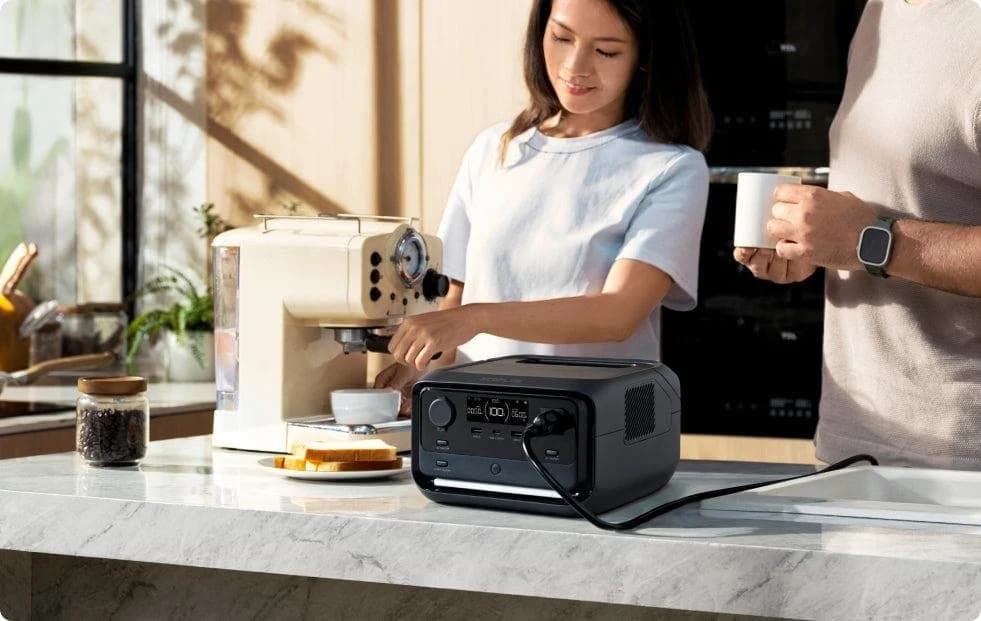
EcoFlow RIVER 3 Plus Portable Power Station (286Wh)286 Wh capacity · 600W AC out · LiFePO4
Choose the EcoFlow RIVER 3 Plus for most small-station purchases: its 600W continuous AC output and optional extra battery make it the more flexible choice for short outages or a gift. Choose the standard 245Wh RIVER 3 when carrying less matters and your loads fit its 300W output. Neither base station is our choice for extended refrigerator backup or electric space heating; size those jobs separately.
Quick picks: start with the job
| Your priority | Our choice | Main trade-off |
|---|---|---|
| A gift or desk backup with room to grow | RIVER 3 Plus | Heavier than standard; extra battery costs extra |
| Light carry, laptop and small electronics | Standard RIVER 3, 245Wh | Lower AC and solar limits; no supported expansion identified |
| Longer runtime from the Plus platform | Max or Max Plus bundle | Adds storage, not stronger AC output |
| USB-C recharging on the station itself | Jackery Explorer 300 v2, if restocked | Maker currently says sold out; backup claims conflict |
These choices use manufacturer specifications, not physical testing. The EcoFlow family page distinguishes the output ratings and battery bundles. Availability needs attention: Jackery's 300 v2 page explicitly says sold out, and EcoFlow's Plus storefront includes preorder wording. Confirm delivery before buying for a fixed gift date.
Comparison: capacity is only part of the upgrade
| Maker's specification | RIVER 3, standard 245Wh | RIVER 3 Plus, standalone | Explorer 300 v2 |
|---|---|---|---|
| Nominal battery | 245Wh | 286Wh | 288Wh |
| Continuous AC output | 300W total | 600W total | 300W total |
| Weight | 7.72 lb, manual figure | 10.4 lb, storefront figure | 8.16 lb, spec table |
| USB-C output | 100W max | 100W max | One 100W port and one 15W port |
| USB-C charging on base unit | Not listed; output port | Not listed; extra battery adds input | 100W max input |
| Wall recharge, maker's claim | Full in one hour | Full in 60 minutes | Full in approximately 76 minutes |
| Solar input | 110W; 11–30V, 8A max | 220W; 11–55V, 13A max | Check exact panel and cable instructions |
| Battery expansion | No compatible extra battery identified | One EB300 or EB600 | No expansion option identified |
Sources: standard manual, EcoFlow charging comparison, Plus specifications, Plus manual, and Jackery specifications. All three specify LiFePO4 cells. EcoFlow rates these RIVER batteries for 3,000 cycles to 80% capacity; Jackery specifies 4,000 cycles to 70% or more. Those endpoints differ, so the cycle counts alone do not establish a winner.
The capacities below are nominal storage, not energy guaranteed at a socket. Max and Max Plus are expanded configurations of the Plus.
Source: linked EcoFlow family page and Jackery specification table
Best for most buyers: EcoFlow RIVER 3 Plus
Buy Plus for the stronger inverter and expansion, rather than expecting a dramatic runtime increase from its base battery. Its three AC outlets share 600W; EcoFlow lists 1,200W surge separately. Two outlets are at the rear, useful when arranging a desk. The maker also specifies a USB-B connection for computer/NAS communication and includes its USB-B to USB-A cable.
EcoFlow
EcoFlow RIVER 3 Plus Portable Power Station (286Wh)
A 10.4 lb, 286Wh LiFePO4 power station with 600W of AC output, a sub-10 ms UPS switchover, one-hour wall charging and expansion to 858Wh with a stackable extra battery.
Comes in 5 versions: see which to buy
- 286 Wh capacity
- 600W AC out
- LiFePO4
EcoFlow's Plus page quotes switching in under 10 ms; its manual describes a standby UPS transferring within 10 ms. Confirm the connected equipment tolerates that interruption. For unattended backup, the manual says to review AC timeout settings: intermittent loads can trigger shutoff. Power Manager software provides the more involved computer/NAS shutdown workflow.
Best for lighter carry: standard EcoFlow RIVER 3
The standard model's 245Wh battery, 300W inverter and roughly 7.72 lb weight make it our lighter-carry choice for loads already within that output limit. Its manual lists a 100W USB-C output, so a compatible laptop can connect there without its AC adapter. Check the laptop's charging requirements and use a suitable cable.
Read the full label. EcoFlow's standard manual distinguishes RIVER 3 and RIVER 3 (10 ms UPS), both 245Wh, from RIVER 3 (230), which is 230Wh. Ordinary RIVER 3 and the 230 version transfer within 20 ms; the separately named 10 ms UPS version transfers within 10 ms. Do not apply the faster variant's claim to an unlabeled standard unit.
The same manual warns against using ordinary RIVER 3 or RIVER 3 (230) for equipment requiring uninterrupted power, including desktops and NAS devices. That makes Plus our better desk-backup pick. Also check the actual product title after following a shopping link: the generic US RIVER 3 address opened a RIVER 3 Max bundle during this research.
Read EcoFlow's RIVER family details
Alternative to watch: Jackery Explorer 300 v2
Jackery's 288Wh, 300W model is worth comparing if you want USB-C input built into the station: it lists 100W input, plus separate 100W and 15W USB-C outputs. Its two AC sockets share the 300W rating; they do not each provide that allowance. The official spec table lists 8.16 lb, while feature copy rounds the weight to 8.1 lb.
However, Jackery's page says the model is sold out. It also advertises a backup response of at most 0.01 seconds while its FAQ says 20 ms. We would get that discrepancy resolved before choosing it for interruption-sensitive equipment. It remains a conditional alternative, not a dependable last-minute gift recommendation. Match 300 v2 exactly; the page also refers shoppers to the differently named Explorer 300.
Check availability with Jackery
What can they run, and for approximately how long?
First check output, then energy. For planning, EcoFlow publishes estimated hours = capacity in Wh × 0.85 ÷ average load in W. The multiplier allows for conversion losses; it is not a measured efficiency rating for these models. We apply it to fully charged, unexpanded batteries with no additional reserve and round the results below.
| Assumed constant AC load, total | Standard 245Wh estimate | Plus 286Wh estimate | Jackery 288Wh estimate |
|---|---|---|---|
| 25W | About eight hours | About ten hours | About ten hours |
| 60W | About three and a half hours | About four hours | About four hours |
| 100W | About two hours | About two and a half hours | About two and a half hours |
| 300W | About forty minutes | About fifty minutes | About fifty minutes |
For example, 245Wh × 0.85 ÷ 60W gives about three and a half hours. These are illustrative loads, not claims about what every router, laptop or fan draws. At very low loads, inverter idle consumption can make a simple percentage allowance optimistic; EcoFlow's own illustrated 3W examples are 30.8 hours for standard and 35 hours for Plus. Its runtime footnote restricts the advertised doubling to that low-wattage example, not every device.
For a load above 300W, standard and Jackery fail the continuous-output screen even if the battery arithmetic seems sufficient. Plus allows a higher running load, but capacity still runs down quickly: EcoFlow illustrates a 400W refrigerator at 31 minutes and a 600W desktop at 21 minutes. Treat those as maker examples. A cycling fridge also needs startup headroom; use its average energy consumption for duration and check starting demand separately. Our refrigerator sizing guide works through that decision.
Check simultaneous demand
Add the running watts and verify motor-starting requirements against the station and appliance specifications.
Calculate duration
Apply the stated capacity-and-load formula, then leave margin for conditions and station consumption.
Decide how to recharge
Choose wall, vehicle or compatible solar charging around the recipient's actual routine.
X-Boost is a separate compatibility feature. EcoFlow advertises it for selected heating devices up to 600W on standard and 1,200W on Plus. Those figures do not replace the 300W and 600W continuous ratings. The manuals exclude voltage-protected equipment and disable X-Boost in bypass mode. Do not buy a small station around a heater's X-Boost headline. For longer outages or larger appliances, start with our power-station size comparison.
Charging and the cables a gift actually needs
Both EcoFlow models offer wall, solar and vehicle charging. Standard accepts up to 320W AC; standalone Plus accepts up to 380W. Their USB-C ports are outputs, so a USB-C charger alone does not recharge either base station. Jackery's 100W USB-C input is a useful distinction.
For solar, check power, voltage, current and cable together. The manuals specify standard at 11–30V, 8A, 110W maximum, and Plus at 11–55V, 13A, 220W maximum. Their connection instructions require panel output below the respective voltage ceilings. Confirm the intended panel's open-circuit voltage with the maker and use the specified solar-to-XT60i cable; a panel's wattage alone is insufficient.
The standard EcoFlow box list contains the station, AC cable and documentation. Plus adds the USB communication cable. Both manuals say the panel and solar charging cable are separate; buy them only if the selected bundle explicitly includes them. Jackery lists an AC cable and manual, says the car cable is separate, and offers a bundle with a SolarSaga 40 Air. Check the exact package rather than assuming every pictured accessory ships.
Expansion: Plus, Max and Max Plus explained
According to EcoFlow's bundle descriptions:
- Plus: station alone, 286Wh and 600W rated AC output.
- Max: Plus with the 286Wh EB300, totaling 572Wh; still 600W output.
- Max Plus: Plus with the 572Wh EB600, totaling 858Wh; still 600W output.
The extra-battery page says to stack one at a time, using clips and Pogo Pin contacts. Its 140W USB-C input/output can also serve separately; EcoFlow reduces that rating to 100W above 95°F. These are specifically RIVER 3 Plus batteries. No supported expansion is identified in the standard model's manual, so do not buy an EB300 expecting to upgrade a standard RIVER 3. Buying only the extra battery also does not give you the station's AC sockets.
Recipient-fit checklist
Choose around the recipient's equipment and carrying comfort. Plus has three AC sockets; Jackery has two. Inspect the exact US standard unit's outlet layout, since EcoFlow's manual warns that socket counts and types vary by region. All capacity estimates here refer to the named versions, not every regional variant.
- Yes: Match the full model label, US outlet version and included accessories
- Yes: Check carrying weight and where the station will sit
- Yes: List every plug and each device's running and starting requirements
- Partly: Confirm low-load timeout settings before relying on unattended backup
- Partly: Verify delivery timing and the exact solar or battery bundle
- No: Choose this size for extended heating or assume a fridge will start
How we choose
We compare official product pages and manuals for capacity, continuous output, charging, ports, expansion and package contents. The standard manual's script data was read as well as visible storefront text, so variant-specific warnings are not replaced by family-wide advertising. Conflicts and availability wording above reflect the sources checked on November 2, 2026. Runtime calculations use the explicitly stated planning assumption; they are not measurements. Qualifying purchases may earn thisWATT a commission (disclosure).
Verdict
Buy RIVER 3 Plus for the most flexible small setup; buy standard for lighter carry when its output covers your equipment. Choose Max or Max Plus only when you need more hours from that same Plus inverter. Consider Jackery's 300 v2 when stock returns and its USB-C input solves a real need. If your priority is prolonged refrigeration or heat, size a larger station before choosing a brand.
Frequently asked questions
Is the EcoFlow RIVER 3 Plus worth choosing over the RIVER 3?
Choose Plus for its 600W continuous AC output, 220W solar input and support for an EB300 or EB600 battery. The standard 245Wh RIVER 3 has 300W AC output and 110W solar input, but weighs less. Plus's 286Wh base battery adds only a modest amount of runtime; the bigger reasons to choose it are output, expansion and its backup features.
Can an EcoFlow RIVER 3 run a refrigerator or heater?
A refrigerator needs both running power and compressor-starting headroom, so check the exact appliance rather than assuming compatibility. EcoFlow illustrates a 400W refrigerator running for 31 minutes on the unexpanded Plus; that is a manufacturer example, not a promise for your fridge. A heater rated above the station's continuous output is a poor reason to buy this size. For extended refrigeration or heating, choose a larger station sized to the load.
Can you charge the RIVER 3 through USB-C?
The USB-C port on the standard RIVER 3 and the base RIVER 3 Plus is an output, rated up to 100W. Adding a compatible RIVER 3 Plus Smart Extra Battery supplies a separate USB-C input/output port rated up to 140W, with temperature restrictions in EcoFlow's footnote. Jackery's Explorer 300 v2 instead lists 100W USB-C input on the station itself. Do not confuse output wattage with charging support.
What is the difference between RIVER 3 Plus, Max and Max Plus?
Plus is the 286Wh station. Max bundles that station with the 286Wh EB300 for 572Wh total; Max Plus bundles it with the 572Wh EB600 for 858Wh total. All retain 600W rated AC output. The Plus accepts one compatible extra battery at a time, so Max Plus does not mean stacking both extra batteries. A solar-panel bundle is a different addition and does not increase battery capacity.
Related guides

LiFePO4 vs Lithium-Ion Power Stations: Cycles and Winter Use
Compare LiFePO4 and other lithium-ion power stations by rated cycles, capacity retention, weight and winter charging limits, with exact-model picks and checks.
Updated November 2, 2026Read
Jackery Explorer 1000 vs 1000 v2 vs 1000 Plus: Which to Buy?
Compare the original Jackery Explorer 1000, 1000 v2 and 1000 Plus: battery types, output, discontinued expansion packs, solar bundles and warranty conditions.
Updated November 2, 2026Read
Anker SOLIX C1000 vs C1000 Gen 2: Which Generation Should You Buy?
Choose the right Anker SOLIX C1000 generation: compare BP1000 battery compatibility, charging conditions, US variants, bundles and equal-load runtime estimates.
Updated November 2, 2026Read