

Best picks
Best Portable Solar Panel Kits with Batteries
Complete Bundles Compared
Compare portable solar panel kits with batteries by exact contents, cables, input limits and winter recharge estimates. Pick a complete US backup package.
By thisWATT EditorialUpdated November 3, 20268 min read
On this page · Quick picks: compare the complete job
For camping and portable outage backup, our best solar panel kit with battery is the EcoFlow DELTA 3 Plus with one NextGen 220W Bifacial Portable Solar Panel: the station provides manufacturer-stated 1,024Wh storage and 1,800W continuous AC output. Choose the Jackery Explorer 1000 v2 + SolarSaga 200W package if a lighter station matters, subject to the panel-revision check below. For modest loads, buy the RIVER 3 Plus and NextGen 160W panel separately so the panel revision and supplied cable are explicit.
Quick picks: compare the complete job
All figures below are manufacturers' specifications. Storage is nominal battery capacity; continuous watts describe the AC output limit, not runtime. Station weights exclude panels and accessories.
Compare specifications and all conditions
Best overall: DELTA 3 Plus solar bundle
- Battery / continuous AC
- 1,024Wh / 1,800W
- Station weight
- 27.6 lb
- Selected solar equipment
- One NextGen 220W bifacial panel
All specifications
- Main trade-off
- Included panel cannot exploit the station's full solar-input ceiling
Lighter station: Explorer 1000 v2 solar bundle
- Battery / continuous AC
- 1,070Wh in US manual / 1,500W
- Station weight
- About 23.8 lb
- Selected solar equipment
- One SolarSaga 200W; confirm revision
All specifications
- Main trade-off
- Panel operating current can exceed the station's per-port rating
Small setup: RIVER 3 Plus + separately purchased NextGen 160W
- Battery / continuous AC
- 286Wh / 600W
- Station weight
- About 10.36 lb
- Selected solar equipment
- One NextGen 160W panel
All specifications
- Main trade-off
- Much less stored energy; panel itself weighs about 12.3 lb
Full comparison table
Swipe to compare. Row labels stay visible.
| Pick and job | Battery / continuous AC | Station weight | Selected solar equipment | Main trade-off |
|---|---|---|---|---|
| Best overall: DELTA 3 Plus solar bundle | 1,024Wh / 1,800W | 27.6 lb | One NextGen 220W bifacial panel | Included panel cannot exploit the station's full solar-input ceiling |
| Lighter station: Explorer 1000 v2 solar bundle | 1,070Wh in US manual / 1,500W | About 23.8 lb | One SolarSaga 200W; confirm revision | Panel operating current can exceed the station's per-port rating |
| Small setup: RIVER 3 Plus + separately purchased NextGen 160W | 286Wh / 600W | About 10.36 lb | One NextGen 160W panel | Much less stored energy; panel itself weighs about 12.3 lb |
Scroll horizontally to see every column
| Pick and job | Battery / continuous AC | Station weight | Selected solar equipment | Main trade-off |
|---|---|---|---|---|
| Best overall: DELTA 3 Plus solar bundle | 1,024Wh / 1,800W | 27.6 lb | One NextGen 220W bifacial panel | Included panel cannot exploit the station's full solar-input ceiling |
| Lighter station: Explorer 1000 v2 solar bundle | 1,070Wh in US manual / 1,500W | About 23.8 lb | One SolarSaga 200W; confirm revision | Panel operating current can exceed the station's per-port rating |
| Small setup: RIVER 3 Plus + separately purchased NextGen 160W | 286Wh / 600W | About 10.36 lb | One NextGen 160W panel | Much less stored energy; panel itself weighs about 12.3 lb |
Contents matrix: panels, cables and extras
The bundles are documented in the EcoFlow US catalog and Jackery US catalog. Cable details below come from each component's standard box list; retain those lists alongside the selected order. Additional accessories are not assumed included.
DELTA 3 Plus solar bundle
- Station and panel identity
- DELTA 3 Plus; NextGen 220W Bifacial
- Solar connection documented in component box
- XT60i charging cable in the panel box
- Other standard contents / buying check
- Station AC cable; panel protective bag. EcoFlow says station and panel ship separately.
Jackery Black solar bundle
- Station and panel identity
- US Explorer 1000 v2; SolarSaga 200W, revision unnamed in selector
- Solar connection documented in component box
- Current JS-200E panel box lists a 3-meter multifunctional cable and DC8020-to-DC7909 adapter
- Other standard contents / buying check
- Station AC cable. Obtain panel-model confirmation; the selector's wattage does not establish JS-200E identity.
Small setup, separate purchases
- Station and panel identity
- US RIVER 3 Plus; NextGen 160W
- Solar connection documented in component box
- XT60i charging cable explicitly included with this panel
- Other standard contents / buying check
- Panel protective bag; purchase station and panel as separate items.
Full comparison table
Swipe to compare. Row labels stay visible.
| Package | Station and panel identity | Solar connection documented in component box | Other standard contents / buying check |
|---|---|---|---|
| DELTA 3 Plus solar bundle | DELTA 3 Plus; NextGen 220W Bifacial | XT60i charging cable in the panel box | Station AC cable; panel protective bag. EcoFlow says station and panel ship separately. |
| Jackery Black solar bundle | US Explorer 1000 v2; SolarSaga 200W, revision unnamed in selector | Current JS-200E panel box lists a 3-meter multifunctional cable and DC8020-to-DC7909 adapter | Station AC cable. Obtain panel-model confirmation; the selector's wattage does not establish JS-200E identity. |
| Small setup, separate purchases | US RIVER 3 Plus; NextGen 160W | XT60i charging cable explicitly included with this panel | Panel protective bag; purchase station and panel as separate items. |
Scroll horizontally to see every column
| Package | Station and panel identity | Solar connection documented in component box | Other standard contents / buying check |
|---|---|---|---|
| DELTA 3 Plus solar bundle | DELTA 3 Plus; NextGen 220W Bifacial | XT60i charging cable in the panel box | Station AC cable; panel protective bag. EcoFlow says station and panel ship separately. |
| Jackery Black solar bundle | US Explorer 1000 v2; SolarSaga 200W, revision unnamed in selector | Current JS-200E panel box lists a 3-meter multifunctional cable and DC8020-to-DC7909 adapter | Station AC cable. Obtain panel-model confirmation; the selector's wattage does not establish JS-200E identity. |
| Small setup, separate purchases | US RIVER 3 Plus; NextGen 160W | XT60i charging cable explicitly included with this panel | Panel protective bag; purchase station and panel as separate items. |
Best overall bundle: EcoFlow DELTA 3 Plus + NextGen 220W Bifacial
Choose this for a larger portable load allowance and room to improve solar charging later. EcoFlow's US station manual specifies 1,024Wh, 1,800W continuous output and solar input of 11–60V, 15A, 500W per port, 1,000W combined. Its solar instructions explicitly require total panel Voc within 60V and total Isc within 15A.
The included panel's front rating is 220W. EcoFlow's advertised 70-minute solar refill describes the station's much larger solar-input configuration; it is not a charging promise for this single-panel bundle. Buy additional panels only after a fresh compatibility check, including each input's limits.
The NextGen panel specifications give 21.5V Voc and front-side 12.4A Isc. Rear generation requires its own current assessment: do not add the separately stated 175W rear rating to the front rating and treat that as guaranteed usable output.
There are source conflicts worth preserving. EcoFlow's catalog says up to 25% more bifacial energy, while its panel page says up to 28%; budget no guaranteed rear-side bonus. The bundle copy says 3000+ battery cycles, while the station manual says 4000 cycles to 80%+ capacity. Neither discrepancy changes this pick's nominal storage or continuous output, but neither justifies a guaranteed service-life claim.
Check the exact EcoFlow solar package.
Best bundle with a lighter station: Jackery Explorer 1000 v2 + SolarSaga 200W
The station weighs about 23.8 lb, versus EcoFlow's 27.6 lb; this is a station comparison, not a claim about complete kit weight. Jackery's catalog confirms the Black / Explorer 1000 v2 + SolarSaga 200W option. Its US JE-1000D manual gives 1,070Wh and 1,500W continuous output. Jackery's catalog description also says 1,024Wh, so confirm the US model rather than silently treating those figures as interchangeable.
Panel revision is the remaining purchase check. The current SolarSaga 200 manual identifies JS-200E and says its multifunctional cable is only suitable for that revision. The bundle selector itself only names SolarSaga 200W. Request confirmation of the supplied panel label; use that revision's manual if it differs.
The station permits 16–60V working input at 10.5A per port, with a 400W combined ceiling. JS-200E's front-side operating specification is 18V and 11.5A, so full panel-nameplate capture is not assured at that port. Jackery's station manual nevertheless explicitly supports direct connection of a 200W panel. Keep the manufacturer's matched connection; an adapter cannot remove an electrical input limit.
Check the Black Jackery solar package.
Best small setup: RIVER 3 Plus + NextGen 160W, bought separately
For smaller energy needs, choose the 286Wh, 600W RIVER 3 Plus and the specifically named NextGen 160W panel. This separate-purchase route solves a documentation problem: that panel's box explicitly lists an XT60i cable and protective bag, so there is no need to guess which cable a generic solar offer contains.
The panel publishes 21.3V Voc and 9.1A Isc; the RIVER 3 Plus manual lists 11–55V, 13A and 220W maximum solar input. Those nominal figures fit, with less rated panel power than the station's ceiling. They do not replace a cold-weather voltage check. The panel weighs about 12.3 lb, more than the station's approximately 10.36 lb: allow space and carrying capacity for both.
RIVER 3 Max and Max Plus are extra-battery combinations with 572Wh and 858Wh respectively. Those names do not identify a supplied solar panel; do not substitute one of those packages without checking contents.
Station component only; the panel is a separate purchase:
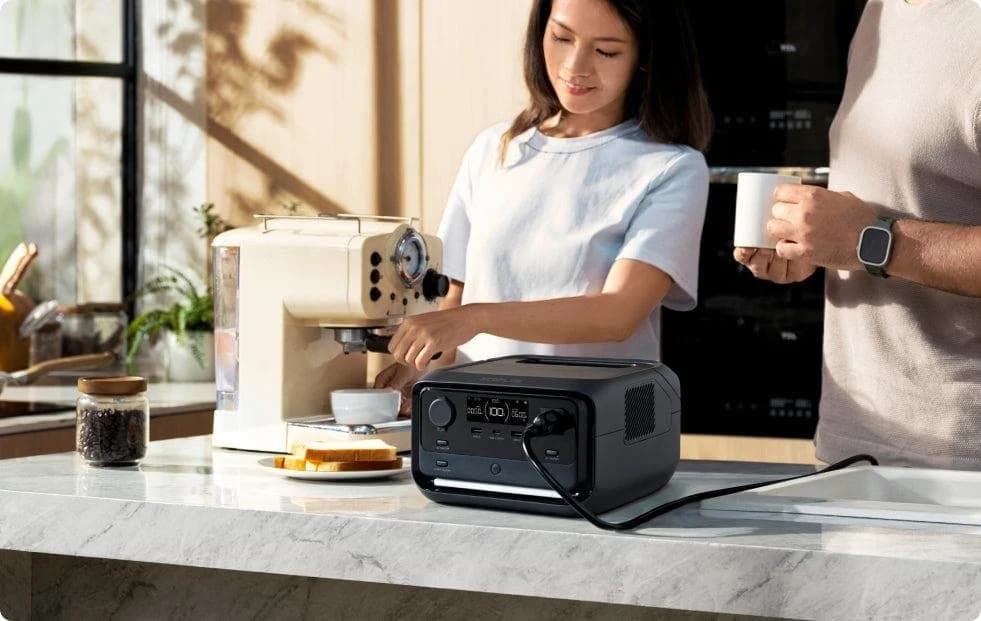
EcoFlow
A 10.4 lb, 286Wh LiFePO4 power station with 600W of AC output, a sub-10 ms UPS switchover, one-hour wall charging and expansion to 858Wh with a stackable extra battery.
Check package and model options
- 286 Wh capacity
- 600 W AC out
- LiFePO4
Check price on Amazon for the station, then check the separately linked panel's contents.
Buying advice: check the whole charging path
These packages combine a battery station with solar equipment. If you want a separate battery-and-controller build, start with our 12V DIY solar guide. For these portable packages, use our panel compatibility guide alongside the actual manuals.
Identify the hardware
Match station model, US outlet version and the actual panel revision.
Check the electrical limits
Compare panel Voc, current and rated power with the receiving input; include required temperature margins.
Verify the cable
Confirm connector, polarity and cable inclusion. Obtain maker approval for uncertain substitutions.
Treat working voltage, open-circuit voltage and current limits as distinct specifications. In particular, Jackery labels its station voltage as working voltage; EcoFlow separately states a panel-Voc limit in its charging instructions. Do not turn the former into an independently verified Voc allowance. Jackery's panel manual also requires voltage and current sizing margins and prohibits reversed polarity. Avoid custom arrays until the maker confirms the complete combination.
For storage sizing, compare your appliances' energy demand with capacity, and their simultaneous running and starting demand with the station's output ratings. Our refrigerator watts guide helps with that appliance-specific decision. Any connection to home wiring needs a licensed electrician and permits where required; use the home backup guide for that scope.
Winter recharge: useful planning, not a sunny-day promise
Consider hypothetical December trips to Seattle, Washington, and Phoenix, Arizona. Assume an unobstructed 200W panel, no operating loads and 75% of rated solar energy reaching storage, a chosen allowance of 25% for combined losses and clipping. Assume one equivalent full-power sun hour for the Seattle stress case and two for Phoenix. These are deliberately chosen planning inputs, not local climate averages, forecasts or measurements.
Seattle stress case
- Calculation
- 200W × 1 hour × 75%
- Estimated daily energy added (Wh)
- 150
Phoenix clearer-day case
- Calculation
- 200W × 2 hours × 75%
- Estimated daily energy added (Wh)
- 300
Full comparison table
Swipe to compare. Row labels stay visible.
| Hypothetical winter case | Calculation | Estimated daily energy added (Wh) |
|---|---|---|
| Seattle stress case | 200W × 1 hour × 75% | 150 |
| Phoenix clearer-day case | 200W × 2 hours × 75% | 300 |
Scroll horizontally to see every column
| Hypothetical winter case | Calculation | Estimated daily energy added (Wh) |
|---|---|---|
| Seattle stress case | 200W × 1 hour × 75% | 150 |
| Phoenix clearer-day case | 200W × 2 hours × 75% | 300 |
Neither scenario restores the Jackery's full 1,070Wh from empty within a day, even before powering appliances. Daily energy needs must fit the harvest as well as the battery. More storage extends the interval between refills; it does not create more daily solar energy.
The loss allowance is ours, not a measured efficiency for these kits. Goal Zero's official solar explanation identifies weather, temperature and cable length as reasons output falls below nameplate. Replace the sun-hour assumptions with location-specific information; PVWatts supplies a planning tool for grid-connected PV, not validation of a portable battery kit.
Black Friday and Cyber Monday: compare the same package
Compare the selected bundle against the same station, same panel revision and quantity, and all required cables bought separately. Keep extension cables, carrying cases and extra batteries as explicit additions. Read the selected seller's return window, opened-item conditions and return freight terms, including how separate parcels are handled. A promotional heading is insufficient evidence of either package contents or savings.
- Yes: Exact station and US outlet region identified
- Yes: Panel model, quantity and necessary cable listed
- Yes: Seller identity and return terms checked
- Partly: An alternative panel needs a fresh compatibility assessment
- No: A station-only offer is incomplete for a first solar setup
How we choose
We compared official US catalog options, station manuals and panel box lists, checked on November 2, 2026. These are manufacturer-specification selections; recharge scenarios are disclosed arithmetic assumptions. We preserve conflicts and flag missing panel-revision confirmation rather than infer it from a photograph. The strongest overall choice here balances output and documented solar equipment; the alternatives address station carrying weight and smaller energy needs. See our selection policy and disclosure.
Verdict
Choose the DELTA 3 Plus + NextGen 220W Bifacial bundle for the larger output allowance. Choose the Explorer 1000 v2 + SolarSaga 200W for a lighter station after confirming the panel revision. For smaller loads, the RIVER 3 Plus + separately purchased NextGen 160W makes the panel and cable choice explicit. Size the daily solar harvest before assuming any of them will stay charged through a winter outage.
Frequently asked questions
Does a solar generator include a battery?
The solar packages selected here include a battery power station and a solar panel. The station stores energy and provides output ports; the panel replenishes it when conditions permit. However, the same manufacturer page can offer a station-only option. Check the selected package name and contents, rather than assuming that every option under a solar-generator heading includes a panel.
Can a portable solar kit run a refrigerator?
Choose using the refrigerator's running power, starting demand and energy use between recharge opportunities. Our larger picks have manufacturer-rated continuous AC outputs of 1,800W and 1,500W, but those figures alone cannot establish refrigerator compatibility or overnight runtime. Compare your appliance's requirements with the station manual, and use our refrigerator watts guide to estimate its energy demand before choosing storage and panels.
How long does a solar generator take to recharge in winter?
There is no reliable universal time. Our hypothetical winter scenarios use a 200W panel, a 75% energy-capture assumption and either one or two equivalent full-power sun hours, giving 150 or 300 watt-hours per day. These are planning calculations, not local weather averages or measured results. Running appliances reduce the energy left for recharging, and the battery must remain within its permitted charging temperature.
Can I use another brand's solar panel?
Only after the receiving station's requirements and the actual panel specifications have been checked together. EcoFlow's DELTA 3 Plus manual explicitly limits total panel open-circuit voltage and short-circuit current, and specifies a Solar to XT60i cable. Connector shape alone does not establish voltage, current or polarity compatibility. Ask the manufacturer to approve an uncertain combination before buying adapters or additional panels.
Is the Explorer 1000 v2 the same as the HomePower 1000 v2?
They are separate Jackery models. Jackery's catalog points Explorer buyers toward the newer HomePower model, while continuing to list Explorer solar packages. This guide's Explorer specifications refer to the US JE-1000D manual. A similar name, a solar-generator heading or an older product URL is insufficient identification: match the model, selected package, outlet region and panel before ordering.
Related guides
Buying guide · Solar Generators
How to Size a Solar Generator for a Shed: Loads, Winter Solar and the Full Kit
Size a shed solar generator from actual loads, battery reserve and winter sunshine. Compare complete kits, check panel cables and avoid costly sizing mistakes.
Explainer · Solar Generators
Mango Power E Bundles: Battery, Solar or 240V Kit?
Choose a Mango Power E solar generator kit with the right battery, panels and cables. Compare 240V requirements, carrying weights and an EcoFlow alternative.
Explainer · Solar Generators
What Is a Solar Generator? Batteries, Panels and Kit Contents
Understand how a solar generator stores power, what works at night, and what a kit includes. Compare two starting points and check panels, cables and limits.