

Explainer
Mango Power E Bundles
Battery, Solar or 240V Kit?
Choose a Mango Power E solar generator kit with the right battery, panels and cables. Compare 240V requirements, carrying weights and an EcoFlow alternative.
By thisWATT EditorialUpdated November 3, 20268 min read1 pick
On this page · Quick picks: buy the parts your load needs
For a Mango solar generator serving plug-in 120V loads, start with one US Mango Power E; add its matching E Battery when you need longer runtime. Consider two Power E stations and mSocket Pro only after resolving the battery requirement below. For a first 240V purchase, our starting pick is the EcoFlow DELTA Pro 3, whose US station supplies 120/240V directly.
Quick picks: buy the parts your load needs
Compare specifications and all conditions
Plug-in essentials
- Purchase checklist
- One US Power E
- Rated storage
- 3,533Wh
- Continuous AC output
- 3,000W total, 120V
All specifications
- Hardware weight to move
- 100.1 lb
Longer backup from an existing E
- Purchase checklist
- One E plus one matching E Battery and E+ cable
- Rated storage
- 7,066Wh
- Continuous AC output
- Same 3,000W, 120V inverter
All specifications
- Hardware weight to move
- 100.1 + 73.1 lb
Solar recharging
- Purchase checklist
- One E plus two Solar Move 200W 36V panels
- Rated storage
- 3,533Wh; 400W rated solar
- Continuous AC output
- 3,000W, 120V
All specifications
- Hardware weight to move
- 45.4 kg station + 2 × 10.4 kg panels
Mango split-phase, following accessory documentation
- Purchase checklist
- Two E stations, two E Batteries, E+ cables, mSocket Pro and E-Link cable
- Rated storage
- 2 × 7,066Wh
- Continuous AC output
- 6,000W system, 120/240V
All specifications
- Hardware weight to move
- 2 × (100.1 + 73.1) lb, plus mSocket
New buyer needing direct 240V output
- Purchase checklist
- One US DELTA Pro 3
- Rated storage
- 4,096Wh
- Continuous AC output
- 4,000W total, 120/240V
All specifications
- Hardware weight to move
- 113.54 lb
Full comparison table
Swipe to compare. Row labels stay visible.
| Your need | Purchase checklist | Rated storage | Continuous AC output | Hardware weight to move |
|---|---|---|---|---|
| Plug-in essentials | One US Power E | 3,533Wh | 3,000W total, 120V | 100.1 lb |
| Longer backup from an existing E | One E plus one matching E Battery and E+ cable | 7,066Wh | Same 3,000W, 120V inverter | 100.1 + 73.1 lb |
| Solar recharging | One E plus two Solar Move 200W 36V panels | 3,533Wh; 400W rated solar | 3,000W, 120V | 45.4 kg station + 2 × 10.4 kg panels |
| Mango split-phase, following accessory documentation | Two E stations, two E Batteries, E+ cables, mSocket Pro and E-Link cable | 2 × 7,066Wh | 6,000W system, 120/240V | 2 × (100.1 + 73.1) lb, plus mSocket |
| New buyer needing direct 240V output | One US DELTA Pro 3 | 4,096Wh | 4,000W total, 120/240V | 113.54 lb |
Scroll horizontally to see every column
| Your need | Purchase checklist | Rated storage | Continuous AC output | Hardware weight to move |
|---|---|---|---|---|
| Plug-in essentials | One US Power E | 3,533Wh | 3,000W total, 120V | 100.1 lb |
| Longer backup from an existing E | One E plus one matching E Battery and E+ cable | 7,066Wh | Same 3,000W, 120V inverter | 100.1 + 73.1 lb |
| Solar recharging | One E plus two Solar Move 200W 36V panels | 3,533Wh; 400W rated solar | 3,000W, 120V | 45.4 kg station + 2 × 10.4 kg panels |
| Mango split-phase, following accessory documentation | Two E stations, two E Batteries, E+ cables, mSocket Pro and E-Link cable | 2 × 7,066Wh | 6,000W system, 120/240V | 2 × (100.1 + 73.1) lb, plus mSocket |
| New buyer needing direct 240V output | One US DELTA Pro 3 | 4,096Wh | 4,000W total, 120/240V | 113.54 lb |
Sources: Mango's station specifications, battery specifications, panel specifications, mSocket documentation and EcoFlow's US manual. Weight sums are calculated from those component figures; add cables and any unlisted cases or accessories. These are separate pieces to transport, not a single lift.
- 3,533 WhStorage in one Power E
- 3,000WShared continuous AC output from one Power E
- 100.1 lbStation alone, before panels or expansion
Best starting point: Mango Power E alone
Choose the station before an accessory when you need household-style outlets. Mango's Power E overview identifies a 3,533Wh CATL LFP station with a 3,000W, 120V, 60Hz inverter. This guide covers that US configuration; Mango's Union and S products are separate documentation families.
The station manual lists the station, AC charging cable and solar charging cable in the box. Its solar cable is MC4 to aviation. Panels, an expansion battery and mSocket are separate checklist items; a solar charging cable alone does not make a solar-generator kit.
The four household AC outlets share the station's output budget. A 30A TT-30 RV connector does not turn the 3,000W inverter into a higher-output supply. Compare running demand and motor starting requirements separately; Mango publishes a timed overload schedule rather than a single surge figure we can safely substitute for continuous power.
Check Power E options with Mango.
Best runtime upgrade: the matching E Battery
Keep your existing E if its output already suits your appliances. The E Battery documentation specifies 3,533Wh, taking the connected system to 7,066Wh. Adding storage leaves the station's inverter as the AC-output limit.
This is not an AC power station by itself. It has USB and car-power outputs, but needs the E for AC. The battery manual lists the E+ connection cable in its box. That is a different cable from the E-Link communication lead used between stations.
The extra pack weighs 73.1 lb. Compare the full 100.1 + 73.1 lb hardware burden with your route through doors, steps and storage space before choosing expansion for a frequently moved setup.
Check the matching E Battery with Mango.
Solar pick: two Solar Move 200W 36V panels
Our starting solar configuration is the E plus two matching 200W 36V Solar Move panels, using the station's solar charging cable. Treat this as a parts specification: confirm the live package's quantity, electrical label, cable contents and stock before paying. The panel manual lists a panel, protective case and manual in the individual panel box.
Power E accepts 60–150V DC, 20A maximum and 2,000W maximum. The panel table has separate columns: the 36V model is 40.32V at maximum power, 48V open circuit and 4.96A at maximum power; the 18V model is 18.75V at maximum power and 22V open circuit. A two-panel series calculation for the 36V version is 2 × 40.32V operating voltage and 2 × 48V open-circuit voltage, within the published window at those stated ratings. One such panel is below the input minimum. Have Mango confirm the approved array and accessories; this is a compatibility calculation, not an assembly procedure.
- Yes: Match the panel's electrical label, quantity and approved array
- Yes: Check the MC4-to-aviation station cable is included
- Partly: A larger rated array still needs voltage and current checks
- No: Substitute the lower-voltage panel solely because both say 200W
The S400 Ultra Light 400W is another panel model, with 41.5V maximum-power voltage and 49V open-circuit voltage. Neither its wattage nor a bundle's “Pro” wording establishes the array contents. Use our portable solar-panel guide to compare the complete package.
Two 200W panels add 2 × 10.4 kg to the station's 45.4 kg. Their 400W combined rating is also far below the E's input ceiling. Mango's charge-time table depends on panel angle and weather; do not plan outage recovery around the panel label alone.
For winter, Mango lists charging at 14–113°F, discharging at −4–113°F, subject to battery-pack temperature. Separately, Victron's PV guidance explains that cold raises open-circuit voltage. Get cold-weather array approval rather than using the station's discharge-temperature limit as a solar-design rule. The E manual specifies an indoor-use power pack, even though the panel documentation gives IP67.
Check Mango's Solar Move panel package.
Mango's 240V route: mSocket Pro, conditionally
This purchase needs two actual Power E stations. An E Battery supplies extra energy; it does not replace the second inverter. Mango describes 6,000W split-phase output from two E units with mSocket Pro.
The documented shopping list is two E stations, two matching E Batteries with their E+ cables, and one mSocket Pro with its included E-Link communication cable. The accessory lists 120/240V and maximum 30A; that connector/current specification does not override the stated 6,000W system rating. Ask about each load and each voltage leg instead of assigning the system total to one outlet.
The manual requires AC charging cables to be disconnected for mSocket use. Do not budget ordinary wall pass-through charging for this configuration. Its station-and-battery mass is 2 × (100.1 + 73.1) lb, before the accessory and cables: roughly triple the alternative station's mass below.
Home circuits are a separate project. Mango identifies mPanel Pro for home backup and requires qualified electrical personnel for its installation. Use a licensed electrician and obtain permits where required; start with our home battery backup guide.
Best 240V alternative: EcoFlow DELTA Pro 3
For a new buyer with compatible plug-in 240V equipment, start here. The US manual specifies 4,096Wh, 4,000W continuous output and 8,000W surge, with 120/240V L14-30R and 240V 6-20R outlets. The station weighs 113.54 lb.
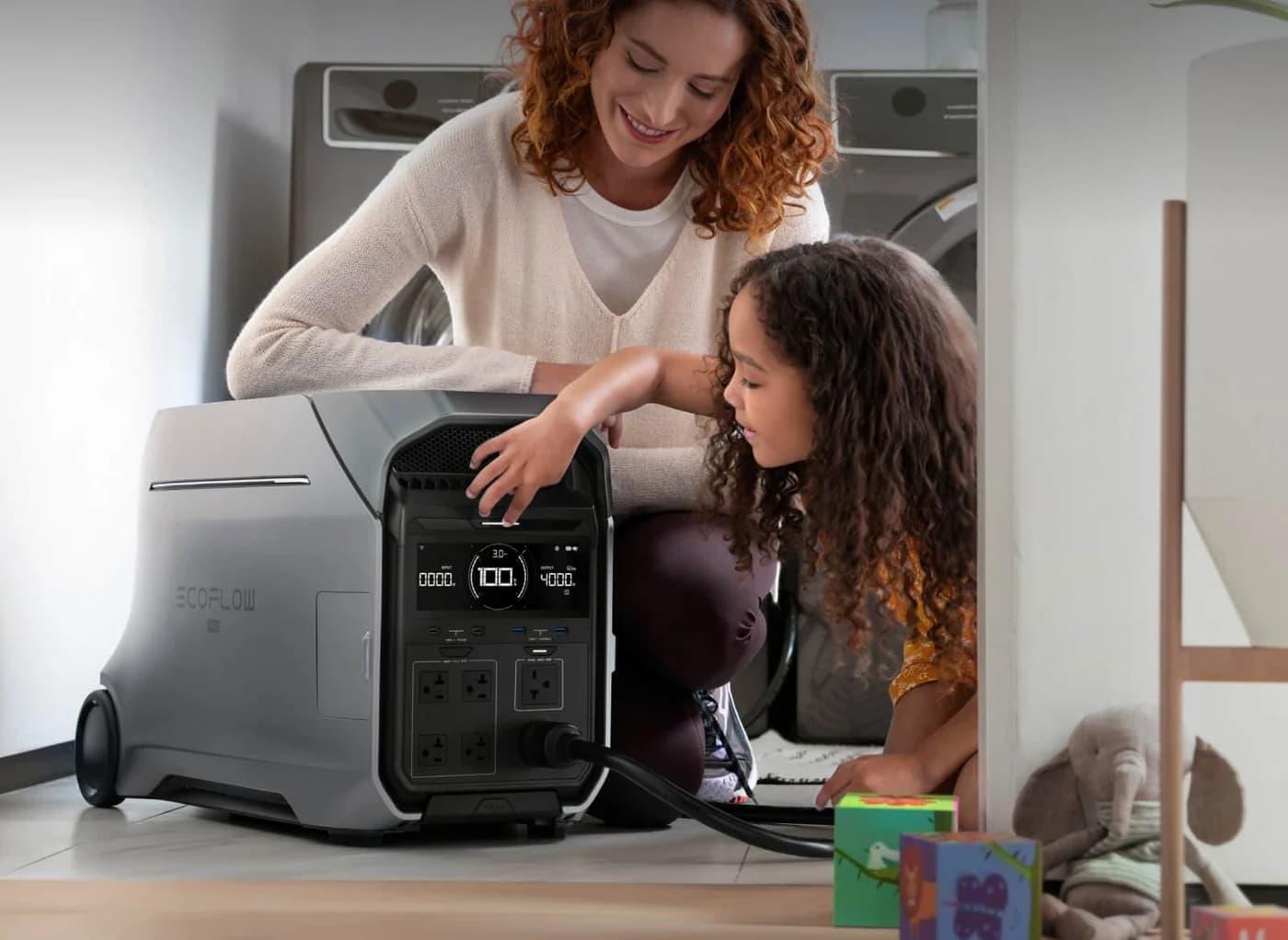
EcoFlow
A 4,096Wh LFP home-backup power station with 4,000W of 120V/240V output (8,000W surge), 2,600W of dual solar input and expansion to 12kWh per unit, listed by EcoFlow as UL 9540 certificated.
Check package and model options
- 4,096 Wh capacity
- 4,000 W AC out
- LiFePO4
That is a complete station for direct compatible loads, with less stored energy and lower total output than the expanded Mango arrangement. It still needs a separately assessed connection system for home circuits. Match the appliance's actual plug and starting demand before ordering.
Its solar paths also differ: 30–150V, 15A, 1,600W maximum at the high-PV input and 11–60V, 20A, 1,000W maximum at the low-PV input. Choose panels and cables for the selected port; Mango's aviation cable is not the EcoFlow manual's XT60/XT60i cable system.
What can one E run, and for how long?
Check voltage, simultaneous running watts and starting demand before calculating hours. A hypothetical 1,000W steady load fits the E's 3,000W continuous budget; that alone says nothing about a particular compressor's start. For a cycling refrigerator, use daily energy or average draw; our refrigerator watts guide explains the distinction.
For illustration, assume 80% of rated capacity reaches the loads, allowing a combined margin for conversion, reserve and station consumption. This is our planning assumption, not a measured Mango efficiency. Mango lists inverter efficiency up to 88%, which is not a guaranteed usable-capacity fraction.
Estimated hours = capacity in Wh × 80% ÷ steady load in W. Thus the small-load example uses 3,533Wh × 80% ÷ 100W. Results below are rounded to whole hours; actual idle draw, temperature, battery condition and load cycling can change them substantially.
100W
- One E: 3,533Wh (estimated hours)
- About 28
- E plus battery: 7,066Wh (estimated hours)
- About 57
300W
- One E: 3,533Wh (estimated hours)
- About 9
- E plus battery: 7,066Wh (estimated hours)
- About 19
1,000W
- One E: 3,533Wh (estimated hours)
- About 3
- E plus battery: 7,066Wh (estimated hours)
- About 6
Full comparison table
Swipe to compare. Row labels stay visible.
| Assumed steady AC load | One E: 3,533Wh (estimated hours) | E plus battery: 7,066Wh (estimated hours) |
|---|---|---|
| 100W | About 28 | About 57 |
| 300W | About 9 | About 19 |
| 1,000W | About 3 | About 6 |
Scroll horizontally to see every column
| Assumed steady AC load | One E: 3,533Wh (estimated hours) | E plus battery: 7,066Wh (estimated hours) |
|---|---|---|
| 100W | About 28 | About 57 |
| 300W | About 9 | About 19 |
| 1,000W | About 3 | About 6 |
Adding the battery helps duration. If the problem is voltage or insufficient output, choose a different system configuration instead.
Before buying a bundle
The E manual distinguishes its included 15A AC cable from a separately sold 30A fast-charge cable for up to 3,000W charging. Confirm the suitable supply with Mango and an electrician; the fastest refill claim is not the standard household-cable experience.
How we choose
We compare official specifications, manuals, included parts and compatibility limits. This is document research, without physical product testing. Runtime and combined-weight figures are explicitly calculated. Mango's store pages could not be retrieved for this check, so the configurations above are manual-based shopping lists, not verified live bundle inventories. Confirm availability and the written package warranty with Mango before ordering; its E specification page lists five years. Purchase links do not change our recommendations (disclosure).
Verdict
Choose one Power E for suitable plug-in essentials, the matching E Battery for longer runtime, and a confirmed two-panel 36V Solar Move configuration for solar recharging. Keep an E you already own when its output meets your needs. For a new 240V purchase, start with DELTA Pro 3; choose Mango's multi-unit route only after its complete parts requirement is confirmed.
Our picks at a glance
- 1
Choose for: Expandable storage with a choice of appliance or installed circuit backup.
Limit: It cannot pair with DELTA Pro Ultra; circuit backup requires compatible connection hardware and an electrician.
Frequently asked questions
Can Mango Power E provide whole home battery backup?
Size it for the actual circuits and appliances. One US Power E is rated at 3,000W and 120V; Mango describes a two-station, 6,000W split-phase system for 240V. Its documentation identifies mPanel Pro for home backup. A home-circuit connection needs a licensed electrician and permits where required. Neither the capacity label nor the phrase whole home establishes that every appliance can run together.
Can the Mango Power E Expansion Battery work by itself?
It cannot supply AC by itself. The matching E Battery adds 3,533Wh to a Power E through the E+ cable, which its manual lists in the battery box. It does have its own USB-C, USB-A and car-power outputs. Buy it to extend an existing Power E's runtime; choose the station when you need household AC outlets.
Do I need two Mango Power E stations for 240V?
Yes. Mango's overview describes two E stations plus mSocket Pro for 240V split-phase output. The mSocket Pro documentation additionally specifies an E Battery on each station. Because those descriptions differ in completeness, get written confirmation of the exact supported configuration before ordering a stripped-down kit. One station plus an expansion battery remains the capacity upgrade, rather than the documented split-phase arrangement.
Will one Solar Move 200W panel charge Power E?
Do not buy one expecting a matched solar setup. The 36V model's published maximum-power voltage is 40.32V and its open-circuit voltage is 48V, both below Power E's 60V input minimum. Our starting configuration uses two matching 36V panels, subject to Mango's approved array requirements. The similarly named 18V panel has different electrical specifications and cannot be substituted on wattage alone.
Is the fastest wall-charging cable included?
The Power E manual identifies an included 15A AC cable and a separately sold 30A fast-charge cable. It associates the latter with up to 3,000W charging; suitable supply requirements also apply. Do not expect the advertised fastest charging from an ordinary outlet and the standard cable. Have Mango and a licensed electrician confirm the supply required for your intended charging arrangement.
Can Mango Power E charge in winter?
Mango lists charging at 14–113°F and discharging at −4–113°F, with operation dependent on actual battery-pack temperature. Being able to discharge in colder weather does not establish permission to recharge at that same temperature. Solar-array voltage is a separate check: cold can raise open-circuit voltage, so have the array approved for the lowest temperature you expect.
Related guides
Buying guide · Solar Generators
How to Size a Solar Generator for a Shed: Loads, Winter Solar and the Full Kit
Size a shed solar generator from actual loads, battery reserve and winter sunshine. Compare complete kits, check panel cables and avoid costly sizing mistakes.
Explainer · Solar Generators
What Is a Solar Generator? Batteries, Panels and Kit Contents
Understand how a solar generator stores power, what works at night, and what a kit includes. Compare two starting points and check panels, cables and limits.
Best picks · Solar Generators
Best Portable Solar Panel Kits with Batteries: Complete Bundles Compared
Compare portable solar panel kits with batteries by exact contents, cables, input limits and winter recharge estimates. Pick a complete US backup package.