

Best picks
Best Home EV Chargers for Kia EV6
Match the Year and Port
Choose a Kia EV6 home charger by model year, inlet and circuit. Compare exact Emporia and Home Flex versions, included cords and realistic overnight charging.
By thisWATT EditorialUpdated November 3, 20268 min read1 pick
On this page · Our picks at a glance
Our picks at a glance
- 1
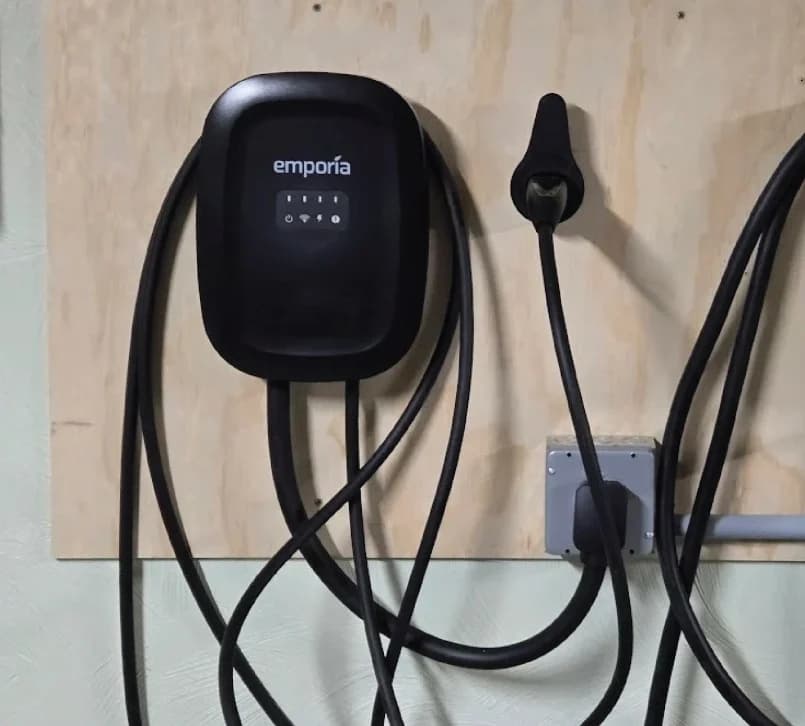
Emporia Classic Level 2 EV Charger (NACS, 48A)
Choose for: Best for a NACS EV6
Check before buying: The plug-in version is limited to 40A; 48A needs hardwiring
For a US Kia EV6 with a J1772 inlet, our starting pick is the Emporia Classic J1772; choose the Classic NACS for a native NACS inlet. The ChargePoint Home Flex is our alternative when an electrician recommends a lower-current hardwired setup. Before buying, check the model-year table: the 2026 EV6 includes a dual-voltage cord, so you may already own enough home-charging equipment.
Quick picks: buy by inlet, then installation
Compare specifications and all conditions
J1772 inlet; buying a home station
- Our recommendation
- Emporia Classic J1772
- What to select
- J1772 vehicle connector; plug-in or hardwired supply connection
NACS inlet; buying a home station
- Our recommendation
- Emporia Classic NACS
- What to select
- NACS vehicle connector; plug-in or hardwired supply connection
Electrician recommends a smaller circuit
- Our recommendation
- ChargePoint Home Flex
- What to select
- Exact hardwired version matching the vehicle inlet
Existing compatible cord covers your daily driving
- Our recommendation
- Keep it
- What to select
- Have the outlet and circuit assessed before relying on it
Full comparison table
Swipe to compare. Row labels stay visible.
| Your situation | Our recommendation | What to select |
|---|---|---|
| J1772 inlet; buying a home station | Emporia Classic J1772 | J1772 vehicle connector; plug-in or hardwired supply connection |
| NACS inlet; buying a home station | Emporia Classic NACS | NACS vehicle connector; plug-in or hardwired supply connection |
| Electrician recommends a smaller circuit | ChargePoint Home Flex | Exact hardwired version matching the vehicle inlet |
| Existing compatible cord covers your daily driving | Keep it | Have the outlet and circuit assessed before relying on it |
Scroll horizontally to see every column
| Your situation | Our recommendation | What to select |
|---|---|---|
| J1772 inlet; buying a home station | Emporia Classic J1772 | J1772 vehicle connector; plug-in or hardwired supply connection |
| NACS inlet; buying a home station | Emporia Classic NACS | NACS vehicle connector; plug-in or hardwired supply connection |
| Electrician recommends a smaller circuit | ChargePoint Home Flex | Exact hardwired version matching the vehicle inlet |
| Existing compatible cord covers your daily driving | Keep it | Have the outlet and circuit assessed before relying on it |
These are specification-based recommendations. For the broader shortlist, see our home Level 2 charger guide.
Identify your EV6: US model year, trim, inlet and original cord
Kia specifies a 10.9kW onboard AC charger for every trim in its model-year specification tables below. Battery size changes the energy you need to replace; it does not establish a higher AC charging limit.
2022: Light; Wind / GT-Line
- Kia battery capacity
- 58kWh; 77.4kWh
- Home AC connector
- J1772
- Onboard charger
- 10.9kW
All specifications
- Portable charging equipment
- Manual says separately sold
2023: Wind / GT-Line / GT
- Kia battery capacity
- 77.4kWh
- Home AC connector
- J1772
- Onboard charger
- 10.9kW
All specifications
- Portable charging equipment
- ICCB optional in feature table
2024: Light; Light Long Range / Wind / GT-Line / GT
- Kia battery capacity
- 58kWh; 77.4kWh
- Home AC connector
- J1772
- Onboard charger
- 10.9kW
All specifications
- Portable charging equipment
- ICCB optional in feature table
2025: Light Standard Range; Light Long Range / Wind / GT-Line
- Kia battery capacity
- 63.0kWh; 84.0kWh
- Home AC connector
- NACS
- Onboard charger
- 10.9kW
All specifications
- Portable charging equipment
- ICCB optional in feature table
2025: GT
- Kia battery capacity
- 84.0kWh
- Home AC connector
- Confirm actual inlet; see GT note
- Onboard charger
- 10.9kW
All specifications
- Portable charging equipment
- ICCB optional in feature table
2026: Light; Light Long Range / Wind / GT-Line
- Kia battery capacity
- 63.0kWh; 84.0kWh
- Home AC connector
- NACS
- Onboard charger
- 10.9kW
All specifications
- Portable charging equipment
- Dual-voltage cable standard; manual conflicts
Full comparison table
Swipe to compare. Row labels stay visible.
| US model year and trims | Kia battery capacity | Home AC connector | Onboard charger | Portable charging equipment |
|---|---|---|---|---|
| 2022: Light; Wind / GT-Line | 58kWh; 77.4kWh | J1772 | 10.9kW | Manual says separately sold |
| 2023: Wind / GT-Line / GT | 77.4kWh | J1772 | 10.9kW | ICCB optional in feature table |
| 2024: Light; Light Long Range / Wind / GT-Line / GT | 58kWh; 77.4kWh | J1772 | 10.9kW | ICCB optional in feature table |
| 2025: Light Standard Range; Light Long Range / Wind / GT-Line | 63.0kWh; 84.0kWh | NACS | 10.9kW | ICCB optional in feature table |
| 2025: GT | 84.0kWh | Confirm actual inlet; see GT note | 10.9kW | ICCB optional in feature table |
| 2026: Light; Light Long Range / Wind / GT-Line | 63.0kWh; 84.0kWh | NACS | 10.9kW | Dual-voltage cable standard; manual conflicts |
Scroll horizontally to see every column
| US model year and trims | Kia battery capacity | Home AC connector | Onboard charger | Portable charging equipment |
|---|---|---|---|---|
| 2022: Light; Wind / GT-Line | 58kWh; 77.4kWh | J1772 | 10.9kW | Manual says separately sold |
| 2023: Wind / GT-Line / GT | 77.4kWh | J1772 | 10.9kW | ICCB optional in feature table |
| 2024: Light; Light Long Range / Wind / GT-Line / GT | 58kWh; 77.4kWh | J1772 | 10.9kW | ICCB optional in feature table |
| 2025: Light Standard Range; Light Long Range / Wind / GT-Line | 63.0kWh; 84.0kWh | NACS | 10.9kW | ICCB optional in feature table |
| 2025: GT | 84.0kWh | Confirm actual inlet; see GT note | 10.9kW | ICCB optional in feature table |
| 2026: Light; Light Long Range / Wind / GT-Line | 63.0kWh; 84.0kWh | NACS | 10.9kW | Dual-voltage cable standard; manual conflicts |
Sources: Kia's 2022, 2023, 2024, 2025 and 2026 specifications, their feature tables, and the current US trim comparison. ICCB means In-Cable Control Box: the portable charging equipment.
GT needs an extra check. Kia's launch release excludes GT in the sentence describing the relocated, NACS-compatible port; a later announcement calls NACS standard on the 2025 EV6 without that qualification. Have Kia confirm the actual GT inlet before ordering. For 2026 GT listings, also obtain vehicle-specific documentation: Kia's specification table omits GT, while its feature table includes a GT column.
The included-cord conflict matters. Kia's 2026 announcement makes the dual-voltage cable standard across trims; its 2026 manual still calls the portable cable separately sold. Check the vehicle's equipment and delivery paperwork before purchasing a replacement.
Identify the vehicle
Confirm US model year and trim, then inspect the actual inlet; resolve GT documentation with Kia.
Inspect your existing kit
Read the cord label and check the supplied input connectors before replacing it.
Get an installation assessment
Ask a licensed electrician to establish the available circuit capacity, connection and cable route.
Order the exact version
Match both the vehicle connector and the supply connection to that assessment.
Best for a J1772 EV6: Emporia Classic J1772
The Classic combines a 25-foot vehicle cable, UL 2594 certification and a NEMA Type 4 indoor/outdoor enclosure, according to Emporia's current sheet. Choose its J1772 connector for a J1772-inlet EV6. A CCS1 inlet also accepts J1772 AC equipment; the extra DC pins do not require a CCS home charger.
The supply connection decides output: 40A / 9.6kW with NEMA 14-50, or 48A / 11.5kW hardwired, at 240V. Select the installation option explicitly; the connector name alone does not specify it. Emporia's app supports off-peak scheduling, but changing rates and enabling automation requires app setup. Preset schedules continue through Wi-Fi outages.
Choose it if: you want a straightforward J1772 station with scheduling. Reconsider if: your existing cord already meets your overnight needs.
Best for a NACS EV6: Emporia Classic NACS
Emporia
Emporia Classic Level 2 EV Charger (NACS, 48A)
A 48A (11.5kW) ENERGY STAR smart Level 2 home charger with a NACS (SAE J3400) connector that opens the Tesla charge port, a 25-ft cable and NEMA Type 4 enclosure.
- 48 A max
- 11.5 kW max
- NACS (J3400)
Buy this connector version for a verified NACS inlet. It has the same 25-foot cable, 48A hardwired ceiling, 40A plug-in ceiling and UL 2594 certification in Emporia's sheet. Choosing native NACS removes the need for a J1772-to-NACS adapter in that home connection.
Emporia describes a NACS handle sensor that opens a Tesla charging port. That statement does not establish remote opening of a Kia charging door; do not make it a reason to buy this version for an EV6.
Choose it if: you are buying a new station for a NACS EV6. Keep what you own if: an existing J1772 station and Kia-approved AC adapter already cover the job. Our Emporia version guide helps check the exact configuration.
Best for a lower-current hardwired quote: ChargePoint Home Flex
The exact J1772 hardwired order code is CPH50-HARDWIRE-L23-K; its NACS counterpart is CPH50-HARDWIRE-L23-NACS-K. ChargePoint's datasheet specifies a 23-foot cable, UL/cUL listing, and current settings of 16A, 24A, 32A, 40A, 48A or 50A. This makes it a useful shortlist option when an electrician proposes charging below the headline maximum.
Its 12kW / 50A ceiling is station capability, not an EV6 charging promise. The NEMA 14-50 and NEMA 6-50 plug-in versions are limited to 32A or 40A; they are separate supply choices from the hardwired models above.
Before accepting an installation quote, resolve ChargePoint's support wording: its FAQ says any licensed electrician can install, but the manual revised May 2026 adds ChargePoint-certified-technician and approved-method warranty conditions. See the Home Flex configuration guide.
See Home Flex configurations at ChargePoint
Compare the equipment, not just the amp badge
Emporia Classic J1772
- Hardwired station maximum at 240V
- 48A / 11.5kW
- Plug-in limit
- 40A, NEMA 14-50
- Vehicle cable
- 25 ft
All specifications
- Maker's safety listing
- UL 2594
Emporia Classic NACS
- Hardwired station maximum at 240V
- 48A / 11.5kW
- Plug-in limit
- 40A, NEMA 14-50
- Vehicle cable
- 25 ft
All specifications
- Maker's safety listing
- UL 2594
Home Flex J1772 or NACS, ordered separately
- Hardwired station maximum at 240V
- 50A / 12kW
- Plug-in limit
- 32A or 40A, NEMA 14-50 or 6-50
- Vehicle cable
- 23 ft
All specifications
- Maker's safety listing
- UL and cUL listed
Full comparison table
Swipe to compare. Row labels stay visible.
| Exact connector version | Hardwired station maximum at 240V | Plug-in limit | Vehicle cable | Maker's safety listing |
|---|---|---|---|---|
| Emporia Classic J1772 | 48A / 11.5kW | 40A, NEMA 14-50 | 25 ft | UL 2594 |
| Emporia Classic NACS | 48A / 11.5kW | 40A, NEMA 14-50 | 25 ft | UL 2594 |
| Home Flex J1772 or NACS, ordered separately | 50A / 12kW | 32A or 40A, NEMA 14-50 or 6-50 | 23 ft | UL and cUL listed |
Scroll horizontally to see every column
| Exact connector version | Hardwired station maximum at 240V | Plug-in limit | Vehicle cable | Maker's safety listing |
|---|---|---|---|---|
| Emporia Classic J1772 | 48A / 11.5kW | 40A, NEMA 14-50 | 25 ft | UL 2594 |
| Emporia Classic NACS | 48A / 11.5kW | 40A, NEMA 14-50 | 25 ft | UL 2594 |
| Home Flex J1772 or NACS, ordered separately | 50A / 12kW | 32A or 40A, NEMA 14-50 or 6-50 | 23 ft | UL and cUL listed |
Sources: the Emporia sheet and ChargePoint datasheet linked above. Plug-in figures describe the separately selected plug-in configurations.
Keep the original cord when it covers your driving
The 2026 EV6 manual's Type B cord specifies 120V / 240V, 12A / 30A maximum with different input cords, a 20-foot cable, and 5-15P and 14-50P detachable connectors. Calculated at 240V, 30A × 240V = 7.2kW before charging losses. Confirm the actual supplied cord matches that label before using these figures; the manual also describes another cord type.
If that compatible equipment replenishes your daily use within your parking window, keep it. A fixed station is worth considering for cable placement, scheduling, or a higher supported charging rate. Have a licensed electrician assess the receptacle and circuit, including for a portable cord; owning a matching plug does not establish installation suitability.
Estimate overnight charging for your car and circuit
Use estimated hours = battery capacity × fraction replenished ÷ effective charging power. Use the lower of the configured station output and Kia's onboard rating as a conservative planning ceiling; allow extra time for losses and conditions. This is planning arithmetic, not measured wall-to-battery efficiency.
30A
- ChargePoint's output setting
- 24A, hardwired
- Maker's approximate station power at 240V
- 5.8kW
40A
- ChargePoint's output setting
- 32A
- Maker's approximate station power at 240V
- 7.7kW
50A
- ChargePoint's output setting
- 40A
- Maker's approximate station power at 240V
- 9.6kW
60A
- ChargePoint's output setting
- 48A, hardwired
- Maker's approximate station power at 240V
- 11.5kW; use Kia's 10.9kW rating for planning
Full comparison table
Swipe to compare. Row labels stay visible.
| Electrician-assessed circuit | ChargePoint's output setting | Maker's approximate station power at 240V |
|---|---|---|
| 30A | 24A, hardwired | 5.8kW |
| 40A | 32A | 7.7kW |
| 50A | 40A | 9.6kW |
| 60A | 48A, hardwired | 11.5kW; use Kia's 10.9kW rating for planning |
Scroll horizontally to see every column
| Electrician-assessed circuit | ChargePoint's output setting | Maker's approximate station power at 240V |
|---|---|---|
| 30A | 24A, hardwired | 5.8kW |
| 40A | 32A | 7.7kW |
| 50A | 40A | 9.6kW |
| 60A | 48A, hardwired | 11.5kW; use Kia's 10.9kW rating for planning |
These are ChargePoint's published pairings, not permission to change a circuit or charger setting yourself. Hardwired chargers need a licensed electrician and a permit where required.
For an assumed 20% to 80% top-up on a 77.4kWh car at 9.6kW, calculate 77.4 × (80% − 20%) ÷ 9.6: about five hours before losses. The same calculation for 84.0kWh is a little over five hours. Compare that with your actual overnight window rather than paying for maximum amperage automatically.
Kia's 2025/2026 AC reference rows list 5h 40m for the smaller battery and 7h 20m for the larger one using 240V / 48A. Those rows do not label the starting and ending percentages. The 2024 feature-tips booklet instead says approximately 9 hours for a full charge without that same reference setup; these figures are not interchangeable. Battery condition, charger specifications and temperature can change charging time.
Cable reach, outdoor siting and the electrician's quote
Measure the parked-car cable route with slack, including your usual parking direction and any second vehicle. Do not close a garage door on the cable. ChargePoint recommends an installation location that reaches the inlet with slack and has Wi-Fi signal.
Emporia lists NEMA Type 4; ChargePoint lists Type 3R and requires hardwiring or a weatherproof receptacle outdoors. ChargePoint's operating-temperature documents conflict: the datasheet gives −22°F to 122°F, while the North American installation manual gives −40°F to 122°F. Obtain confirmation for the exact unit before relying on the colder limit.
Ask the electrician to document available capacity, permitted current, outdoor protection and the complete installation scope. Both makers flag possible nuisance trips with an upstream GFCI and recommend considering hardwiring where local requirements call for that protection. Let the electrician resolve code compliance.
Home AC adapters and public DC accessories are separate purchases
Kia's 800V fast-charging description concerns DC; these home stations use 240V AC.
Kia distinguishes J1772-to-NACS for AC, NACS-to-CCS1 for DC, and CCS1-to-NACS for DC. Match the source connector, vehicle inlet and charging type; use equipment approved for your exact vehicle and remain within every component's rating.
- Yes: J1772-inlet EV6 with a J1772 AC station: direct connection
- Yes: NACS-inlet EV6 with a NACS AC station: direct connection
- Partly: NACS-inlet EV6 with a J1772 AC station: approved J1772-to-NACS AC adapter needed
- No: Kia NACS-to-CCS1 DC adapter as proof of AC home-charger compatibility
Kia's adapter FAQ restricts its NACS adapter to compatible fast charging stations. Confirm your public-charging accessory separately from this home purchase; our NACS and J1772 adapter guide explains the directions.
How we choose
We compare official US Kia model tables and manuals against charger datasheets, installation guides and support pages. Selection weighs connector fit, current settings, cable reach and installation constraints. Unresolved official-source conflicts stay visible. We have not physically evaluated these chargers; estimates use stated assumptions. Affiliate commissions do not determine the picks (disclosure).
Verdict
Start with Emporia Classic J1772 or NACS, matched to the actual EV6 inlet. Consider the exact Home Flex hardwired version when it fits your electrician's proposed circuit. For a 2026 EV6, inspect the included dual-voltage cord first: buy a fixed station when its placement, features or supported rate solves a problem you actually have.
Frequently asked questions
What home charger should I buy for a Kia EV6?
Start with the Emporia Classic in the connector version matching your actual inlet: J1772 or NACS. Both offer up to 48A hardwired or 40A with their NEMA 14-50 plug. Consider the ChargePoint Home Flex when your electrician recommends a lower-current hardwired installation. For a 2026 EV6, inspect the standard dual-voltage charging cable before buying another charger.
Does the Kia EV6 come with a charging cable?
It depends on the US model year. The 2022 manual calls the portable charger separately sold, and Kia's 2023 through 2025 feature tables mark the ICCB optional. Kia's 2026 announcement makes a dual-voltage cable standard across trims, although the 2026 manual still says separately sold. Check your vehicle's delivery equipment and cable label; a manual section describing a charger does not establish that it was included.
Will a 50A charger charge my EV6 faster than a 48A charger?
Do not buy it for that expectation alone. Kia lists a 10.9kW onboard charger throughout the model years covered here, while its AC charging-time tables use a 240V, 48A supply. Home Flex's 50A and 12kW figures describe the station's capability. Your actual charging rate also depends on the installed current setting, vehicle settings and battery conditions.
Can I use my Kia NACS Supercharger adapter at home?
Kia says its NACS-to-CCS1 adapter is for compatible DC fast charging stations. It does not establish compatibility with a NACS AC home charger. A NACS-inlet EV6 using a J1772 AC station instead needs an approved J1772-to-NACS AC adapter. Check both the direction and the charging type, and confirm approval for your vehicle before buying an adapter.
How long does a Kia EV6 take to charge at home?
For the 2025 and 2026 specifications, Kia lists 5h 40m for the smaller battery and 7h 20m for the larger battery on its 240V, 48A AC reference supply. The specification row does not identify the starting and ending charge percentages, so do not treat those figures as a universal empty-to-full promise. Calculate your own top-up and allow extra time.
Related guides
Best picks · Level 2 EV Chargers
Best Home EV Chargers for BMW iX: Keep the Cord or Buy?
Choose a home EV charger for your BMW iX: when to keep the BMW cord, which J1772 wall chargers to buy, and how to check model year, supply and overnight needs.
Best picks · Level 2 EV Chargers
Best Home EV Chargers for Subaru Solterra: 25-ft Picks by Year
Choose a home charger for your US Solterra by model year, connector and actual cable reach. Compare verified 25-ft options, shorter alternatives and setup.
Best picks · Level 2 EV Chargers
Best Home Chargers for Tesla Model Y: Buy for Your Daily Miles
Choose a Tesla Model Y home charger by vehicle limits, daily miles and parking reach. Compare Tesla, Emporia and Home Flex, or keep your Mobile Connector.