

Explainer
Level 1 vs Level 2 Charging
Will Overnight Cover Your Commute?
Find out whether your home charging covers tomorrow's drive: use official vehicle consumption, overnight hours and winter scenarios before choosing a charger.
By thisWATT EditorialUpdated November 3, 20268 min read1 pick
On this page · Quick decisions
Keep your supplied Level 1 cord if it replaces your daily driving energy during the hours you actually charge, with room for cold days. In the sedan example below, ten hours at 120V/12A supplies about 14 kilowatt-hours before allowances, while a 40-mile daily drive needs about 11, rounded up from its official consumption rate. When the worksheet shows a regular shortfall, our fixed home pick is the Emporia Classic, with the connector matched to your car.
Quick decisions
Daily energy fits comfortably, including your cold-weather allowance
- Our pick
- Keep the supplied cord, after checking its rating and the supply
A recurring shortfall, short charging windows or irregular departures
- Our pick
- Consider Level 2; size it with the worksheet below
A fixed home charging location
- Our pick
- Emporia Classic, J1772 or NACS to match the car
A portable cord that can use either supply voltage
- Our pick
- Ampure Go 1 for J1772; Grizzl-E Mini Connect for NACS
Full comparison table
Swipe to compare. Row labels stay visible.
| Your result | Our pick |
|---|---|
| Daily energy fits comfortably, including your cold-weather allowance | Keep the supplied cord, after checking its rating and the supply |
| A recurring shortfall, short charging windows or irregular departures | Consider Level 2; size it with the worksheet below |
| A fixed home charging location | Emporia Classic, J1772 or NACS to match the car |
| A portable cord that can use either supply voltage | Ampure Go 1 for J1772; Grizzl-E Mini Connect for NACS |
Scroll horizontally to see every column
| Your result | Our pick |
|---|---|
| Daily energy fits comfortably, including your cold-weather allowance | Keep the supplied cord, after checking its rating and the supply |
| A recurring shortfall, short charging windows or irregular departures | Consider Level 2; size it with the worksheet below |
| A fixed home charging location | Emporia Classic, J1772 or NACS to match the car |
| A portable cord that can use either supply voltage | Ampure Go 1 for J1772; Grizzl-E Mini Connect for NACS |
DOE's home-charging guidance says overnight Level 1 meets many drivers' daily needs; longer commutes and irregular schedules can justify Level 2. Replacing yesterday's driving is the useful comparison here, rather than filling an empty battery every night.
Level 1 vs Level 2: what changes?
In North America, Level 1 uses 120V AC; residential Level 2 usually uses 240V AC, with 208V also used commercially. The car's onboard charger converts AC to DC for the battery. Its AC acceptance limit can restrict either setup (DOE, AFDC).
The table shows AC ratings or calculations: volts × charging amps ÷ 1,000 gives kilowatts. These are charging currents, not instructions for selecting breakers or wiring; battery energy received will be lower because of losses.
Level 1 example
- Supply and charging current
- 120V × 12A
- AC power ceiling
- 1.4 kW, maker-rounded
- Relevant distinction
- Ampure Go 1's household mode
Modest Level 2 example
- Supply and charging current
- 240V × 16A
- AC power ceiling
- 240 × 16 ÷ 1,000
- Relevant distinction
- Calculate the kilowatts; can be sufficient for modest overnight needs
Portable Level 2 example
- Supply and charging current
- 240V × 32A
- AC power ceiling
- 7.7 kW, maker-rounded
- Relevant distinction
- Ampure Go 1's higher-voltage mode
Higher-output plug-in Level 2
- Supply and charging current
- 240V × 40A
- AC power ceiling
- 9.6 kW
- Relevant distinction
- Maximum plug-in output of the Emporia Classic
Hardwired Level 2
- Supply and charging current
- 240V × 48A
- AC power ceiling
- 11.5 kW, maker-rounded
- Relevant distinction
- Requires hardwiring and sufficient vehicle acceptance
Full comparison table
Swipe to compare. Row labels stay visible.
| Charging setup | Supply and charging current | AC power ceiling | Relevant distinction |
|---|---|---|---|
| Level 1 example | 120V × 12A | 1.4 kW, maker-rounded | Ampure Go 1's household mode |
| Modest Level 2 example | 240V × 16A | 240 × 16 ÷ 1,000 | Calculate the kilowatts; can be sufficient for modest overnight needs |
| Portable Level 2 example | 240V × 32A | 7.7 kW, maker-rounded | Ampure Go 1's higher-voltage mode |
| Higher-output plug-in Level 2 | 240V × 40A | 9.6 kW | Maximum plug-in output of the Emporia Classic |
| Hardwired Level 2 | 240V × 48A | 11.5 kW, maker-rounded | Requires hardwiring and sufficient vehicle acceptance |
Scroll horizontally to see every column
| Charging setup | Supply and charging current | AC power ceiling | Relevant distinction |
|---|---|---|---|
| Level 1 example | 120V × 12A | 1.4 kW, maker-rounded | Ampure Go 1's household mode |
| Modest Level 2 example | 240V × 16A | 240 × 16 ÷ 1,000 | Calculate the kilowatts; can be sufficient for modest overnight needs |
| Portable Level 2 example | 240V × 32A | 7.7 kW, maker-rounded | Ampure Go 1's higher-voltage mode |
| Higher-output plug-in Level 2 | 240V × 40A | 9.6 kW | Maximum plug-in output of the Emporia Classic |
| Hardwired Level 2 | 240V × 48A | 11.5 kW, maker-rounded | Requires hardwiring and sufficient vehicle acceptance |
Sources: Ampure specification sheet and Emporia Classic sheet. The modest-current row is a sizing example, not another product recommendation.
Build your overnight charging worksheet
Use total daily miles, including the return trip and errands. For consumption, find your exact year and configuration on FuelEconomy.gov and use combined kWh/100 miles. For time, count hours when charging is actually allowed by both car and charger schedules, not simply hours parked.
Avoid counting losses twice. EPA explains that its electricity-economy figures include charging losses under Level 2 AC conditions. Use them as a wall-energy starting point; Level 1 efficiency can differ. We separately choose a 20% planning reserve for extra overhead, interruptions and uncertainty. This is an editorial allowance, not a claim that every charger loses 20%.
Daily energy
Daily miles × official combined kWh/100 miles ÷ 100; multiply by your chosen weather factor.
Available AC power
Use the lowest of the approved supply output, EVSE setting and vehicle AC acceptance limit.
Overnight budget
Available kW × actual charging hours × 80%, using this guide's discretionary planning reserve; round down to whole kilowatt-hours.
Decision
A recurring energy need above that budget supports considering Level 2 or another dependable charging window.
For the Level 1 example, use the maker's conservatively rounded 1.4 kW. With ten hours of charging, available energy in kilowatt-hours is 1.4 × 10 = 14; apply the reserve with 14 × 80%, then round down to 11. This planning budget is an allowance against EPA wall-energy demand, not a prediction of energy stored in the battery.
If using consumption shown by the car instead, first confirm what it measures. For a battery-energy reading, estimate wall demand as battery kWh ÷ assumed charging efficiency, clearly identifying the efficiency as an assumption unless documented for that setup. Do not apply that conversion to the EPA wall-energy figure. Actual losses depend on the vehicle, charging system, battery state and weather (DOE/EPA).
Worked examples: short, medium and long daily drives
These historical vehicle configurations provide reproducible examples, not ratings for every car bearing the same name. FuelEconomy.gov lists the 2024 Tesla Model 3 Long Range AWD-E at 26 kWh/100 mi, and the 2024 Ford F-150 Lightning 4WD Extended Range at 48 kWh/100 mi (sedan, pickup).
These estimates use those rates, no weather multiplier, and the 11 kilowatt-hour overnight budget above. Round energy demand up to whole kilowatt-hours; calculate hours from unrounded demand ÷ 1.4 kW, then round up to whole hours before the reserve.
Sedan, 20 miles
- Wall energy (kWh), rounded up
- 20 × 26 ÷ 100 → 6
- Charging time (hours), rounded up before reserve
- 4
- Decision for the assumed overnight window
- Comfortable baseline margin: keep the cord if cold-weather use also fits
Sedan, 40 miles
- Wall energy (kWh), rounded up
- 40 × 26 ÷ 100 → 11
- Charging time (hours), rounded up before reserve
- 8
- Decision for the assumed overnight window
- Fits narrowly; check winter and missed charging
Sedan, 80 miles
- Wall energy (kWh), rounded up
- 80 × 26 ÷ 100 → 21
- Charging time (hours), rounded up before reserve
- 15
- Decision for the assumed overnight window
- Exceeds the window: consider Level 2
Pickup, 40 miles
- Wall energy (kWh), rounded up
- 40 × 48 ÷ 100 → 20
- Charging time (hours), rounded up before reserve
- 14
- Decision for the assumed overnight window
- Exceeds the window despite the shorter distance
Full comparison table
Swipe to compare. Row labels stay visible.
| Total daily drive | Wall energy (kWh), rounded up | Charging time (hours), rounded up before reserve | Decision for the assumed overnight window |
|---|---|---|---|
| Sedan, 20 miles | 20 × 26 ÷ 100 → 6 | 4 | Comfortable baseline margin: keep the cord if cold-weather use also fits |
| Sedan, 40 miles | 40 × 26 ÷ 100 → 11 | 8 | Fits narrowly; check winter and missed charging |
| Sedan, 80 miles | 80 × 26 ÷ 100 → 21 | 15 | Exceeds the window: consider Level 2 |
| Pickup, 40 miles | 40 × 48 ÷ 100 → 20 | 14 | Exceeds the window despite the shorter distance |
Scroll horizontally to see every column
| Total daily drive | Wall energy (kWh), rounded up | Charging time (hours), rounded up before reserve | Decision for the assumed overnight window |
|---|---|---|---|
| Sedan, 20 miles | 20 × 26 ÷ 100 → 6 | 4 | Comfortable baseline margin: keep the cord if cold-weather use also fits |
| Sedan, 40 miles | 40 × 26 ÷ 100 → 11 | 8 | Fits narrowly; check winter and missed charging |
| Sedan, 80 miles | 80 × 26 ÷ 100 → 21 | 15 | Exceeds the window: consider Level 2 |
| Pickup, 40 miles | 40 × 48 ÷ 100 → 20 | 14 | Exceeds the window despite the shorter distance |
Shorten the charging window to eight hours, and the same Level 1 planning budget falls to 8 whole kilowatt-hours after rounding down: 1.4 × 8 × 80%. Even the sedan's baseline 40-mile day then falls short. A timer that starts late can change the decision as much as the commute.
Winter sensitivity: see where the answer flips
For the sedan's 40-mile day, increase the unrounded demand by assumed 30% and 50% increments, then round up. Whole kilowatt-hours needed become 11 at baseline, 14 with the assumed 30% increase and 16 with the assumed 50% increase. Both colder-weather scenarios exceed our 11 kilowatt-hour planning budget. These are sensitivity scenarios, not predictions for specific temperatures; the separate planning reserve remains unchanged.
Source: linked EPA sedan rating; demand rounded up; weather increases are assumptions
DOE recommends preconditioning while plugged in, so cabin and battery warming can occur before departure. That guidance does not guarantee a low-power cord has enough surplus for your winter needs. Check your morning charge level through representative cold days; if it trends downward across similar driving days, revise the worksheet or charging arrangement.
How much Level 2 do you actually need?
Rearrange the worksheet: required AC kW = daily wall-energy need ÷ charging hours ÷ 80%. Use unrounded inputs for equipment sizing. The 80-mile sedan example, including our assumed 30% weather increase and reserve, fits within an approved 240V/16A setup over ten hours: compare (daily demand + daily demand × 30%) ÷ 10 ÷ 80% with 240 × 16 ÷ 1,000, both in kilowatts. Confirm the car and equipment support the intended setting with your electrician.
Check the vehicle's AC onboard rating, not its advertised DC fast-charging peak. Nissan specifies a 6.6 kW onboard charger, with 6.0 kW output, for the 2024 LEAF. For that car, a higher-rated EVSE cannot force acceptance above the onboard limit. Use the AC figure when comparing supply ceilings; the DC output figure describes a different point in the energy path.
Fixed home pick for J1772: Emporia Classic
Choose this when the calculation supports Level 2 and the car accepts J1772 AC charging. Emporia specifies 40A/9.6 kW maximum through its NEMA 14-50 plug, or 48A/11.5 kW hardwired, a 25-ft cable, and UL 2594 certification. Its app supports charging schedules; use the scheduled window in your calculation (official specifications).
Fixed home pick for NACS: Emporia Classic NACS
Choose the NACS connector version for a car that accepts it. It shares the J1772 Classic's output limits, cable length and stated safety certification; choosing NACS does not raise the charging power. Connector choice and plug-in versus hardwired configuration are separate selections on Emporia's page. Check both before ordering, and distinguish Classic from Pro.
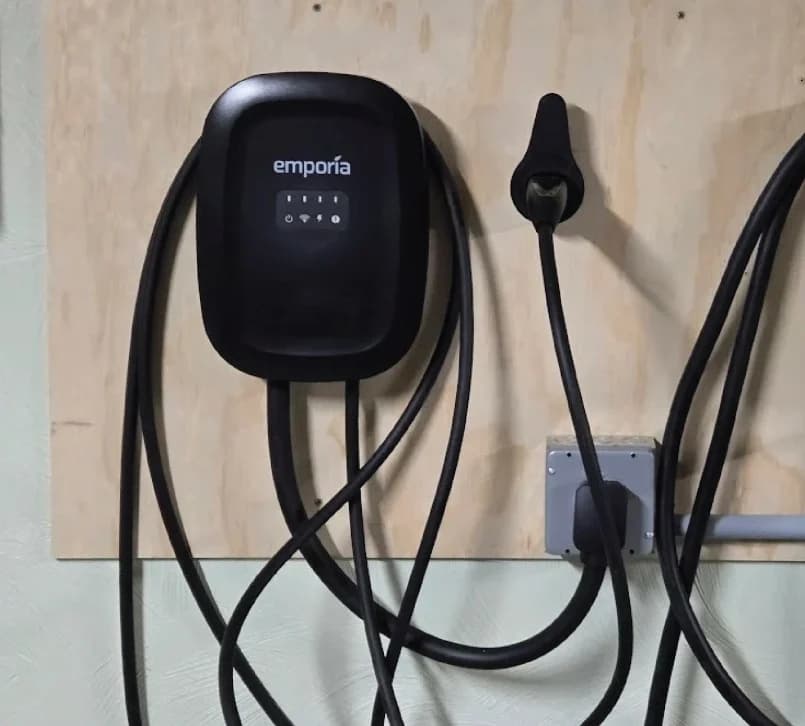
Emporia
Emporia Classic Level 2 EV Charger (NACS, 48A)
A 48A (11.5kW) ENERGY STAR smart Level 2 home charger with a NACS (SAE J3400) connector that opens the Tesla charge port, a 25-ft cable and NEMA Type 4 enclosure.
- 48 A max
- 11.5 kW max
- NACS (J3400)
Portable J1772 pick: Ampure Go 1
Ampure Go 1 suits a J1772 driver who needs both voltage options: its sheet states 12A at 120V, 32A at 240V, a 20-ft cable, NEMA 5-15 and 14-50 plugs, and UL/cUL certification. Higher-voltage capability helps only where a suitable supply exists.
Confirm availability with Ampure: its page and product feed show conflicting availability indicators.
Choose Go 1 J1772 deliberately. Go 2 is a different selection: Ampure's business page gives both 32A overview wording and a 40A specification, while its consumer page advertises 32A. Confirm that model's exact rating before substituting it. Go 1's sheet also says 9 lbs and NEMA 6P, while its North American manual says 8.6 lb and Type 6; we do not use those conflicting figures to choose it.
Portable NACS pick: Grizzl-E Mini Connect
Choose the Mini Connect NACS version if you need its portable outlet kit. Its manual states 40A/9.60 kW maximum, a 25-ft cable, UL certification E510712, and a NEMA 14-50 plug with 5-15, TT-30, 14-30 and 6-50 adapters. The product page calls the output 10 kW; the manual gives the more precise figure.
Its voltage detection cannot detect circuit amperage. Have the permitted charging current confirmed for each supply before use; a supplied adapter does not establish safe current. The maker lists Mini Connect and Mini Original separately, and J1772 is another connector option: match the connector and the manual to the version ordered.
Before choosing the equipment
Have a licensed electrician assess supply capacity, outlet suitability and any required installation; hardwired chargers need professional installation and a permit where required. USFA advises using certified equipment and plugging household EV charging directly into a suitable outlet, without an extension cord or multiplug adapter. Follow the equipment and vehicle manuals.
After sizing, compare the wider fixed Level 2 shortlist or portable EV charger choices.
How we choose
This is specification research and arithmetic, without physical product testing. We use official vehicle-consumption records, government charging guidance and manufacturer documents; the picks follow connector fit, rated current and stated safety certification. The reserve, weather multipliers and example driving schedules are explicit assumptions. Actual voltage, charging efficiency, temperature, vehicle limits and interruptions can change the result. Check morning charge levels against the estimate before relying on a narrow margin.
Verdict
Keep the supplied cord when your daily replacement calculation leaves comfortable room. Choose Level 2 for a recurring shortfall, then buy the output and connector the calculation supports: Emporia Classic for a fixed location, Ampure Go 1 J1772 or Grizzl-E Mini Connect NACS for portable use. Recheck the answer when your driving, charging hours or winter demand changes.
Our picks at a glance
- 1
Emporia Classic Level 2 EV Charger (NACS, 48A)
Choose for: Fixed home pick for NACS
Check before buying: The plug-in version is limited to 40A; 48A needs hardwiring
Frequently asked questions
Is Level 1 charging enough for a 40-mile commute?
It can be, depending on the vehicle and charging window. Our sedan example rounds its energy requirement up to 11 kilowatt-hours for 40 total daily miles. Ten hours at the maker-rounded 1.4 kW gives 14 kilowatt-hours before allowances. Our chosen reserve and conservative rounding leave an 11 kilowatt-hour planning budget. That covers the baseline narrowly; our colder-weather scenarios exceed that budget. Include the return journey and errands in your mileage.
Do I need a 48A charger to get Level 2 charging?
No. Level 2 describes the AC supply category, not a requirement to charge at 48A. An approved 240V/16A setup is one lower-current example: calculate its AC power as 240 × 16 ÷ 1,000, in kilowatts. Size the charging window against your energy need, then have a licensed electrician assess a suitable supply. Emporia Classic's 48A rating applies to hardwiring; its plug-in limit is 40A.
Can I use my supplied charging cord with a 240V outlet?
Only if that exact cord is rated for the higher voltage and uses the manufacturer's approved outlet connection. A household plug alone does not establish dual-voltage support. Ampure Go 1 is a documented example: its sheet specifies 120V/12A and 240V/32A with the listed outlet plugs. Check your own cord's label and manual rather than buying a generic conversion adapter.
How much extra charging time should I allow in winter?
There is no single allowance for every vehicle. Our worksheet explores 30% and 50% higher wall-energy demand as assumptions, not measured winter losses or temperature forecasts. Official guidance says charging losses vary with weather and recommends preconditioning while plugged in. Start with your vehicle's guidance, then compare actual charging-session energy and morning charge levels during your own cold weather.
Related guides
Best picks · Level 2 EV Chargers
Best Home EV Chargers for Subaru Solterra: 25-ft Picks by Year
Choose a home charger for your US Solterra by model year, connector and actual cable reach. Compare verified 25-ft options, shorter alternatives and setup.
Best picks · Level 2 EV Chargers
Best Home Chargers for Tesla Model Y: Buy for Your Daily Miles
Choose a Tesla Model Y home charger by vehicle limits, daily miles and parking reach. Compare Tesla, Emporia and Home Flex, or keep your Mobile Connector.
Best picks · Level 2 EV Chargers
Best Home EV Chargers for BMW iX: Keep the Cord or Buy?
Choose a home EV charger for your BMW iX: when to keep the BMW cord, which J1772 wall chargers to buy, and how to check model year, supply and overnight needs.