

Explainer
EV Charger Extension Cords
Safer Ways to Reach Your Car
EV charging cable too short? Compare safer reach fixes, check supplied cable lengths, and use a parking worksheet before buying a charger or relocating it.
By thisWATT EditorialUpdated November 3, 20268 min read1 pick
On this page · Quick picks: solve the gap before shopping
Do not buy an extension lead to fix a short EV charging cable. The U.S. Fire Administration tells Level 1 users to plug directly into a suitable outlet and never use an extension cord. Our first pick is to reposition the car and keep suitable equipment you own; if replacement is necessary, the Emporia Classic offers a supplied 25-ft charging cable in J1772 and NACS versions, provided your measured route fits.
Quick picks: solve the gap before shopping
- Best first move: try parking with the charge port nearer the charger, then complete the worksheet below.
- Fixed charger for a shorter-cable problem: Emporia Classic, choosing J1772 or NACS to match your vehicle. Its cable is 25 ft; buy only if that solves the route.
- Portable candidate: J+ BOOSTER 2 Dual Traveler. Its approximately 25-ft specification is total cable length, so confirm usable reach before treating it as an upgrade.
- Still too far away: ask a licensed electrician to assess a charging location closer to the parking space before ordering equipment.
Can you use an EV charger extension cord?
Our recommendation is no extension lead. USFA's direct-outlet warning specifically addresses Level 1 charging; it also recommends certified equipment and following manufacturer instructions. For an explicit equipment warning, Tesla's Mobile Connector manual prohibits extension cords, multiplugs and power strips. Its Gen 3 Wall Connector manual separately prohibits cord extension sets.
There is a manufacturer-specific distinction: the J+ manual prohibits third-party extension cables but permits only original J+ extensions and adapters through its proprietary J+ CONNECTOR system. That is not approval for an ordinary wall extension or a generic vehicle-side extender. We recommend solving this reach problem without adding an extension and do not shortlist those accessories here.
Wall-side extensions, vehicle-side extenders and adapters
Identify which connection you are trying to change:
Wall-side extension lead
- Where it goes
- Between the power outlet and the charging unit's wall plug
- What to check
- Direct-outlet requirements; no extension recommendation here
Vehicle-side extension cable
- Where it goes
- Between the supplied charging handle and the car
- What to check
- Exact charger and vehicle instructions; matching connector shapes are insufficient
Vehicle connector adapter
- Where it goes
- Changes the connection between a charging handle and vehicle inlet
- What to check
- Approved compatibility; it is not our solution for missing cable reach
Original outlet adapter
- Where it goes
- Connects a compatible portable charger's own adapter system to a specified outlet
- What to check
- Exact maker-approved adapter and permitted charging current
Full comparison table
Swipe to compare. Row labels stay visible.
| Product or connection | Where it goes | What to check |
|---|---|---|
| Wall-side extension lead | Between the power outlet and the charging unit's wall plug | Direct-outlet requirements; no extension recommendation here |
| Vehicle-side extension cable | Between the supplied charging handle and the car | Exact charger and vehicle instructions; matching connector shapes are insufficient |
| Vehicle connector adapter | Changes the connection between a charging handle and vehicle inlet | Approved compatibility; it is not our solution for missing cable reach |
| Original outlet adapter | Connects a compatible portable charger's own adapter system to a specified outlet | Exact maker-approved adapter and permitted charging current |
Scroll horizontally to see every column
| Product or connection | Where it goes | What to check |
|---|---|---|
| Wall-side extension lead | Between the power outlet and the charging unit's wall plug | Direct-outlet requirements; no extension recommendation here |
| Vehicle-side extension cable | Between the supplied charging handle and the car | Exact charger and vehicle instructions; matching connector shapes are insufficient |
| Vehicle connector adapter | Changes the connection between a charging handle and vehicle inlet | Approved compatibility; it is not our solution for missing cable reach |
| Original outlet adapter | Connects a compatible portable charger's own adapter system to a specified outlet | Exact maker-approved adapter and permitted charging current |
For a concrete example, J+'s NACS Traveler combines a J1772 charger with a separate J1772-to-NACS vehicle adapter. Its NEMA outlet adapters serve the other end. Those are different jobs; neither should be confused with permission to extend the cable. Our portable EV charger guide compares complete travel kits.
Measure the cable path, not the parking-space gap
Emporia's placement guidance says the cable should reach comfortably without stretching or crossing a high-traffic area. The following worksheet turns that advice into a purchasing check; it is our planning method, not a manufacturer-specified clearance rule.
Use a tape measure or nonconductive string with the equipment disconnected. Start at the proposed vehicle-cable exit, follow the intended route around obstacles, and finish at the actual charge port. Include the descent from the mounting location and the rise to the port. For portable equipment, separately check that its supplied input assembly reaches the outlet without tension; do not count that assembly again as vehicle-side cable.
Locate both endpoints
Mark the charging-cable exit and actual charge port in the intended parking position.
Trace the usable route
Include bends and changes in height; avoid stretched cable, pinching and busy walking paths.
Try another parking position
Repeat with the charge port nearer the charger before considering replacement or relocation.
Copy this worksheet for each parking space or vehicle:
Exact charger and vehicle connector
- Current parking
- ___
- Port nearer charger
- ___
- Proposed new location
- ___
Maker's cable length and measurement endpoints
- Current parking
- ___
- Port nearer charger
- ___
- Proposed new location
- ___
Complete routed path to the port
- Current parking
- ___
- Port nearer charger
- ___
- Proposed new location
- ___
Comfortable slack remains without pulling the handle
- Current parking
- Yes / no
- Port nearer charger
- Yes / no
- Proposed new location
- Yes / no
Route avoids walking areas and pinching
- Current parking
- Yes / no
- Port nearer charger
- Yes / no
- Proposed new location
- Yes / no
Supplied wall-side connection reaches, if applicable
- Current parking
- Yes / no
- Port nearer charger
- Yes / no
- Proposed new location
- Yes / no
Full comparison table
Swipe to compare. Row labels stay visible.
| Record before ordering | Current parking | Port nearer charger | Proposed new location |
|---|---|---|---|
| Exact charger and vehicle connector | ___ | ___ | ___ |
| Maker's cable length and measurement endpoints | ___ | ___ | ___ |
| Complete routed path to the port | ___ | ___ | ___ |
| Comfortable slack remains without pulling the handle | Yes / no | Yes / no | Yes / no |
| Route avoids walking areas and pinching | Yes / no | Yes / no | Yes / no |
| Supplied wall-side connection reaches, if applicable | Yes / no | Yes / no | Yes / no |
Scroll horizontally to see every column
| Record before ordering | Current parking | Port nearer charger | Proposed new location |
|---|---|---|---|
| Exact charger and vehicle connector | ___ | ___ | ___ |
| Maker's cable length and measurement endpoints | ___ | ___ | ___ |
| Complete routed path to the port | ___ | ___ | ___ |
| Comfortable slack remains without pulling the handle | Yes / no | Yes / no | Yes / no |
| Route avoids walking areas and pinching | Yes / no | Yes / no | Yes / no |
| Supplied wall-side connection reaches, if applicable | Yes / no | Yes / no | Yes / no |
Spare length = confirmed usable cable length minus the complete routed path. Treat this as a screening calculation: a route consuming all of a 25-ft charging cable leaves no allowance for slack. We do not prescribe a universal spare length; follow the maker's placement guidance and verify the layout before purchase.
Reversing into the same space may put the port nearer the charger; measure it rather than assuming. If the car fits only by pulling on the connector or putting cable across a walking route, reject that layout. For a shared space, check every vehicle and normal parking position, not just the easiest arrangement.
Compare supplied cable lengths and ratings
The figures below come from the Emporia Classic sheet, J+ product page and J+ product sheet. Current ratings are ceilings, not instructions to configure your supply.
Emporia Classic J1772
- Published length and its meaning
- 25-ft charging cable
- Car connection
- J1772
- Maker's current rating
- Up to 48A hardwired; 40A plug-in
All specifications
- Maker's safety certification
- UL certified; UL 2594, E528156
Emporia Classic NACS
- Published length and its meaning
- 25-ft charging cable
- Car connection
- NACS
- Maker's current rating
- Up to 48A hardwired; 40A plug-in
All specifications
- Maker's safety certification
- UL certified; UL 2594, E528156
J+ BOOSTER 2 Dual Traveler
- Published length and its meaning
- Approximately 25-ft total cable length; confirm endpoints
- Car connection
- J1772
- Maker's current rating
- Up to 40A; supplied household 5-15 adapter limits charging to 12A
All specifications
- Maker's safety certification
- ETL listed to UL standards
Full comparison table
Swipe to compare. Row labels stay visible.
| Candidate | Published length and its meaning | Car connection | Maker's current rating | Maker's safety certification |
|---|---|---|---|---|
| Emporia Classic J1772 | 25-ft charging cable | J1772 | Up to 48A hardwired; 40A plug-in | UL certified; UL 2594, E528156 |
| Emporia Classic NACS | 25-ft charging cable | NACS | Up to 48A hardwired; 40A plug-in | UL certified; UL 2594, E528156 |
| J+ BOOSTER 2 Dual Traveler | Approximately 25-ft total cable length; confirm endpoints | J1772 | Up to 40A; supplied household 5-15 adapter limits charging to 12A | ETL listed to UL standards |
Scroll horizontally to see every column
| Candidate | Published length and its meaning | Car connection | Maker's current rating | Maker's safety certification |
|---|---|---|---|---|
| Emporia Classic J1772 | 25-ft charging cable | J1772 | Up to 48A hardwired; 40A plug-in | UL certified; UL 2594, E528156 |
| Emporia Classic NACS | 25-ft charging cable | NACS | Up to 48A hardwired; 40A plug-in | UL certified; UL 2594, E528156 |
| J+ BOOSTER 2 Dual Traveler | Approximately 25-ft total cable length; confirm endpoints | J1772 | Up to 40A; supplied household 5-15 adapter limits charging to 12A | ETL listed to UL standards |
These length figures are not interchangeable. J+'s storefront says “25ft Cable,” while its sheet specifies total cable length and labels the drawing overall length. We use the more specific description and do not assume a 25-ft vehicle-side lead. Ask J+ to confirm the usable reach of the exact kit for your route.
Fixed J1772 pick: Emporia Classic
Choose this when your existing charging cable is shorter and a 25-ft vehicle cable demonstrably reaches. Emporia specifies J1772, UL certification to UL 2594, a NEMA Type 4 indoor/outdoor enclosure and a separate handle holder. Maximum current is 48A hardwired or 40A with the NEMA 14-50 plug.
The longer supplied cable is the reason to consider it here. If you already have suitable equipment with the same reach, buying this does not solve a location problem. Have a licensed electrician assess installation or relocation, including permits where required.
Fixed NACS pick: Emporia Classic
Select the NACS Classic if that is the native AC connector your vehicle accepts. It retains the same 25-ft charging-cable specification, 48A hardwired/40A plug-in ceiling and UL 2594 certification. Connector choice does not add length.
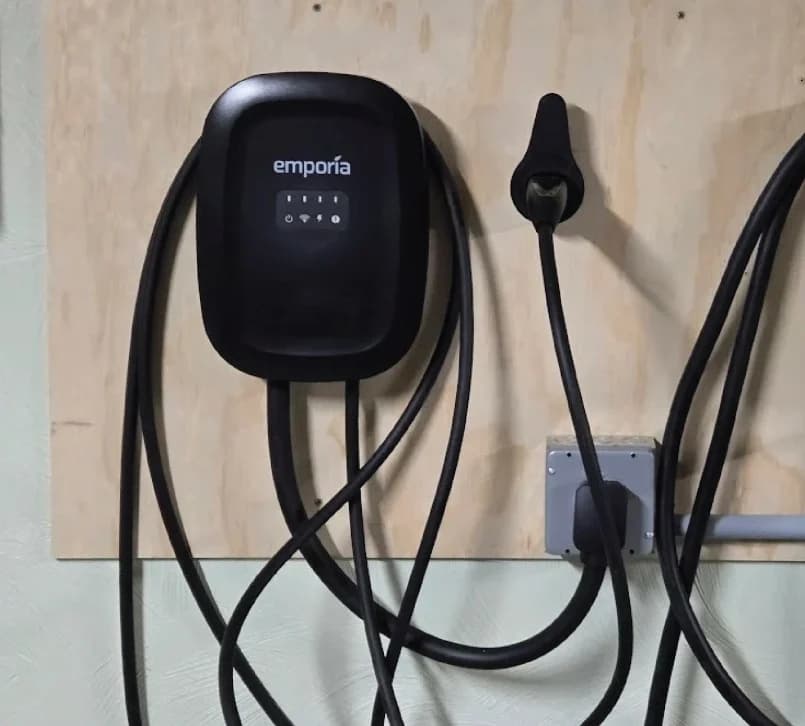
Emporia
Emporia Classic Level 2 EV Charger (NACS, 48A)
A 48A (11.5kW) ENERGY STAR smart Level 2 home charger with a NACS (SAE J3400) connector that opens the Tesla charge port, a 25-ft cable and NEMA Type 4 enclosure.
- 48 A max
- 11.5 kW max
- NACS (J3400)
Check connector and installation option separately: Emporia sells J1772 or NACS, and plug-in or hardwired configurations. Keep the distinction between Classic and Pro visible, too: Emporia's placement page gives both the same cable length, so changing that model name alone is not a reach upgrade. Our home Level 2 charger guide covers the broader buying decision.
Portable candidate: J+ BOOSTER 2 Dual Traveler
Consider this only when you need portable equipment and its confirmed usable reach solves the problem. The Dual Traveler includes NEMA 5-15 and 14-50 outlet adapters, a carrying case and wall bracket. J+ rates the J1772 charger at up to 40A, states ETL listing, and says no app or network connection is required.
The approximate 25-ft total length is a qualification, not a promise of reach from a wall-mounted control box. Keep an existing suitable portable charger if this kit would leave the same gap.
Bundle trap: the NACS Traveler component list includes the vehicle adapter, but that page's generic FAQ says it is sold separately. Confirm the exact contents; do not assume a native NACS cable or extra cable length. The charger's ETL statement does not independently establish an accessory's certification.
Check the Dual Traveler kit at J+
When relocation is the useful purchase
If neither parking orientation passes the worksheet, request a licensed electrician's site assessment before buying another charger. DOE's home-charging guidance says electricians can assess electrical capacity and installations must meet applicable codes, with permits where required.
Share the worksheet and ask whether the existing unit can be relocated, whether an appropriate outlet nearer the car is feasible, and whether a different installation method is suitable. Ask for the proposed location and complete installation scope in the quote. This is especially useful when a replacement offers no more usable cable than you already have.
For a rented or shared space, start with the property owner or manager before commissioning changes. If home charging cannot be arranged with suitable equipment and reach, plan another charging location rather than improvising an extension.
Outdoor connections and damaged equipment
DOE says outdoor charging requires outdoor-rated equipment. Emporia specifies a NEMA Type 4 enclosure; J+ advertises IP67, but its manual warns that unplugged connectors are not watertight and tells owners to keep connections dry and capped when unused. Follow those component-specific instructions rather than treating an enclosure rating as protection for every connection.
USFA says not to use visibly damaged equipment. Emporia's manual calls for inspecting the cables, connector and station each time; Tesla's Mobile Connector manual also rejects damaged, loose or worn outlets.
How we choose
We compared official US product pages, manuals and specification sheets for cable definitions, connectors, current ratings and stated safety certification. These are document-based recommendations, without physical product testing. We reuse existing product identities and call out ambiguous length descriptions and bundle conflicts. A purchase recommendation depends on the worksheet demonstrating a reach improvement; see our disclosure.
Verdict
Try the parking change first. Choose the appropriate Emporia Classic only when its supplied cable fixes a measured shortfall; consider J+ only after confirming its total-length definition against your layout. Otherwise, put the decision to an electrician before shopping.
- Yes: The exact connector matches the vehicle's approved AC charging connection
- Yes: The confirmed cable definition covers the complete route with comfortable slack
- Yes: The normal parking layout avoids stretched or pinched cable and walking obstructions
- Partly: Any new outlet, hardwiring or relocation has been assessed by a licensed electrician
- No: An extension lead is needed to make the plan work
Our picks at a glance
- 1
Emporia Classic Level 2 EV Charger (NACS, 48A)
Choose for: Up to 48 A hardwired, with Wi-Fi scheduling and J1772 or NACS choices.
Limit: 48 A needs hardwiring and a suitable 60 A circuit; panel load management costs extra. Ask an electrician.
Frequently asked questions
Can I use a heavy-duty extension cord for my EV charger?
We recommend a different reach solution. The U.S. Fire Administration tells Level 1 users to plug directly into a suitable outlet and never use an extension cord. Tesla's Mobile Connector manual also prohibits extensions. A heavy-duty or outdoor label does not change those instructions; measure another parking position or arrange an electrician's assessment.
Is a J1772 or NACS extension cable different from a wall extension cord?
Yes: a vehicle-side extender adds cable between the charging handle and the car, while a wall-side extension goes between the outlet and charging equipment. That distinction does not establish permission to use either. Tesla's Gen 3 Wall Connector manual prohibits cord extension sets. Follow the exact vehicle and charger's instructions rather than assuming matching connectors establish approval.
How long should my EV charger cable be?
Long enough for the actual route to your charge port with comfortable slack and no obstructed walkway. Emporia specifies a 25-ft charging cable, while J+'s product sheet calls its approximately 25-ft figure total cable length. Confirm the measurement endpoints before comparing them. Our worksheet checks the complete route in each parking position rather than using the straight-line distance.
Does reducing charging current make an extension cord acceptable?
Do not treat a lower setting as permission to disregard the manufacturer's instructions. Tesla's Mobile Connector warning against extension cords is not conditional on selecting its maximum current. J+'s manual prohibits third-party extensions and restricts approved accessories to its own connection system. Solve the reach problem through parking, suitable supplied equipment or professional relocation.
Can I charge outdoors in the rain?
Use outdoor-rated equipment and follow its instructions for the entire connection. DOE says outdoor charging, including in rain, can be safe with suitable equipment. USFA says to protect the charging outlet from water and check the manufacturer's wet-weather guidance. J+'s manual warns that unplugged connectors are not watertight, despite the charger's advertised IP67 rating.
Related guides
Best picks · Level 2 EV Chargers
Best Home EV Chargers for Subaru Solterra: 25-ft Picks by Year
Choose a home charger for your US Solterra by model year, connector and actual cable reach. Compare verified 25-ft options, shorter alternatives and setup.
Best picks · Level 2 EV Chargers
Best Home Chargers for Tesla Model Y: Buy for Your Daily Miles
Choose a Tesla Model Y home charger by vehicle limits, daily miles and parking reach. Compare Tesla, Emporia and Home Flex, or keep your Mobile Connector.
Best picks · Level 2 EV Chargers
Best Home EV Chargers for BMW iX: Keep the Cord or Buy?
Choose a home EV charger for your BMW iX: when to keep the BMW cord, which J1772 wall chargers to buy, and how to check model year, supply and overnight needs.